

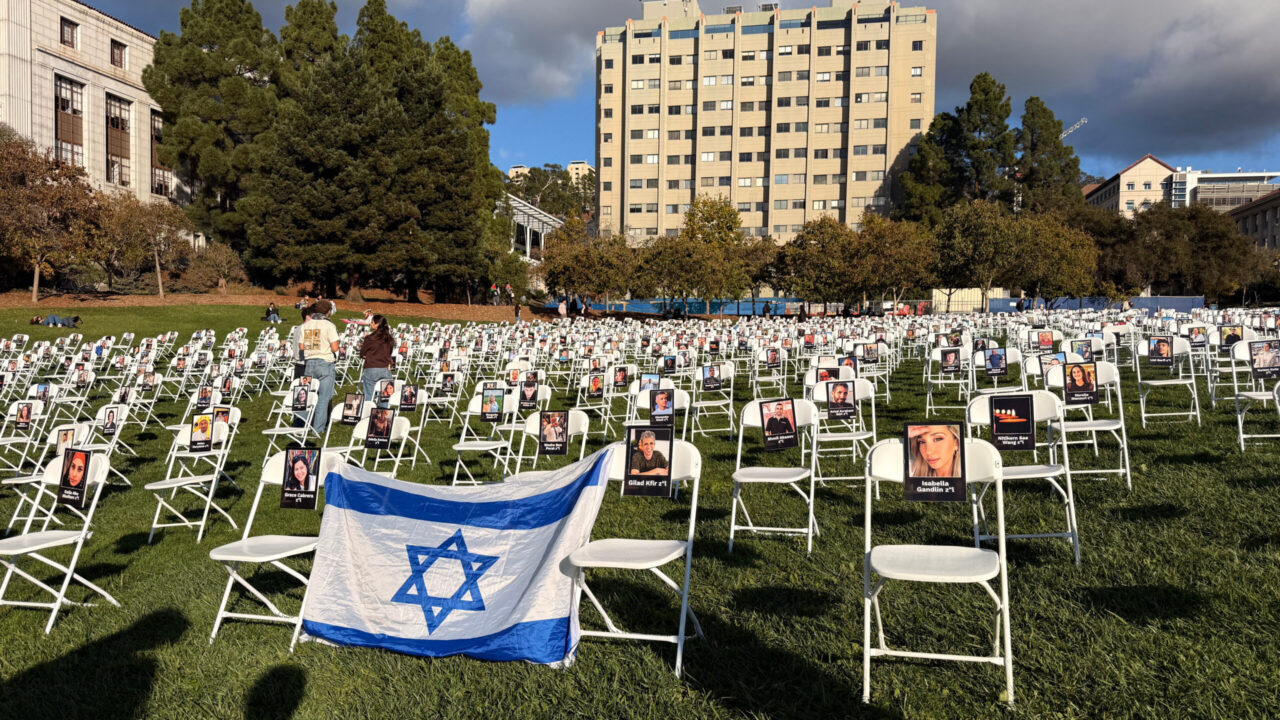
Just over a month since Israel and Hamas signed a cease-fire agreement, a trio of events Tuesday at UC Berkeley, including a talk with former hostage Omer Shem Tov, sought to shed light on the aftermath of Oct. 7, 2023.
The events at Cal were accompanied by small protests from pro-Palestinian groups.
In the morning, undergraduates in the Cal chapter of Students Supporting Israel set up over 1,200 white chairs on Memorial Glade, a large lawn outside Cal’s main library. On each chair, students placed a photo of a person killed in the Oct. 7 Hamas massacre or during captivity in Gaza.
Lielle Abramov, a third-year student in media studies, told J. that the installation was designed “to spread the message that we shouldn’t just be remembering the victims on Oct. 7,” referring to the anniversary date. “We are remembering these people every day.”
The chairs remained on the lawn throughout the day with no major disruptions, Abramov said. Berkeley SSI members occasionally spoke with passersby who asked about the chairs. At one point, three people stood quietly on one corner of the lawn and held up a Palestinian flag. Abramov told J. she felt thankful the event went smoothly.
“Berkeley is a really polarized campus. We are built on free speech, so we’ve definitely gotten some differing opinions,” Abramov said. “But we value those opinions, and we welcome them, and we’re just honored to be on a campus that allows us to express ourselves and to remember these amazing souls.”
Across campus in Berkeley Law’s building, the university chapter of the Federalist Society, a conservative legal organization, hosted an early afternoon event titled “Why Israel Won: A Panel on Oct. 7 and the Wider War.”
The panel featured three Cal faculty members: history professor Daniel Sargent and law professors John Yoo and Steven Davidoff Solomon. The panelists discussed Israel’s strategic successes over the past two years, its damaged international reputation and the country’s responsibilities in promoting peace.
Pro-Palestinian activists protested both before and during the event. In the days leading up to the panel discussion, the group Berkeley Law Students for Justice in Palestine published Instagram posts calling the participants “fascists” who support “genocide.” A post on Monday showed the three panelists with their eyes crossed out, advertising a “Rally for Gaza: glory to our martyrs.”
Around 20 police officers and security guards stood inside in a Berkeley Law hallway outside of Booth Auditorium to prevent potential disruptions. Fewer than a dozen protesters stood in the hallway and handed out rally flyers as nearly 90 attendees checked in and entered the auditorium.
During the panel, about two dozen protesters attended the rally outside the law building.
Solomon, one of the panelists, said he has become accustomed to protests.
In fall 2024, protesters targeted his “Antisemitism and the Law” class. They handed out flyers that referenced McCarthyism and called Solomon a “sabotager” of careers.
In mid-October 2023, Solomon wrote an op-ed in the Wall Street Journal titled “Don’t Hire My Antisemitic Law Students,” focusing on a 2022 initiative by Berkeley Law Students for Justice in Palestine to ban outside speakers who support Zionism. Solomon wrote another op-ed in February 2025 for the Wall Street Journal headlined “Mr. Trump, Investigate My Campus.” He wrote the piece, inviting the federal government to investigate antisemitism at Cal, after panelists who had made extreme anti-Israel statements were invited to a university-sponsored event online.
Solomon said he believed that Tuesday’s protesters were trying to use intimidation to shut down opposing views.
“I’m not going to have people intimidate me into not speaking what I believe,” Solomon told J. “We have people in a university environment who are allowed to do that without condemnation, and that’s a problem. And I think we need to learn as a university that this should just not be tolerated behavior.”
Jacob Shofet, a third-year law student and Federalist Society chapter vice president, told J. he was relieved the event went as planned, but found it disappointing and “concerning” that police needed to be present.
The panelists, he said, were “far from controversial speakers. Both [Yoo and Solomon] have been tenured for a decade. They’re as much of Berkeley as anyone else.”

Shofet also briefly attended Shem Tov’s talk hosted by Cal’s Rohr Chabad Jewish Student Center at Pauley Ballroom on Tuesday evening. Over 500 people gathered inside the ballroom, according to Cal Chabad Rabbi Gil Leeds.
Shem Tov told his story of surviving 505 days in Hamas captivity.
Naomi Toubian, a Jewish student involved in pro-Israel activism on campus who helped spearhead the white chairs display, said she found his talk inspiring.
“One of the things Omer said was that when he was in captivity, he asked HaShem to give him the light to share with others,” Toubian told J. in a text on Wednesday, adding that she hoped those who protested the day’s events would “let the light in.”
About a dozen demonstrators protested outside Shem Tov’s talk.
They wore kaffiyehs, held a banner from the anti-Zionist group Jewish Voice for Peace, and waved Palestinian flags. Signs read “Stop normalizing genocide” and “Antizionism is a mitzvah.”
Shofet, the Jewish law student, said that the protesters had it all wrong.
Some of their messaging was a “great reminder to enroll your kids in Jewish schools,” he said. “If your kid can’t differentiate an empty political slogan from a mitzvah, Jewish education has failed.”
“Just because you can do something doesn’t mean you should,” he added. “This is a hostage event. That’s ridiculous to protest.”