

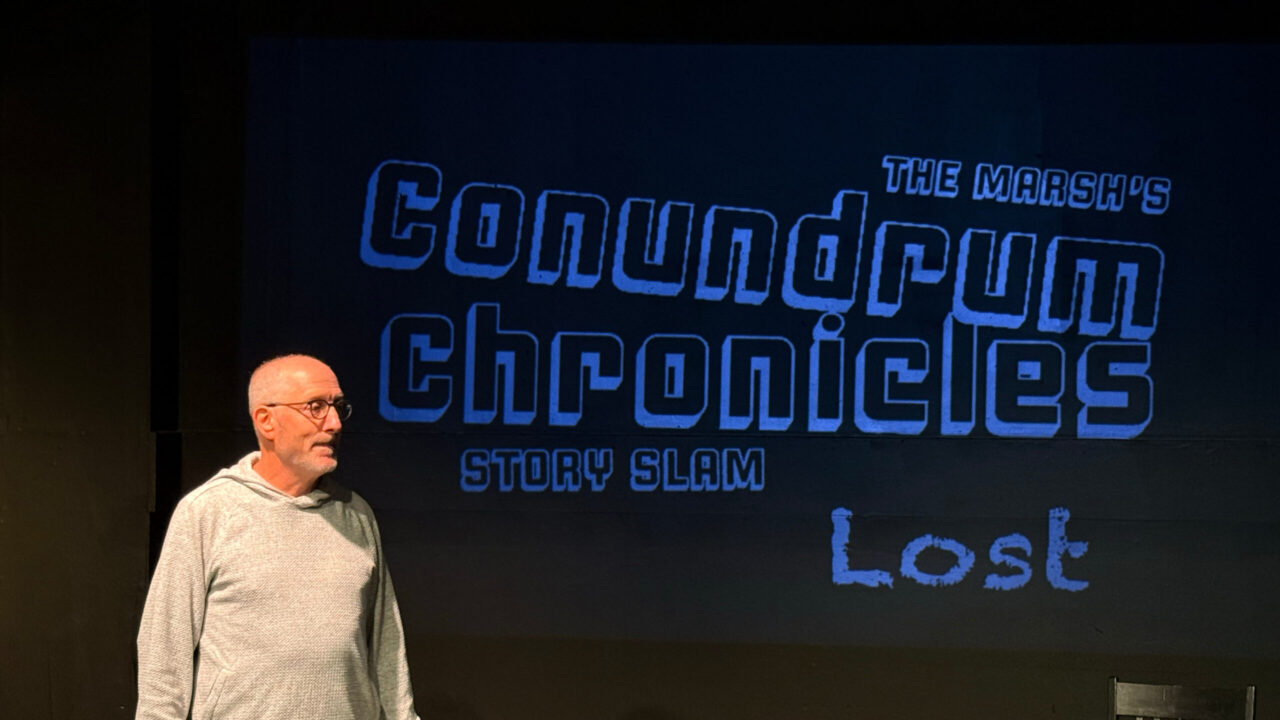
After Fred Brill’s monthly storytelling competition featured a night for people of color this summer, he got a suggestion from that show’s producer: You’re Jewish, why not do a similar night for Jewish storytellers?
He initially rejected the idea, guided by a notion that Jews already “don’t really have trouble grabbing the microphone.” If anything, he told J., they have trouble releasing it.
But after thinking it over, Brill realized the value that such an event could bring in America’s present political moment.
“I believe very very strongly that it’s primal, that we are wired to learn and connect through stories,” Brill said.
Since summer 2024, Brill has hosted monthly “story slams,” known as the “Conundrum Chronicles,” at The Marsh theater in San Francisco’s Mission District. Each show revolves around a different theme but with the same intent of focusing on a moral dilemma. The theme is usually summed up in one word or phrase, such as “the price of honesty,” “schooled” or “a moment of doubt.”
At the Dec. 9 show, Jewish storytellers will get the chance to poke and prod their identities through the theme “The Jew in You.”
“I began to think about Trump and about the divisiveness — the fact that, not just immigrants, but a lot of people are shrinking into their shadows now, and not owning their identity,” he said. “Then I thought, ‘You know what, this is important right now to create a space to hear some of these stories.’”
Other than a handful of storytellers picked at random, “The Jew in You” will showcase three Bay Area residents.
Mindy Myers, a 12-time Moth storytelling winner, has been a fixture of past “Conundrum Chronicles” shows. She is known for telling vivid, expressive stories from her wild teenage years, such as the summer she flew home with a bag of marijuana she’d harvested from a farm near a Quaker retreat center.

But for “The Jew in You,” she has decided to share a story based on her mom’s escape from Vienna to the Caribbean island of Trinidad, where she ended up in an internment camp during World War II. Both of Myers’ parents survived the Holocaust, but “they lost a lot of people,” Myers told J. “What remained were stories that were indelible. These people came alive through my parents’ stories. It was very natural for me to continue the tradition: storytelling.”
Steve Budd, an actor, writer and public-speaking coach, is also no stranger to standing alone on a stage. Since 2022, he has produced five one-man shows that premiered at The Marsh.

(Courtesy/Cheshire Isaacs)
His most recent show, “Oy, What They Said About Love,” was a mashup of stories from Jewish couples he interviewed to understand what brought and kept them together.
Writing about Jewish identity, Budd told J., helps him “explore and understand that part of myself more, and also just use more of myself.… It makes it mean more, feel more — funnier in some ways, more emotional in others.”
Artemis Frederick, a newcomer to live storytelling who has nevertheless already won a local story slam, recently graduated from Bard College in New York with a bachelor’s degree in literature. Frederick, who uses they/them pronouns, converted to Judaism in late 2023.

Frederick’s story will chronicle how their upbringing led their conversion, the experience of going through conversion on the heels of the Oct. 7, 2023, attack and how their new identity might shape their future.
“People will take from my story what they want to take. I want to make sure that I’m telling it in a way that will connect with people and feel authentic to me,” Frederick told J. “But mostly, I’m going to tell my story and just put it out there.”
The “Conundrum Chronicles” follow a similar open-mic format to The Moth, a nationally recognized storytelling competition. In each “Conundrum” show, storytellers write their names on pieces of paper collected in a hat, from which Brill picks out names at random of people who will then perform alongside that night’s lineup of featured storytellers.
The storytellers must all work within the same parameters: All stories must be true and personal, around five minutes long and memorized (in other words, not read from a script).
Having previously worked as an English teacher, school principal and superintendent, Brill also wanted the “Conundrum Chronicles” to offer performers feedback. The entire audience can take part in judging and offer detailed, constructive criticism to each storyteller, ranking stories for authenticity, tension, emotional resonance, entertainment and more.
At Moth competitions, Brill said, “you don’t know why you did well or didn’t do well. There’s no opportunity to learn and grow. As an educator, you’ve got to have a rubric.”
Storytellers must also focus on a moral dilemma, per the contest’s guidelines — another aspect of the event that Brill considers unique.
“I would argue that these kinds of dilemmas are very common to the human experience,” Brill said. “Most good stories have a tipping point” where the protagonist asks: “What do I do? How do I navigate this? Which path do I choose?”