

Food coverage is supported by a generous donation from Susan and Moses Libitzky.
Gabi Moskowitz is too young to have followed the Grateful Dead — but the 43-year-old food writer learned to love the quintessential stoner jam band during her summers at Camp Tawonga.
(“There’s nothing like hearing 300 kids screaming ‘Got a wife in Chino babe, and one in Cherokee’ in the dining hall,” she jokes, quoting the lyrics of “Friend of the Devil.”)
So when a publishing company approached Moskowitz about writing “Dead in the Kitchen: The Official Grateful Dead Cookbook,” it was an easy yes for the Novato resident.

This is Moskowitz’s fifth cookbook, and the first since her two daughters were born (they’re 4 and 7 now). Not only did she serve a stint as recipe columnist for this newspaper years ago, but her food blog, “The BrokeAss Gourmet,” became the inspiration for a television show called “Young & Hungry,” loosely based on her life, for which she served as a producer.
There was another reason Moskowitz believes she was the right person for this project. When she was growing up in Santa Rosa, her mom shopped in natural grocery stores with bulk sections, eschewing Skippy or Jif for the natural peanut butter that needs vigorous stirring, or the peanut butter they ground themselves.
“My mom was a brown rice, tofu and sprouts kind of mom,” Moskowitz said.
The recipes in “Dead in the Kitchen” are inspired by the Grateful Dead and their food culture, so you won’t find band members’ favorite recipes here. And this book isn’t only about the stoner-friendly dishes sold in parking lots before and after shows — though there is at least one cookbook like that in circulation. Somewhere, I picked up a 1995 copy of “Cooking with the Dead: Recipes and Stories from Fans on the Road” by Elizabeth Zipern, with recipes from the fans who sold the communal food.
“We wanted to make it feel true to the Deadhead experience, and wanted it to be an homage to Deadhead food,” Moskowitz said.
Through her research, Moskowitz learned that three of the band members had been vegetarians at different times. “Dead in the Kitchen” is vegetarian with some vegan dishes, and all of the recipes have instructions for vegan modifications.
Moskowitz isn’t a vegetarian herself, but she eats that way most of the time. Her husband keeps kosher, “and it’s a whole thing to drag out the meat dishes” in her home, she said. “I was a vegetarian when I was younger, and I’ve always been a lover of that sort of ’70s health food.”
The book opens with a foreword from vegetarian pioneer cookbook author and longtime Berkeley resident Mollie Katzen, of “Moosewood Cookbook” fame, who has her own connection to the Dead. Before opening her Moosewood restaurant in upstate New York, Katzen worked in a San Francisco restaurant that would occasionally cook and deliver late-night dinners to people hanging out at band leader Jerry Garcia’s midnight jam sessions.
Rather than being conventionally organized by appetizers, mains and desserts, the book’s chapters are named after parts of Dead shows. One titled “The Lot: Dishes Inspired by Parking Lot Fare” has recipes for three kinds of grilled cheese sandwiches — all with garlic salt sprinkled on the bread, a must at a Dead show — and “kind” burritos. If you know, you know.
But recipes for grilled cheese and burritos — no matter how good they are or how much the munchies drive one’s cravings — aren’t the main draw here. More complex recipes can be found in other sections including “Tuning Up: Soup and Salads” and “Riff Break: Improvisational Cooking.”
That’s Moskowitz’s favorite, named for the band’s signature long improvisational jams. Likewise, she explains how one can start with a simple pot of rice, pasta or tomato sauce, a block of tofu or a ball of pizza dough, and then offers numerous ways to riff on each one.
“There was an ethos in the band when it came to improv that in order to really go crazy and make new spiritual connections in the throes of a jam, you had to be incredibly well-prepared, and that very much echoes my approach to cooking, which is that you have to have a well- stocked pantry,” she said.
Moskowitz had some limitations due to access. Even though the cookbook was authorized by the band’s organization, sadly she wasn’t allowed to use the musicians’ names or song lyrics. She did collaborate closely with Grateful Dead archivist Dave Lemieux, a longtime vegan and excellent home cook who helped brainstorm some of the recipe notes. A handful have a Dead connection, like the peanut sauce recipe that begins, “There are practically as many varieties of peanut sauce as there are bootleg tapes of Dead shows on eBay…”
Moskowitz brought her global palate to the cookbook, with creative twists like a hummus with carrots, red lentils and curry powder. (During our interview, she recommended dipping challah in the hummus as part of Shabbat dinner.) Some dishes I want to try from the book: Brown Butter Gochujang Brussels Sprouts, Plantain-Black Bean Veggie Burgers and Cashew Caramelized Onion Dip.
I found “Encore,” the dessert section, particularly appealing, as Moskowitz uses coconut sugar and other healthier alternatives to refined sugar and flour. There’s a brownie recipe using avocado as the fat, a chocolate pudding made from silken tofu that will fool anyone, she said, and a shortbread with almond flour and date caramel.
For the Deadhead in your life who already has her fair share of tie-dye, stuffed dancing bears, or neckties with designs taken from Jerry Garcia’s watercolors, the cookbook would make a wonderful Hanukkah gift.
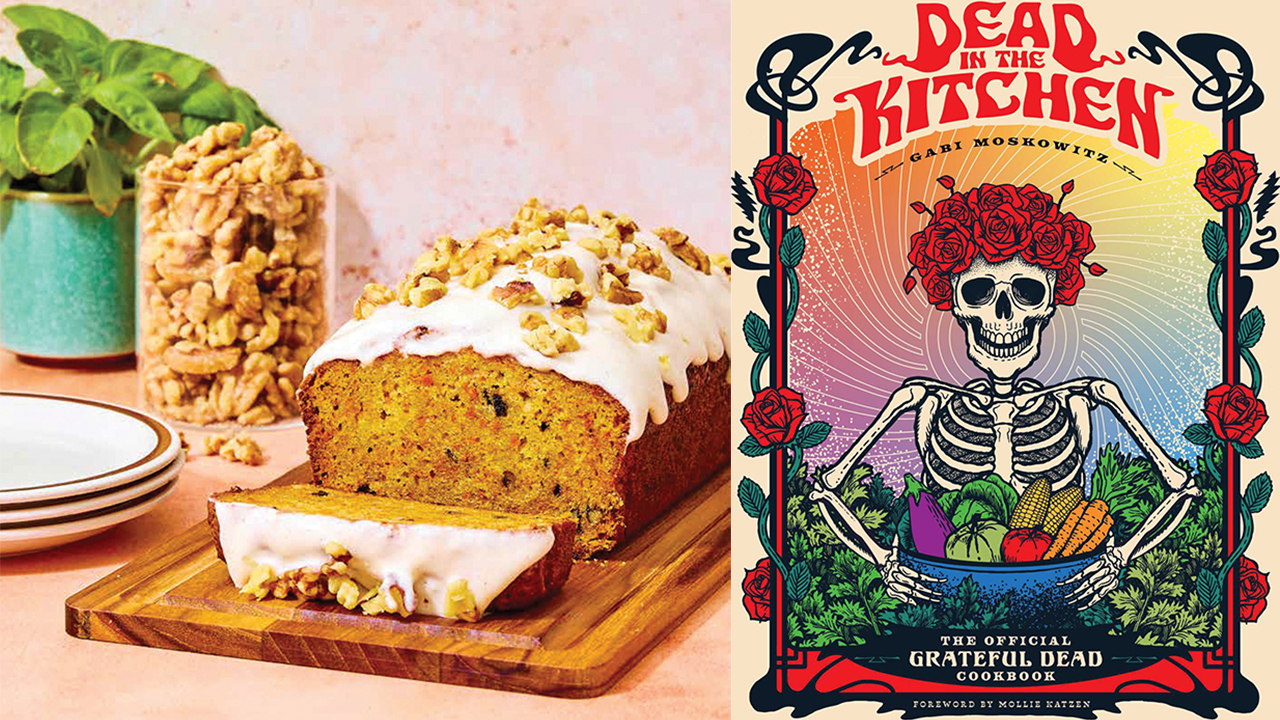
“Dead in the Kitchen: The Official Grateful Dead Cookbook” by Gabi Moskowitz (Weldon Owen, 205 pages). Available from Afikomen Judaica and other local bookshops.
Carrot-Cardamom Loaf Cake With a Cream Cheese Glaze
By Gabi Moskowitz — from “Dead in the Kitchen: The Official Grateful Dead Cookbook”
Between March and October 1974, the Dead toured with a sound system coined the Wall of Sound. At the time, it was the largest concert sound system ever built.
It featured 48 amps and 604 speakers — each of which carried the sound of just one instrument or vocalist, which meant the sound was unprecedentedly clear. The audience was quite literally surrounded by a wall of distinct, maximized sound,making every note the band played a full-body experience for the listener.
This turned-up rendition of a carrot cake takes the same approach — intensifying the whole experience by magnifying one ingredient: carrots. Roasting the carrots until deeply caramelized, then puréeing, distills their flavor far more than grating them raw, as in traditional carrot cakes.
Yield: 6-8 servings
Ingredients
For the carrot purée:
- 7 or 8 medium carrots, peeled and cut into 1-inch pieces
- 2 Tbs. avocado or grapeseed oil, or melted coconut oil
For the loaf cake:
- ½ cup avocado or grapeseed oil, melted coconut oil or melted unsalted butter (dairy or plant-based), plus more for the pan
- 3 large eggs (use flax eggs or vegan egg replacer for a vegan version)
- 1¼ cups granulated or coconut sugar
- 2 Tbs. milk (dairy or plant-based) or water
- 1 tsp. baking powder
- ¾ tsp. baking soda
- ¾ tsp. fine sea or table salt
- ¾ tsp. ground cardamom
- ½ tsp. ground cinnamon
- ¼ tsp. ground nutmeg
- 2 tsp. grated fresh ginger or ¼ tsp. ground ginger
- 2⅔ cups all-purpose flour (for a denser, nuttier crumb, replace 1 cup all-purpose flour with whole wheat or spelt flour)
- ½ cup chopped raw walnuts (optional), plus 1 to 2 Tbs. for garnish (optional)
- ¼ cup raisins (golden raisins or chopped dates also work well)
For the cream cheese glaze:
- 4 oz. cream cheese (dairy or plant-based), at room temperature
- ½ cup confectioners’ sugar, sifted
- 1 tsp. vanilla extract or paste
- 3 to 4 Tbs. milk (dairy or plant-based)
Instructions
Preheat the oven to 375°F.
To make the carrot purée:
Spread the carrots on a rimmed baking sheet and drizzle the oil over them. Use your hands to toss them well, ensuring each carrot is well coated. Roast for 25 to 30 minutes, until the carrots are very soft and browned.
Remove the carrots from the oven and let sit until cool enough to handle. Transfer to a food processor and purée until very smooth. Set aside until ready to use.
To make the cake:
Oil, butter or spray with cooking spray a 6-cup/8-inch loaf pan and dust lightly with flour.
In a large bowl, whisk together the puréed carrot, oil, eggs, granulated sugar and milk until smooth. Sprinkle the baking powder, baking soda, salt, cardamom, cinnamon, nutmeg and ginger over the batter, and whisk until well combined. Fold in the flour, just until mixed, then fold in the walnuts, if using, and raisins. Scrape the batter into the prepared loaf pan.
Bake the loaf for 60 to 65 minutes, until domed and browned. A cake tester or toothpick should come out clean when inserted into the center.
To make the glaze:
In a stand mixer or bowl with a handheld mixer, beat the cream cheese until very creamy. Gradually beat in the confectioners’ sugar and vanilla, then beat in 3 Tbs. of the milk, or a bit more as needed to make the glaze loose enough to drizzle.
Refrigerate if not ready to use. The glaze will thicken the longer it sits in the refrigerator and will loosen after sitting out for a few minutes. You may also add a tablespoon of milk (dairy or plant based) to thin it enough to pour over the top of the cake.
To finish the cake:
Let the cake cool in the pan, then gently remove it and transfer to a platter or plate. Don’t try to glaze the cake while it’s hot — the glaze won’t stick.
Pour the glaze over the top of the cooled cake and use an offset spatula or rubber scraper to gently spread it over the top, allowing it to drip down. It’s important to make sure the cake has cooled fully before icing; otherwise, the glaze will melt too much. If desired, top with a light sprinkle of finely chopped walnuts. Slice and serve. Leftovers may be stored in the refrigerator for up to a week.