
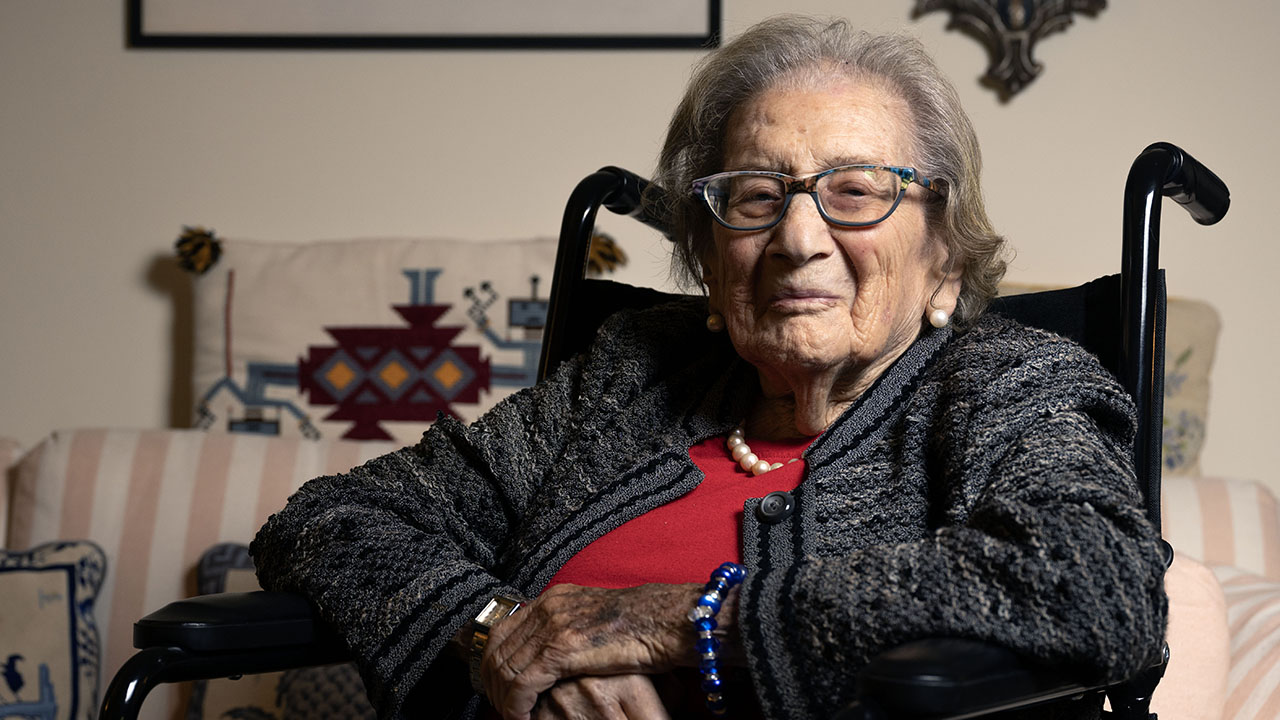
When I arrived at Rita Semel’s apartment on the evening of her 104th birthday, bouquets of flowers and birthday cards adorned the room. A potted white orchid was placed on the coffee table between us. “These are from Nancy Pelosi,” said Semel’s daughter, Elisabeth. The former House speaker, a friend dating back more than 50 years, always sends a birthday gift.
Semel celebrated her Nov. 15 birthday with relatives and close friends over dinner at Troya, her favorite Turkish restaurant in San Francisco, a quieter birthday compared with the big celebration for her 100th.
Semel, who served as executive director of the Jewish Community Relations Council Bay Area in the late ’80s, is most known for pioneering several initiatives fostering dialogue and understanding across faiths and races. She is the co-founder of the San Francisco Interfaith Council, which she began in 1988 with Father Eugene Boyle, a “maverick” Catholic priest.
Still, her brief stint in journalism in the 1940s, working for the San Francisco Chronicle as a “copy boy” and later as associate editor of the Jewish Community Bulletin (one of the former names of this publication), holds a special place in her heart. She left the Bulletin in 1950 when Elisabeth was born. Two years later, she welcomed a second daughter, Jane, who died at age 18 in a tragic accident.
Elisabeth Semel recalled growing up with a front row seat to the Civil Rights Movement, thanks to her mother’s activism.
“When Martin Luther King came to San Francisco to speak at the Cow Palace, my parents took us. When John Kennedy came to speak at Cal, my parents took us,” said Elisabeth Semel, now a professor at UC Berkeley Law and co-director of the school’s Death Penalty Clinic. She noted how her mother took part in demonstrations along San Francisco’s “Cadillac Row” on Van Ness Avenue, protesting employment discrimination by auto dealers against Black Americans. And in 1965, during the Delano grape strike, when farmworkers protested for fair wages and working conditions, Semel brought her daughters to march with Cesar Chavez and Dolores Huerta in California’s Central Valley.
J. sat down with Semel to hear about the challenges and successes she’s experienced over her 104 years.
This interview has been edited for length and clarity.
You and I are both proud Barnard alumni, many, many decades apart. You majored in political science when you were at Barnard. What got you interested in politics?
I thought it would be a good background to being a reporter.
So you and I were the same. You knew you wanted to pursue journalism after Barnard.
It was unusual for women to be reporters in my day, but I tried, and I was a reporter at the San Francisco Chronicle. I remember going in the street to ask people about how they felt about World War II ending. And the men that I stopped to talk to thought I was trying to pick them up. I mean, it was very unusual in those days for a woman to be a reporter. But anyway, I managed to get through it. I had an assignment where I went to see them sign the U.N. charter in San Francisco in June 1945. That was very exciting. I enjoyed my days at the Chronicle.

Was being a reporter a dream come true?
Yes, absolutely, it was a dream. I got to meet different people. I got to learn about different things. It was a way to see the world in a different place.
In 1964, you organized the inaugural San Francisco Conference on Religion and Race, bringing people of different races, ethnicities and faiths together who were all committed to desegregation. What got you interested in interfaith work?
I guess I’m a busybody at heart, but I wanted to know what was different about each religion, what was the same and what we all believed and what we didn’t believe. And I still feel that it’s very important to get to know people of other religions and other faiths, because you never should stop learning. There’s always something new to learn. Even at my age, I feel like I still learn something.
Being a reporter, you must know that you’re always looking for a good story. And so I got introduced to this Catholic priest, Eugene Boyle, who had a very good story, and we became very close friends. In those days everybody was sort of in their own closet. I felt that it was time for people to come out and meet each other, because there were certain things we shared. There were differences, of course, but there were more similarities than people realized.
You’re a longtime member of Congregation Emanu-El.
I go every Friday.
Besides the recent major renovation of Emanu-El, does synagogue life feel like it always has, or have things changed?
It’s much more open than it used to be, and that’s probably true of most. How is it at other houses of worship? I mean, there was a time when someone who went to a Catholic church never met anybody who went to a Protestant church. But I think that’s changed somewhat. Not enough. I started an organization called the San Francisco Interfaith Council, in which we brought in people of different faiths to meet each other, and we found that we had more in common than anybody ever thought. When you think about it, what’s the reason for being anything — Catholic, Protestant, Jewish, Muslim — is to make the world a better place. That’s something we all want to do.
Did those experiences change the way you saw intermarriage, which was much less accepted in the mainstream Jewish community a generation ago?
I was fortunate to marry someone who was Jewish, but if I found someone who wasn’t Jewish, I would have married him. I think that, and we have to learn from each other. I hope the time is over when if you didn’t marry someone of your own faith you were ostracized. I hope that’s no longer happening.
Someone who has long embraced the Jewish community and celebrates connections across faiths is Rep. Nancy Pelosi.
What you said about her is very true. She and I are old friends. She was one of the best. I worked very hard to get her elected. She’s done a wonderful job in Congress.
Early in your life, what are the things you set out to accomplish?
I wanted to make the world a better place. And I was very fortunate. I had a husband who — he probably would have preferred a housewife, but he didn’t have one. He had me. But he was very willing to let me do the things I needed to do. So we had a good marriage.
Are those pearls that you’re wearing from your late husband, Max? They look special.
He gave them to me a long time ago.
It’s pretty remarkable to live past 100.
It’s interesting that you say it’s remarkable. I guess it is, and I never really thought about it that way. Here I am, I just make the best of it.
What’s a typical day like for you?
I wish I had more to do. I’d love to get a job, but who wants to hire me?
What kind of job would you take?
I’d love to work for a newspaper.
I’ll let J.’s editors know.