

Welcome to the second installment of our look back at J.’s history to mark our 130th birthday. (Gifts are welcome, by the way.)
Our first issue was Nov. 22, 1895. In the first half of this series celebrating our anniversary, we looked at a single article from a November issue in each decade, which took us up to 1935.
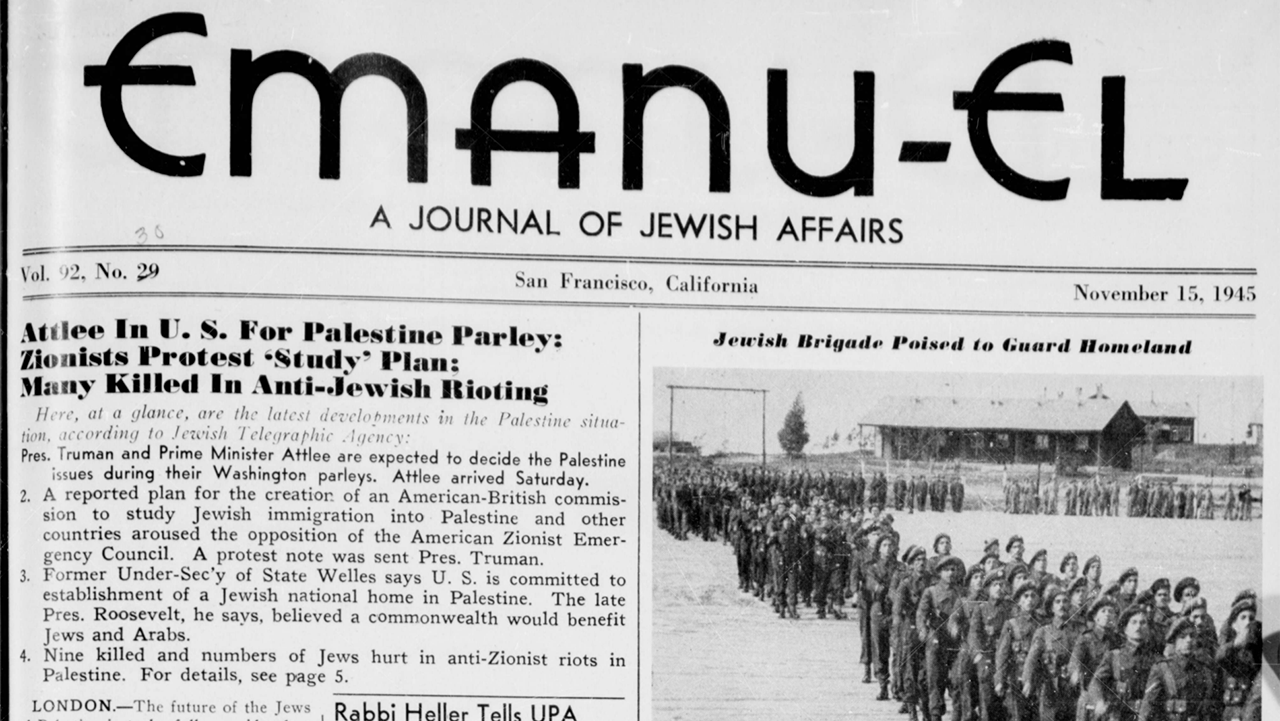
The ’40s: The “Palestine Problem,” Nov. 15, 1945
The hope that postwar Palestine would be a home for the Jews was a complicated diplomatic wrangle that we followed in great detail. We also reported on the ongoing situation on the ground in what would become the State of Israel, then still under British control.
“An 11 p.m. to 6 a.m. curfew was proclaimed by military authorities for all vehicular traffic outside municipal areas following fifty simultaneous attacks on Palestine’s railway system and blasts in Jerusalem, Haifa and Jaffa. Nine persons were killed, seven injured and the country’s transport network disrupted. The attacks, attributed in an official police communique to Jews, were preceded by a time bomb explosion that rocked Jerusalem.…In Cairo widespread rioting started as a protest by the Arabs on the 28th anniversary of the Balfour Declaration and continued for several days. Nine persons were killed in Alexandria.”
The ’50s: Seeking relatives, Nov. 25, 1955
In a plaintive reminder of how both World War II and the Iron Curtain severed families, here’s a personal ad looking for a local connection. There were lots of ads like this in our paper in the 1950s, usually sponsored by local charities helping families reunite.
“SEEKS RELATIVE: Mrs. Gita, niece of Zora Bay, born Mendlesohn, from Mitava, Latvia, seeks information on the whereabouts of her aunt, Zora Bay, of San Francisco. Anyone having information please call Mrs. John Yalovoy, 338 Fulton Street, San Francisco, WE 1-7559.”
The ’60s: Vietnam and civil rights, Nov. 19, 1965
A meeting of Reform rabbis made a call for the U.S. to leave Vietnam, we reported, and to support the Civil Rights Movement.
They “overwhelmingly called upon President Johnson to seek an armistice in the conflict in Vietnam… in a resolution on Judaism and world peace, which proved to be the most heated controversy of the convocation.” Rabbi Maurice N. Eisendrath, then president of the Reform rabbinical association, “called upon members of Reform Judaism for renewed involvement and action to make real the integration of the Negro into the mainstream of American life. He urged them to ‘picket, boycott, attend rallies… watch at the polls, solicit contributions and if necessary, limit our own spending in order to help aid the cause of the American Negro.’”
The ’70s: Is Zionism racism? Nov. 21, 1975
This issue was filled with news about a controversial U.N. resolution that had just passed that defined Zionism as racism. It was revoked in 1991.
“A rare public showing of wide interracial and interreligious unity marked a protest here against the U.N. resolution equating Zionism with racism. Representatives of various ethnic and religious groups joined nearly 2,000 San Franciscans at a Union Square Rally last Sunday to emphasize that the resolution was an affront not just to Jews but to all people.
The ’80s: Saving Soviet Jewry, Nov. 22, 1985
The Bay Area was a major center of the effort to help the “refuseniks,” as they were called, get out of the Soviet Union, which blocked most Jews from leaving the country for many years.
“Fifty-five local activists, 54 of them Jewish, were arrested in San Francisco Monday for participating in civil disobedience as they protested the harassment of Soviet Jews and other dissidents by the Soviet government. While TV cameras rolled and supporters sang ‘We Shall Overcome,’ 20 rabbis marched solemnly through San Francisco police barricades to padlock themselves to the fence surrounding the consulate. Exclaimed Lillian Foreman, one of the many Jewish lay leaders arrested, ‘We will never forget them. We will never stop doing this, not until the last Jew is free to leave.’”
The ’90s: Rabin falls, Nov. 17, 1995
This issue of the newspaper was consumed by the assassination of Israeli Prime Minister Yitzhak Rabin on Nov. 4, an event that shocked and horrified Jews in Israel and around the world. We reported on how local educators and leaders were making sense of it all.
“In tragedy there is often a lesson. Bay Area Jewish educators agree the assassination of Israeli Prime Minister Yitzhak Rabin provides a springboard into many difficult-to-teach subjects among them, morality, ethics and Israel. In the classrooms, some teachers attempted to dissect a map of the Middle East. Others jumped online to surf the Internet for Rabin-related information.”
The 2000s: Tough Jews, Nov. 25, 2005
This decade was a time of general security for Jews, so we often turned to human interest stories. In this article, we talked with Rebecca Rosenblatt, a Palo Alto police officer, about stereotypes and expectations.
“‘You know Jewish parents want doctors and lawyers,’ said Rosenblatt. Police work ‘is not what they were hoping for. My mom is not a big fan. She thinks it is too dangerous. But I’m trained to defend myself.’ Rosenblatt’s experience of having to confront resistance within her own family is not so unusual. ‘Where you get the resistance is from the Jewish community itself, from Jews,’ noted Art Krinsky, the president of Shomrim, national organization of Jewish public safety officers. The typical question, he said, is: What’s a nice Jewish boy doing being in law enforcement?’”
The 2010s: Whither the potato? Nov. 27, 2015
Not everything in our paper was about serious stuff. Ten years ago, we went deep into the relationship of Jews with the humble potato.
“While it is hard to imagine Hanukkah without also picturing a plate of hot, crispy potato pancakes, it was relatively recently — a couple hundred years ago — that East European Jews were introduced to the potato, the ingredient essential to the latke’s latke-ness. Brought over from Peru in the 16th century, it made its way first to Spain and the British Isles, and then slowly to the rest of Europe. Unlike other New World products that caught on relatively quickly, the potato wasn’t an instant hit in Europe, especially Eastern Europe.”
The 2020s: 130 years of J.!
This year, our Nov. 28 issue marked 130 years of this publication. We’re still looking out for the community, reporting on everything from public schools flying Palestinian flags to what’s new on the burgeoning Bay Area bagel scene. But we couldn’t do it without our readers.
Do you have a favorite article, recipe or photo from the last decade (or two… or four… or six!)? We’d love to hear about what in J. has touched you over the years. Drop us a line at [email protected]. And here’s to another 130 years together!