
When Tiffany Shlain was in fourth grade, her dad, a surgeon and writer, came to parent day at her Mill Valley school and presented her classroom with a human brain soaked in formaldehyde. “A lot of the kids screamed and ran out,” Shlain said. “I was riveted.”
Her innate fascination with neuroscience, coupled with her natural artistic and creative talents, set Shlain on an unconventional path. Over her 30-year career as an artist, filmmaker, writer and the founder of the Webby Awards, Shlain, 55, has produced award-winning videos and documentaries as well as traveling art exhibits, often focused on her three signature interests: feminism, technology and Judaism.
Her fascination with the brain endures. Last year, Shlain and actress-producer Goldie Hawn created a 10-minute video that aired on ABC’s “Good Morning America” all about what’s happening inside the teenage brain.
Last month, Manny’s cafe in San Francisco hosted a 20th anniversary screening of one of Shlain’s most celebrated works, the 2005 documentary short “The Tribe,” described as “an unorthodox history of the Jewish people and the Barbie doll.” Shlain co-wrote the 18-minute film with her husband, Ken Goldberg, a professor of robotics at UC Berkeley who is also an artist.
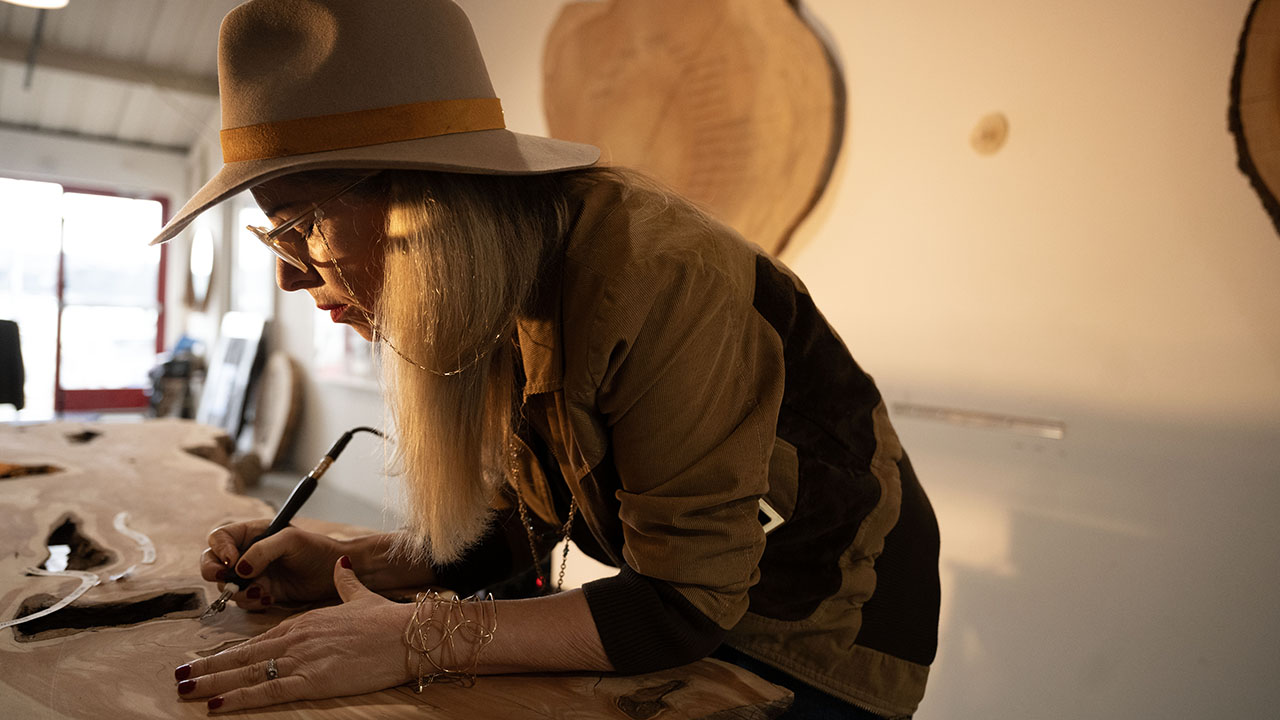
On Jan. 22, the Mill Valley couple will bring their latest exhibit to the di Rosa Center for Contemporary Art in San Francisco. “Ancient Wisdom for a Future Ecology: Trees, Time, and Technology” debuted in October 2024 at the Skirball Cultural Center in L.A., part of a Getty Museum initiative exploring the intersection of art and science. A number of pieces explore Jewish history and themes. Notably, several massive slices of tree trunks — at least one weighing 10,000 pounds — are used to ask existential questions (“Tree of Knowledge”), explore feminist history (“Dendrofemonology”) and trace 5,000 years of the Jewish people (“DendroJudaeology”), with words sculpted into the tree rings.
Shlain spoke with J. about the exhibition’s big plans for Tu Bishvat, her complicated relationship with AI and technology, and the joys of creating art with her husband of nearly 30 years. This interview has been edited for length and clarity.
You’ve spoken about growing up in a culturally Jewish but nonreligious household, and later as a mother of two you embraced a tech-free ritual during Shabbat. How did that come about?
We started doing Shabbat when our children were young, on and off, lighting the candles. It was really when I had this very dramatic couple of weeks [in 2009], where I lost my father and our second daughter was born, that we started turning off screens every week. It just made our lives so much better.
We’re not designed to be online all the time, and this idea of Rabbi Abraham Joshua Heschel describing Shabbat as a “palace in time” has never been more needed, especially as the technology is becoming more and more in the ether. We need to have the courage to step up and bring back this practice, because it refreshes and recharges you. It feels like the most important practice I’ve brought into my life. Friday night, we have people over for Shabbat, and all the screens go off. I do my best thinking on Saturday, and we’re usually in nature.

Is being in nature a big part of your life?
I grew up in Mill Valley near the Muir Woods, and I spent a lot of time in the Muir Woods with my family and at the Sequoia Theater. We went to the movies every Sunday. That was a real way to have an art form open up a deep conversation after we went to the movies. Those two things were really important growing up.
How did you get into filmmaking?
I went to Berkeley and studied sciences, philosophy and trees, and then eventually studied film. I took a film class, and I was like, this is going to be the way I can bring it all together. I made films at Berkeley and then studied filmmaking at NYU during the summer of my junior year. I tried to make a very ambitious film right out of college, which was called “Zoli’s Brain.” It was my big failure. I kept running out of money. I was a waitress, a professor’s assistant. I was doing multiple jobs trying to raise money for this movie. I went to work in the CD-ROM industry — this was all before the web. Eventually, I was like, maybe I should stop working on this movie.
In 1996 you founded the Webby Awards, back when the internet was young. Now we’re in this new frontier of AI. Is there anything we can learn now about your creative approach then?
[Creating the Webbys] was almost like I was honoring this new medium that I was so excited about. I was making films, doing this really edgy, alternative, subversive award show.
I think new technology is good and bad. Just like media theorist Marshall McLuhan said, it’s an extension of us as humans, and Jews certainly know the idea of questioning everything. AI is about actually learning how to ask interesting questions. The whole process of AI, if you think of ChatGPT, is how do you ask the right question and keep iterating on the question? It couldn’t be more Jewish.
There’s immense potential with AI, with medical research and having the world’s knowledge at your fingertips, and there’s a lot of concern with disinformation spreading. What kind of knowledge is it basing it on? And how do you trust it? It’s good and bad and everything in between. Cultural critic Neil Postman talked about having a “bullshit detector,” and that is something that you’re going to need to have on overdrive at all times.

How did this latest exhibit, about trees, time and technology, come about?
I spend a lot of time in salvaged lumber yards looking for wood. In 2022 I was working on tree ring sculptures — my first one being the feminist history tree ring — and Ken was working with AI and robots. He was working on a tree census of L.A. We got an email saying the Getty Museum’s theme was “art and science collide.” So we kind of merged. I brought my tree ring sculptures, he brought his AI, and we co-created all of these works.
How did you bring a Jewish lens to the exhibit?
You could say that all of my work comes from that lens, because that is absolutely who I am. A new work for the show is called “The World Is a Narrow Bridge.” I saw this piece of wood, which to me looks like a narrow bridge. It’s a juniper, and it actually has a lot of natural dots. I’m going to engrave on there “The world is a narrow bridge, and the most important thing is to…” And then you need to think of what for you is the most important thing in this moment.
Especially these last couple years, since Oct. 7, have been so difficult being Jewish, but they’ve also been very clarifying. It’s underscored for me how incredibly important being Jewish is for me.
The timing of this exhibit is right around Tu Bishvat, the new year for the trees.
Ken and I love artist-led tours. On the eve of Tu Bishvat, Feb. 1, from 1 to 4 p.m., we’re inviting the Jewish community to come for a more Jewish-focused, artist-led tour. We’re going to walk you through our Jewish lens on the show.
Related programs at di Rosa SF:
- Opening night reception, 6 to 8 p.m. Jan. 22. RSVP
- Artist talk and tour for SF Art Week, 11 a.m.-12 p.m. Jan. 24. RSVP
- Tu Bishvat artist-led tour, talk and celebration, 1-4 p.m. Feb. 1. RSVP
- An afternoon of feminist art and action, 1-4 p.m. March 7. RSVP
- Art & AI conversation with Ken Goldberg and Whitney curator Christiane Paul, 6-8:30 p.m. March 12. RSVP
- Tiffany Shlain and Ken Goldberg in conversation with journalist Krista Tippett, 6:30-8 p.m. March 26. RSVP
- Show closes April 11