

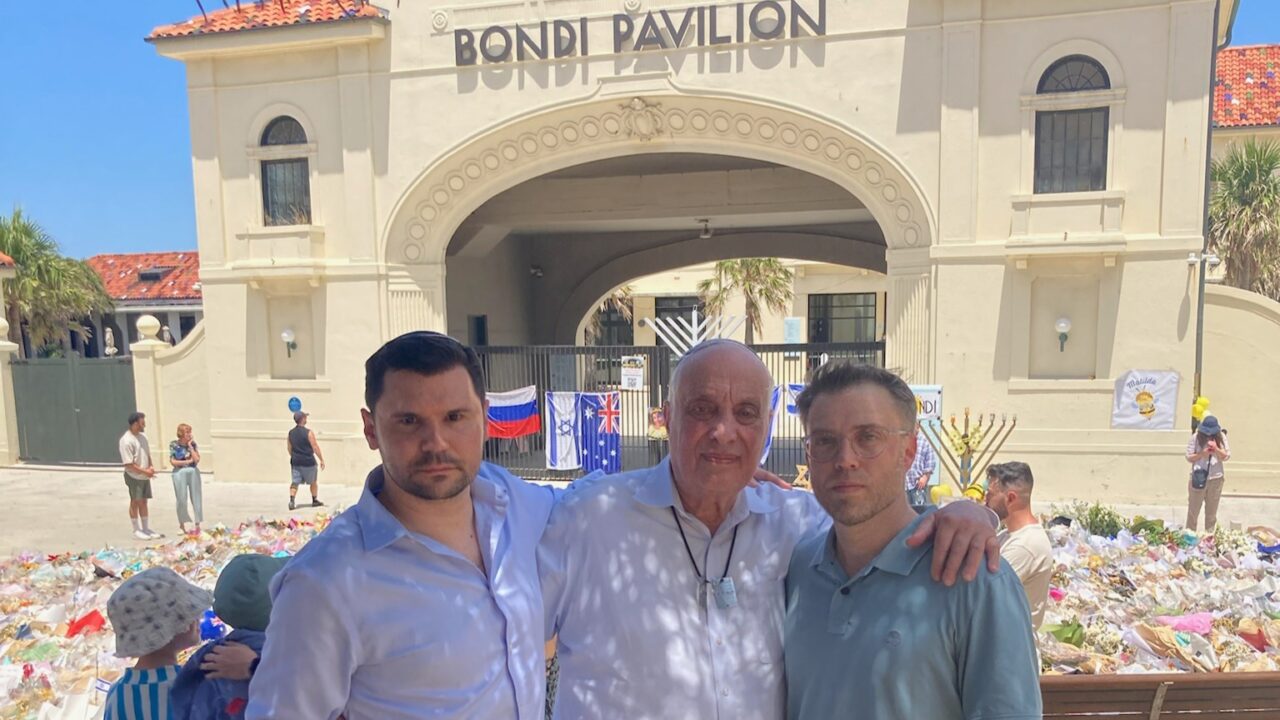
On the first night of Hanukkah, news broke of a terror attack at a Jewish candlelighting at Bondi Beach in Australia. Fifteen people were murdered. Children and elderly community members were among the victims. A public moment of Jewish joy was violently turned to devastation in an instant.
That same night, here in the Bay Area, many of us found ourselves making a quiet decision. Without planning it, and without language for what had happened or what it would demand of us, we went to light candles together. We gathered publicly and unapologetically as Jews — not because we understood the moment, and certainly not because we felt ready, but because it felt impossible not to show up.
A few days later, I was on a plane to Sydney with my teacher and mentor, Rabbi Avi Weiss, founder of Yeshivat Chovevei Torah, where I was ordained. The trip came together quickly and without a strategy. We were not traveling for leadership meetings or policy conversations. We were going to sit in shiva homes, visit hospitals and stand quietly with a Jewish community in mourning.
When people in Sydney asked where we were from, the first reaction was surprise when they learned we had come from the United States, then a split second of disbelief, and then gratitude. Not because of the distance traveled, but because we had come at all. When they asked why, Rav Avi offered a simple answer: “When you think of the Jewish people not as a nation, not as a religion, and not as an ethnicity, but as a family, the question is not why we came. It is, how could we not?”
His underlying message lives at the core of many of our Jewish communal institutions: Families show up.

It’s the ethos of a Judaism that is relational before ideological, grounded in responsibility before rhetoric. A Judaism that does not wait for permission to care.
In Sydney, I saw that same ethos play out in real time. In shiva homes, filled beyond capacity. In hospital corridors where words were insufficient, and presence mattered more than anything that could be said. In public gatherings where fear and resolve stood side by side. The details were different. The geography was different. The vulnerability was more raw. But the resonance was unmistakable.
Unlike Rav Avi, who has spent decades being present with Jewish communities after tragedy around the world, this was new terrain for me. I boarded the plane with questions: What could I offer? With what authority does one arrive in someone else’s grief? Those questions dissolved quickly. From the moment we attended the first funeral, it was clear that explanation was not what was needed. Meaning could wait. Presence could not.
Jewish life has long insisted on that ordering. Responsibility comes first. Commitment precedes certainty. Meaning emerges later, if at all.
Na’aseh v’nishma, as the Israelites said at Sinai — we will do, and then we will understand.
But showing up only in moments of tragedy is not enough. Families do not gather only in sorrow. They gather to mark time, to celebrate, to argue, to learn and to remind one another who they are. Waiting for loss to tell us when to show up cedes too much power to fear. Choosing to gather regardless is an act of agency.
Jewish peoplehood is not theoretical. It is lived. It is expressed through showing up when it would be easier to stay home, through standing with people rather than commenting from the outside, and through refusing to let Jewish life shrink in response to hatred or intimidation.
Here in the Bay Area, many of us are navigating what it means to live visibly Jewish lives in a moment of rising antisemitism. We are holding fear, anger, exhaustion and uncertainty all at once. We are also holding a choice. Whether to retreat or to gather. Whether to wait for clarity or to act from responsibility.
The trip to Sydney did not resolve those questions. It did not offer answers. But it clarified something essential. Judaism is not meant to be reactive. It is connected. It is confident. It recognizes family across oceans and insists on presence.
We did not go to Australia on behalf of any institution or initiative. But the fact that the trip made sense to us at all is inseparable from the values we are trying to practice. A Judaism rooted in peoplehood, animated by responsibility and anchored in the belief that presence matters, not only in moments of loss, but in moments of life.
We are part of a people that shows up for one another.
Here. There. And wherever our family needs us, in sorrow and in joy.