

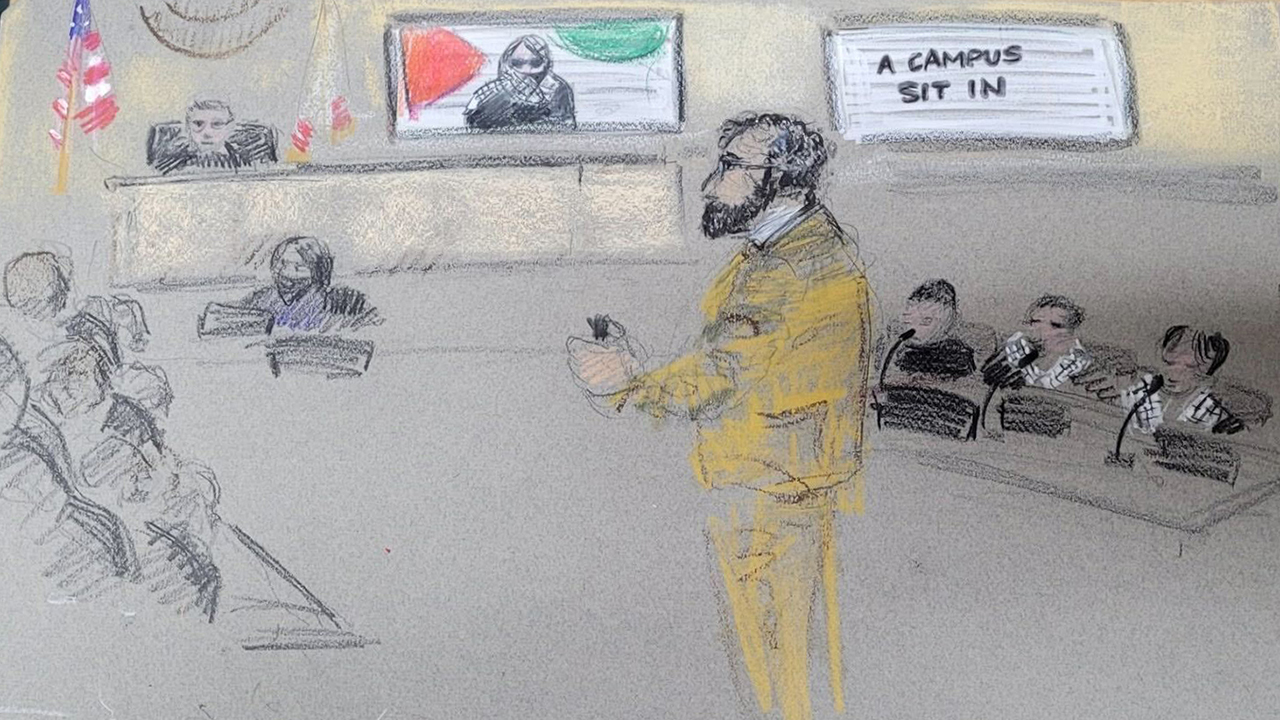
Attorneys delivered opening statements on Friday in the trial of five people facing felony charges after breaking into and barricading themselves inside the Stanford University president’s office in June 2024 during a dramatic pro-Palestinian protest.
“This wasn’t a sit-in. It was an attempted extortion,” Santa Clara County Deputy District Attorney Robert Baker said in his opening remarks.
Each defendant faces charges of felony vandalism and conspiracy to trespass for a June 5, 2024, incident that capped off a turbulent academic year with numerous pro-Palestinian and anti-Israel protests, including two encampments, at Stanford.
The five defendants — Taylor McCann, 33; Maya Burke, 29; Hunter Taylor-Black, 25; German Gonzalez, 22; and Amy Zhai, 22, all Stanford students or alumni — were in the San Jose courtroom, some wearing kaffiyehs.
Many of the supporters of the group originally called the “Stanford 11” sat in the courtroom gallery, also wearing kaffiyehs. At least one wore a sign attached to their clothing with the message: “Stanford 11: Drop the Charges.”
Eleven protesters were indicted in early October. Since then, three agreed to guilty pleas on reduced misdemeanor charges, and three others were granted mental health diversions. A 12th person pleaded no contest earlier in 2025.
In his opening statement in Santa Clara County Superior Court, Baker presented a series of video clips from security cameras inside Building 10, which houses the president’s office. Prosecutors have said the demonstrators carried tools including an electric grinder, hammers, crowbars and chisels.
In the clips from around 5:30 a.m., protesters are seen breaking into the building through windows, opening doors to let the rest of the group in, gathering materials to barricade the building’s entrances from the inside and covering security cameras with foil.
Baker’s presentation also included video captured by a campus police officer’s body camera, showing how officers used a sledgehammer to break the glass in one of the doors to the building and then used bolt cutters to disassemble the makeshift barricade protesters built out of furniture, ladders and miscellaneous cables.

Sounds of a nearby campus rally are heard throughout the clip, with protesters chanting “Free Palestine,” “We are all Palestinians” and “Stanford PD, KKK, IOF — they’re all the same.”
Baker listed the repair costs for some of the damages to campus property that occurred during the protest. A bar on one of the exit doors, which Baker called a “historical piece,” was bent and cost $700 to repair. An antique grandfather clock that was sprayed with fake blood cost $10,000 to be professionally assessed and $1,000 to clean. The broken doorframes of two offices each cost $6,000 to repair.
The minimum amount of damage to charge vandalism as a felony in California is $400.
Baker described Gonzalez as the group’s “ringleader.”
Avanindar Singh, a Santa Clara County deputy public defender representing Gonzalez, gave the first opening statement for the defense. Early in Singh’s statement, Baker made an objection over a screenshot that Singh displayed from the group’s planning documents.
The screenshot contained an excerpt from a list of questions and answers that Singh argued illustrated the group’s state of mind when they planned their protest.
“What is happening in Gaza?” The document read. “Over the past eight months, Israel has subjected Gaza to a severe siege and relentless bombing … Stanford holds multi-million dollar investments in companies supporting Israel’s military campaign against Palestinian life, including Hewlett Packard, Lockheed Martin, and Chevron.”
Baker later withdrew his objection after Singh assured the judge that he will clarify to the jury that the documents in his presentation were authored by the group and are relevant to the defense’s case.
The planning documents also included an organizational flowchart showing how the group decided to conduct itself during the break-in and instructed other protesters who were not comfortable with the action to provide support from outside of the building.

Singh argued that while the documents show the defendants planned their protest in advance, they also show how the group and other student protesters at Stanford “exhausted other options” of getting university administrators to discuss possible actions to take in response to the Israel-Hamas war.
In June 2024, protesters published a list of their demands on Instagram, calling on the university to divest from companies linked to Israel and to drop charges and disciplinary actions against “all pro-Palestinian student activists.” Stanford did not agree to either demand.
Challenging Baker’s characterization of the protest, Singh referred to it as a “campus sit-in to save lives.”
“Protests are meant to be disruptive and bring attention to urgent issues that are otherwise ignored,” Singh said. “The defendants wanted to highlight injustices. Disruption was a small price to pay.”
Margaret Trask and Anthony Brass, attorneys for McCann and Taylor-Black, respectively, also gave opening statements on Friday.
The students “saw the murder of Gazans as being committed in their name,” Trask said. “They felt that the university was complicit in genocide.”
The jury “doesn’t have to think about genocide,” Brass said. “Children were killed. That was enough.”
During pre-trial sessions in December, attorneys argued over the extent to which the defense should be allowed to make references to alleged genocide or speak to the protesters’ motivations.
In both cases, Judge Hanley Chew limited the use of the term “genocide” and protesters’ motivations in defense arguments, while not prohibiting either outright. During his opening statement, Baker reminded the jury they do not need to consider the defendants’ motivations or political beliefs to arrive at a guilty verdict.