

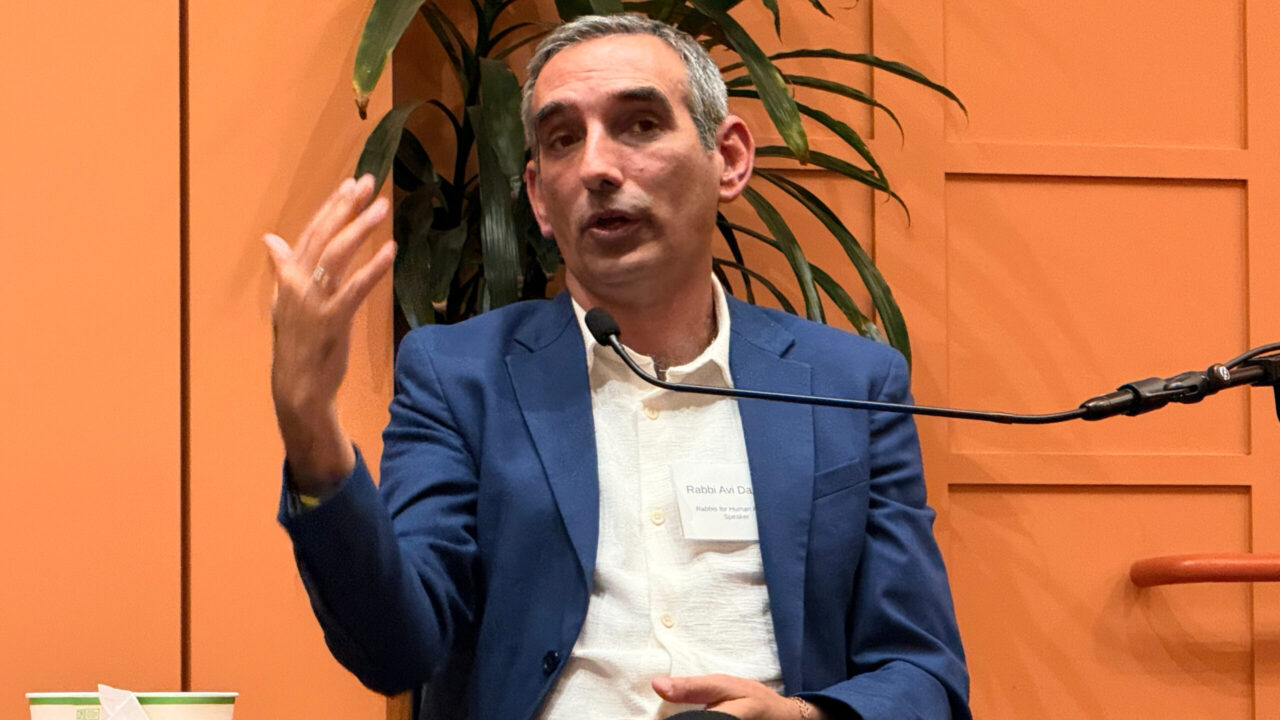
Before he joined Rabbis for Human Rights, Rabbi Avi Dabush was already entrenched in the Israeli left. He knew all of the slogans, and he opposed the Israeli occupation of the West Bank. But he didn’t know “the reality on the ground,” he told an audience at San Francisco’s Congregation Sha’ar Zahav on Monday night.
Dabush still doesn’t purport to know everything about the region, despite serving as executive director of the Israeli NGO since 2019. But after overseeing the group’s network of members and volunteers for the past seven years — and since surviving the Hamas attack on Oct. 7, 2023 — Dabush has acquired a new perspective on the position of the religious right in Israeli politics. He also sees the need for a pragmatic approach to peacemaking.
“I really believe in the local knowledge,” said Dabush, 49. “We try to know more and more about what’s happening. This is the only way to make change, or at least make some partnerships.”
Dabush was in conversation with Sha’ar Zahav Rabbi Mychal Copeland, with about 100 people attending in person and on Zoom. Attendees were invited to submit questions.

Since its founding in 1988, Rabbis for Human Rights has brought together Israeli rabbis and international volunteers to protect Palestinians in the territories, as well as minorities in Israel. They lobby Knesset members and set up volunteer projects with Palestinians in the West Bank.
Volunteers often go on “protective presence” trips, Dabush said, in which they accompany Palestinian farmers and shepherds who have been targeted by extremist Israeli settlers.
Dabush said the dire situation of Palestinian and Bedouin communities in the West Bank makes the work more urgent. Every time volunteers are out in the field, he said, “we can see new farms, new outposts — the illegal outposts that in the eyes of their government are now becoming legal.”
Dabush said over the past two years there has been an upward trend in volunteers, who now number in the “thousands.” He said his belief in the group’s mission was strengthened, rather than shaken, by his experience on Oct. 7.
“My commitment got more deep and concrete,” Dabush said.
That morning, Dabush was at home in Kibbutz Nirim, less than a mile from the Gaza border. It was the first residential community targeted by Hamas and Islamic Jihad terrorists, Times of Israel reported. Dabush and his family sheltered in place for over 30 hours. Five members of the kibbutz were murdered that day. Five more were kidnapped into Gaza, two of whom, Yagev Buchshtav and Nadav Popplewell, were murdered in captivity.
“We’ve fallen into a deep, dark pit,” Dabush wrote in an op-ed for Haaretz published weeks after the attack, “and the only chance of finding a way out is through precise, measured and practical action.”
To him, the experience brought new meaning to the Biblical commandment in Deuteronomy 30:19: “I have put before you life and death, blessing and curse. Choose life — if you and your offspring would live.”
After surviving or witnessing such trauma, he said, it’s not easy to “choose life” in the throes of fear, confusion and anxiety. A hunger for revenge is also common, something he learned growing up in his religious, right-wing Mizrahi family.
Recent polling data from the Jewish People Policy Institute showed that more than half of respondents who identified as moderate or center-right had moved further right in their political ideology since Oct. 7. This shift was especially evident among Jewish youth across the political spectrum, according to its November 2025 report.
In early December, the Israeli security cabinet approved the establishment of 11 new settlements in the West Bank, which Finance Minister Bezalel Smotrich said were intended to block the possibility of a Palestinian state, Times of Israel reported.
Settler violence against Palestinian and Bedouin communities in the West Bank has simultaneously peaked. Between 2024 and 2025, according to data from the Israeli military and Shin Bet security agency, attacks by extremist Jewish settlers against Palestinians and Israeli security forces increased 27% (from 682 to 867 incidents), according to Times of Israel.
During the height of the olive harvest season in the fall, there were several incidents of settlers tearing down and setting fire to olive trees. As a rebuilding effort, Rabbis for Human Rights began a fundraising campaign to sponsor the planting of new trees throughout the region.
“For me, hope and optimism come from actions,” Dabush said at Sha’ar Zahav. “We can talk about Zionism, genocide, apartheid, war crimes and so on. It’s important, I’m not cynical about it, but actions are something that we can see some results all the time.”