
This is a true story. A Pharoah imagined a small group of foreigners rising up and causing mayhem in his country. He sent an army of agents to root them out with incredible cruelty. But many folks simply refused to comply, coming to the aid of their neighbors in loving and peaceful ways.
In the Biblical Exodus story, when Pharaoh realizes that he can’t find enough people to carry out his evil plan to kill all the Israelite baby boys, he simply orders every single Egyptian to become complicit — which they do. That’s the essence of Exodus 1:22.
Complicity is the beginning of darkness, and that is where the story in Minneapolis diverges sharply from the one we know in Exodus. Because ordinary Minnesotans did not comply. When the ninth plague descended on Minneapolis — the plague of darkness — good, kind, compassionate people stood up to hatred and cruelty. They refused to be complicit. They are heroes and angels and an example for us all of what we can do when darkness descends on our country.
Following their brave example, I made my own exodus last week, boarding a plane to Minneapolis with a ridiculously large winter coat and my passport, to join more than 600 interfaith clergy from around the country to protest what was going terribly wrong there.
We showed up to be a force for good, a reminder to our government of its responsibility to the people of our country, of our shared civil and human rights. We showed up to pray, to march, and to witness the abhorrent tactics of U.S. Immigration and Customs Enforcement.
But we also witnessed something far more powerful: Human beings acting like human beings. As our tradition teaches, “In a place where people are not acting human, we must strive to be human.” (Pirkei Avot 2:5)
Weeks before the army of 3,000 ICE and other federal agents arrived in the city, people started getting to know one another, neighborhood by neighborhood, so they could offer each other protection. My friend and colleague Rabbi Jason Rodich, formerly at Congregation Emanu-El in San Francisco, now serves Temple Israel in Minneapolis. His temple adopted the local school a few blocks away and has been caring for 400 families in hiding, whose children made up half the school’s population. They have raised funds for food, diapers and medicine and, together with many other synagogues and churches, are helping support thousands of their neighbors in hiding.
I am so grateful for the moral compass and the call to active righteousness that Jewish tradition offers powerfully in moments like these. I’m proud of the different Jewish denominations whose leaders have made bold statements and called out violent immigration enforcement. Minnesotans are not standing by the blood of their neighbors, no matter the color of their skin, the religion they practice or where they were born. That’s Leviticus 19:16.
But it’s not just the faith community and other activists who are showing up. Ordinary people are purchasing and delivering food, diapers and medicine for the thousands of families living in hiding. The commandment to love, protect and welcome the stranger, or ger, is mentioned 36 times in the Torah, because we ourselves were strangers, foreigners, the others, in Egypt. That’s Leviticus 19:33-34.
Jewish tradition also commands us: Al tirah — do not be afraid. It’s not a suggestion; it’s a spiritual imperative. In Minneapolis, pastors, rabbis, ministers, imams, cantors, priests, monks and nuns together were not afraid. One hundred members of the clergy were arrested at the airport for protesting flights that have been transporting people seized by federal agents. Others marched and raised their voices with 50,000 Minnesotans in a city that shut itself down to stand up for justice.
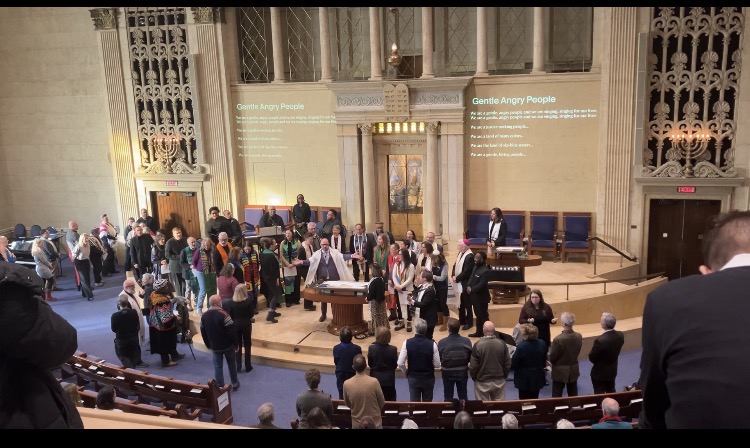
On the morning of Jan. 23 before the march, people of all faiths joined together to pray and sing and lift our spirits at Temple Israel. A Catholic priest led us into the sanctuary with fragrant incense, the Muslim call to prayer opened the service, the shofar was blown, and a Buddhist led us in meditation. Elected officials including U.S. Sen. Amy Klobuchar lit candles, a church ensemble led the music, and Rabbi Marcia Zimmerman, the synagogue’s senior rabbi, made sure everyone felt warmly embraced. As I lit one of the candles, I gazed into the pews and cried. What does it take for us to look at one another as created in the Divine image, every single one of us? By the way, that’s Genesis 1:26.
In the corridors of ICE detention centers and on the streets where Renee Good and Alex Pretti were taken from us, there is a vacuum of humanity. Our responsibility as Jews and as Americans is to fill that profoundly un-American vacuum. If we move our gaze from Minneapolis to look at our entire country, we know that we are living at perhaps the most significant moment in our own lifetimes. I encourage you to think about what you are doing — or not doing — at this moment.
In his famous poem, Pastor Martin Niemöller wrote:
Then they came for me
And there was no one left
To speak out for me
Get organized and really get to know your neighbors. There are no innocent bystanders, and we have not yet reached the end of the poem.