

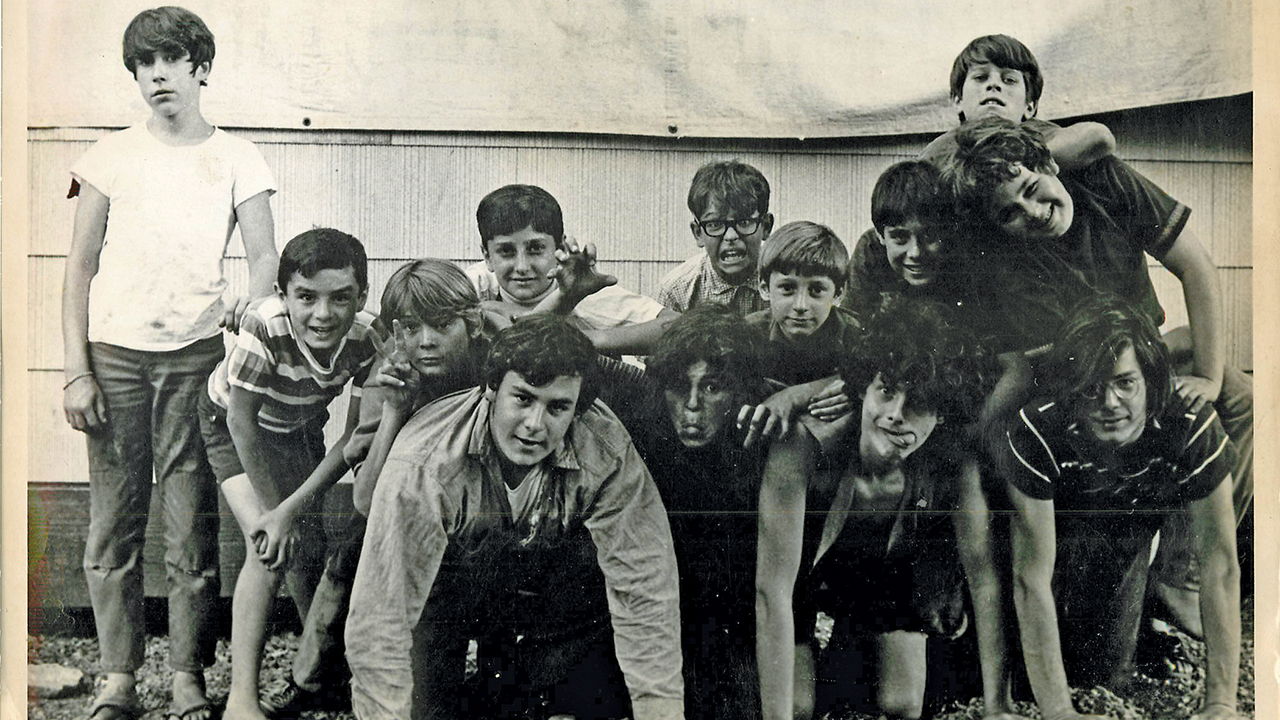
J. recently asked readers to share their memories about Jewish overnight camps in Northern California. While camps have changed with the times, there are some things that carry across the decades: friendships, fun and Jewish joy.
One of the sites, Camp Arazim, closed more than a quarter century ago but still elicited warm memories.
Magic in the air
I was both a camper and staff at Camp Swig in the late 1960s and early 1970s for four or five summers. Both experiences were magical and longlasting to say the least. The camaraderie with staff and campers was like nothing else I’ve ever been exposed to.
Swig, located near Saratoga in the Santa Cruz Mountains, was called “the place for living Judaism.” It was also called “the place for loving Judaism.” It lived up to the billing, and it was much more.
Rabbi Joseph Glaser and Rabbi Morris Hershman were there when I was at camp. The song leader was the amazing Carol Kretzer and the cook was World War II veteran Barbara Sparrenberger. The incredible Helen Burke and Mark Wachter were the artists in residence. Helen crafted two portable Torah arks at Swig that were brought to Camp Newman in Santa Rosa and survived the 2017 wildfire.

I still remember when we all gathered together in July 1969 to watch the landing on the moon.
I loved camp so much that both my daughter and son went to Camp Newman in Santa Rosa (after Camp Swig moved and changed its name), and I volunteered there for a dozen years.
Havdalah on Saturday night was so special that you wanted to do it every night. You could say there was magic in the air at camp. I look back on Camp Swig as truly a highlight of my life.
I met Ron Eber there [see below] and made a lifelong friend. We’ve had many adventures together.
Mike Pechner
Fairfield
Our shelter from the storm
I was on staff at Camp Saratoga/Camp Swig between 1966 and 1972. (Many of us continued to call it Camp Saratoga after the name changed in 1965.) I worked in the kitchen, maintenance and administration and as the onsite camp caretaker.
Being a camp staff member on weekends or during the summer led to many special moments and lasting friendships. The most special times happened after-hours in the staff lounge with counselors, song leaders and support staff.
We sang the folk songs of the times, talked about life and national and world events like Israel’s Six-Day War, the assassinations of the Rev. Martin Luther King Jr. and Robert F. Kennedy, the draft and the Vietnam War.
The 1960s were troubling times for all of us. Saratoga/Swig was a sacred place, where among the redwoods, we could escape it all, share our time together in song sessions and in friendship circles on the “bimah lawn.” (We called it that because of the stage at the end of it). Camp was our home away from it all — our shelter from the storm of the ’60s.
One special moment happened in 1969. Everything stopped and the entire camp community gathered to watch and experience the first moon landing. The kitchen staff delayed serving lunch until the Eagle had landed.
Ronald Eber
Edmonds, Washington
From shy to song leader

My most memorable experience working last summer at Maccabi Sports Camp in Hayward was co-leading Shabbat services with the camp director. Before camp I was a very shy person and only sang in the shower. But when I got to camp to work as a counselor, I promised that I would push myself out of my comfort zone. So when three boys in the cabin I oversaw wanted to participate in the camp talent show, I knew that this was my chance to do something.
My boys had learned the cup song from the girls cabin but had no idea of the cinematic masterpiece that is “Pitch Perfect,” so I showed them a couple of iconic scenes, which they loved!
They begged me to sing with them for the talent show, so I did. It went amazingly. We got so many compliments. Everyone said I should sing in Shabbat services. I listened to them and did so the following Shabbat.
This experience unfortunately did not launch my career into stardom, but I’m now much more interested and excited to celebrate Shabbat and help lead services. So thank you, Meshuga Monkeys (my cabin) and Maccabi Sports Camp, for helping me to connect more with my Judaism.
Tajah Kwatia
Brighton, England
‘A Beautiful Day’ at camp
In the summer of 1969, I was a camper at Camp Tawonga, which is set in the Yosemite foothills. Midway through the session, in July, my parents and youngest brother were due to arrive. My father was coming up to serve as camp doctor. So I found myself waiting for them on the main lawn with my two brothers just below me in age. Instead of watching the first lunar landing, we listened to it over the camp loudspeakers, the crackling broadcast drifting through the pines.

Between updates from the moon, one of that summer’s big hits, “White Bird” by the San Francisco band It’s a Beautiful Day, floated through the speakers as well.
At the time, I had no idea that Linda LaFlamme, who co‑wrote and sang that haunting song, would one day become a dear friend, a fellow member of our shul, Beth Jacob Congregation in Oakland, and even our children’s piano teacher.
Looking back, it feels like a perfect blend of memories: Camp Tawonga, the moon landing and a future friend’s voice carried on the summer air.
Brian Kaye
Piedmont
An impactful counselor
I went to Camp Tawonga during the summers of 1976 to 1980. I loved all the stuff we did: gaga, hiking and white-water rafting. One counselor who stands out the most is Scott Snook. He made a major impact in my life by bringing me out of my shell. He was such a positive influence. I reconnected with him a few years ago on Facebook. I’m ever so grateful.
Bryan Conjulusa
Daly City
Never wanted it to end
Camp Arazim was the place where I made my lifelong friends. I was a camper there from 1978 to 1981 and a staffer from 1985 to 1986. [Editor’s note: The Conservative camp in Stanislaus County welcomed kids for three decades before closing in 2000.]
There are too many formative experiences I had at Arazim to list! Some things I will never forget: singing “Jeremiah was a prophet” (not a bullfrog); my brother’s bunk filling our bunk with frogs; experiencing my first Jewish (mock) wedding; singing for what felt like hours following Birkat HaMazon, the blessing after meals, on Friday night; singing again for what felt like hours during Havdalah (no wonder I became a Jewish song leader during college); crying all night long the last night of camp, knowing we could only write letters to stay in touch (because phone calls from Cupertino to just about anywhere else in Northern California were “toll” calls). And yes, I still have many of those letters.
Now in our fifth and sixth decades of life, I am still in contact with my fellow Arazimniks, having made and maintained deep connections over those summers in the 1970s and 1980s.
When Arazim eventually shut its doors, I was compelled to send my children to Camp Ramah in Ojai, so they could experience a similar kosher, Zionist, experiential Judaism that I grew up on. The lack of a Northern California camp affiliated with the Conservative movement was the No. 1 reason I joined the founding board of Camp Ramah (aka Ramah Galim), south of Santa Cruz. I want future generations to experience joyful Judaism and create lifelong friendships.
Deborah Hoffman Gonzalez
Carmichael
Met my bestie in my bunk
I attended Camp Arazim during the summers of 1987 to 1992. It was the first day of our “Vatikim” summer in 1988 at Camp Arazim. I really admired the wide range of Gap pocket T-shirts the new girl in the top bunk had brought. Little did I know that, 38 years later, we’d still be hanging out, having gone through the ups and downs of high school, college, first jobs, heartbreaks, love, weddings, pregnancies and kids, long-term marriages and now perimenopause together.
I also had my first boyfriend that summer of 1988, but he’s long gone. My best friend? She’s here to stay.
Lisa White
Piedmont

Still friends, decades later
My first summer as a camper at Camp Saratoga (later Camp Swig) was in 1962 when I was 11. It was an amazing experience. I remember on the last day of camp I was sitting in my bunk crying. My counselor came over to ask what was wrong. I said, “How can they let us have such a wonderful time and then take it away.” I wanted to stay at camp forever. I attended camp as a camper six more summers, then a summer on staff. The joy of that first summer never left me.
So many aspects of camp are memorable. But the very best part of camp is the lifelong friends I made. There was and is a bond among us that is unbreakable. We have a group of 20+ camp friends from across the U.S. and Israel who get together monthly for a Zoom call that we refer to as “The Friendship Circle.”
More than 50 years later these people are more than friends, they are family. We talk about how camp shaped our lives and, for many, was instrumental in career choices with the lessons learned.
My friends include six people who became rabbis or cantors, and several others who went into Jewish education and community work. The amazing song writer, Debbie Friedman, was a Swig song leader.
Camp equipped us with a firm basis in Jewish life, ethical living, leadership and tikkun olam, how to heal the world.
Rosalind (Roz Coleman) Whitesides
Fountain Valley