

Aviva and Keith Siegel know what it’s like to live in a pit of despair.
The married couple were abducted from their home in Kibbutz Kfar Aza on Oct. 7, 2023, and taken hostage by Hamas. After 51 days, Aviva was released in a hostage-prisoner exchange and immediately began a public campaign to bring her husband home. Keith was freed last February after 484 days.
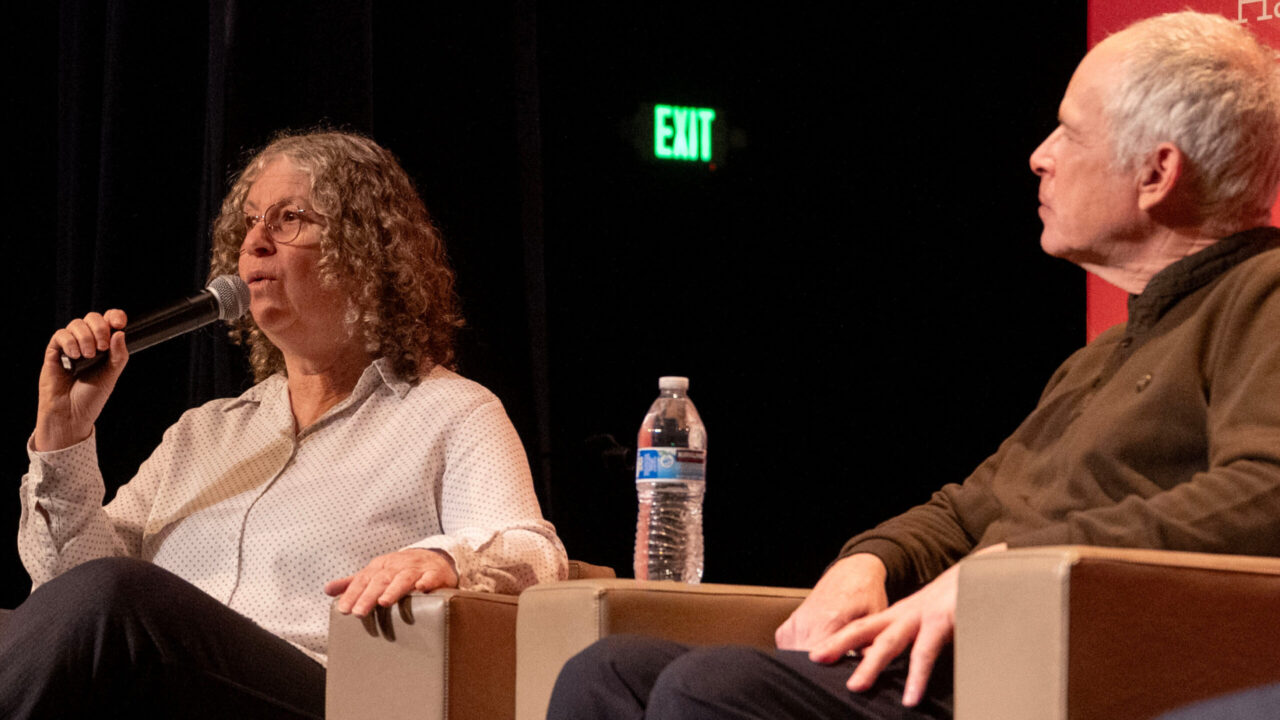
Both survived physical and psychological torment, they told an audience at a Feb. 12 event at the Addison-Penzak JCC in Los Gatos.
After reuniting, they vowed to help others facing similar conditions around the world. Late last month, the Siegels became ambassadors for IsraAID, Israel’s largest humanitarian aid organization. Since its founding in 2001, IsraAID has worked with local volunteers to respond to crises in over 60 countries.
The Siegels, whose recent travel has included a visit to a refugee camp in Kenya and a short meeting with first lady Melania Trump in the White House, shared how they survived brutal conditions as hostages in Gaza and how their experience connected them to refugees displaced by conflict in Africa.
“To learn about how many people all over the world … had done so much to get me back — and to this day I learn more and more about it — it’s very special for me to meet with all of you,” Keith told the crowd of 200. He was born in San Rafael and moved to North Carolina with his family at a young age. “All of you were part of a collective effort to bring us back.… I’m very, very grateful for that.”
Located about 3 miles east of the Gaza border, Kibbutz Kfar Aza, where the Siegels had lived since 1983, was one of the first civilian communities attacked by Hamas terrorists on Oct. 7.
The Siegels took shelter in a safe room for several hours, until a dozen terrorists stormed in, shot at them and dragged them out of their home, injuring Keith’s hand and ribs in the process. They were driven into Gaza in Keith’s own car.
Sixty-four residents of Kibbutz Kfar Aza were killed that day.

“It really sounded and looked like the end of the world,” Aviva said.
In Gaza, the couple was taken into a home and forced to climb down a hole that led them to a Hamas tunnel, they said. While in captivity, they encountered other hostages, including Liri Albag and Agam Berger, two IDF soldiers who were kidnapped from the Nahal Oz military base.
They were moved 13 times and mostly held in homes belonging to Hamas terrorists and their families, Keith said. Throughout that time, they were deprived of food and water and subjected to what Aviva described as “brainwashing.”
“The terrorists used to say, ‘There’s no Israel anymore’” said Aviva, whose family moved to Israel from South Africa when she was 9 years old. “Don’t ask me how, but I believed them.”
After her release, she recalled seeing Tel Aviv and thinking, “I can’t believe it, [it’s] still standing,” Aviva told Jewish Silicon Valley CEO Daniel Klein, who moderated the event.
The Siegels were held captive together until Aviva was released on Nov. 26, 2023, along with 16 other hostages.
“Until he came home, I was still in captivity with him,” she said. “I didn’t get out of that, not for one minute.”

The Siegels were traumatized not only by what they endured, but also by what they witnessed. At an Israeli parliament hearing in January 2024, Aviva said she believed that one of the female hostages, whom she did not name, was sexually abused, according to Israeli media reports.
Keith said he saw the torture of another female hostage. His captors forced him to convince her to confess to being an IDF officer and hand over military intelligence she did not have, he said.
“I saw her being beaten after they had tied her hands together and her feet together, and they covered her mouth with tape,” Keith said.
For six months of his captivity, Keith said he was held in complete isolation from other people, except for occasional contact with a Hamas captor. He relied on visualization and mindfulness techniques to stay grounded, picturing himself talking directly with each member of his family.
“I didn’t feel alone, even though I was physically alone,” he said. “I was hoping somebody would receive that message and be able to spread the word that they know I’m alive.”
He reunited with his family when he was released Feb. 1, 2025 as part of cease-fire negotiations. He also met what Aviva called a new type of extended family: the Hostages and Missing Families Forum, a group created after Oct. 7 to coordinate efforts to secure the release of the hostages.

Through their advocacy for the 79 hostages still held at the time, the Siegels met Matan Sivek, co-founder of the forum’s U.S. chapter. Sivek later joined IsraAID as its head of strategic partnerships.
The Siegels volunteered to travel with IsraAID to a refugee camp in Kakuma, Kenya, to learn about conditions there and raise awareness, according to IsraAID communications director Ethan Schwartz.
“We went through so much,” Aviva said. “When we were offered to help and be part of IsraAID, we couldn’t think of anything better to do to help others, knowing what it feels like being starved, being without water, being tortured, losing hope, not knowing what’s going to happen tomorrow.”
IsraAID is one of several nongovernmental organizations that operate in the camp, which was established in 1992 to house refugees fleeing Sudanese civil war. Today, the camp is home to refugees from South Sudan, Somalia, Ethiopia and Burundi who are fleeing civil wars and ethnic conflicts.
Having spent just four days at the camp last month, Keith was surprised by the strong connection he built with the refugees. Although they had nothing, he said, “It turned out that we do have a lot in common but completely different backgrounds. It was a very emotionally empowering experience for me, and really created within me a very strong desire to do whatever I can to help these people.”