

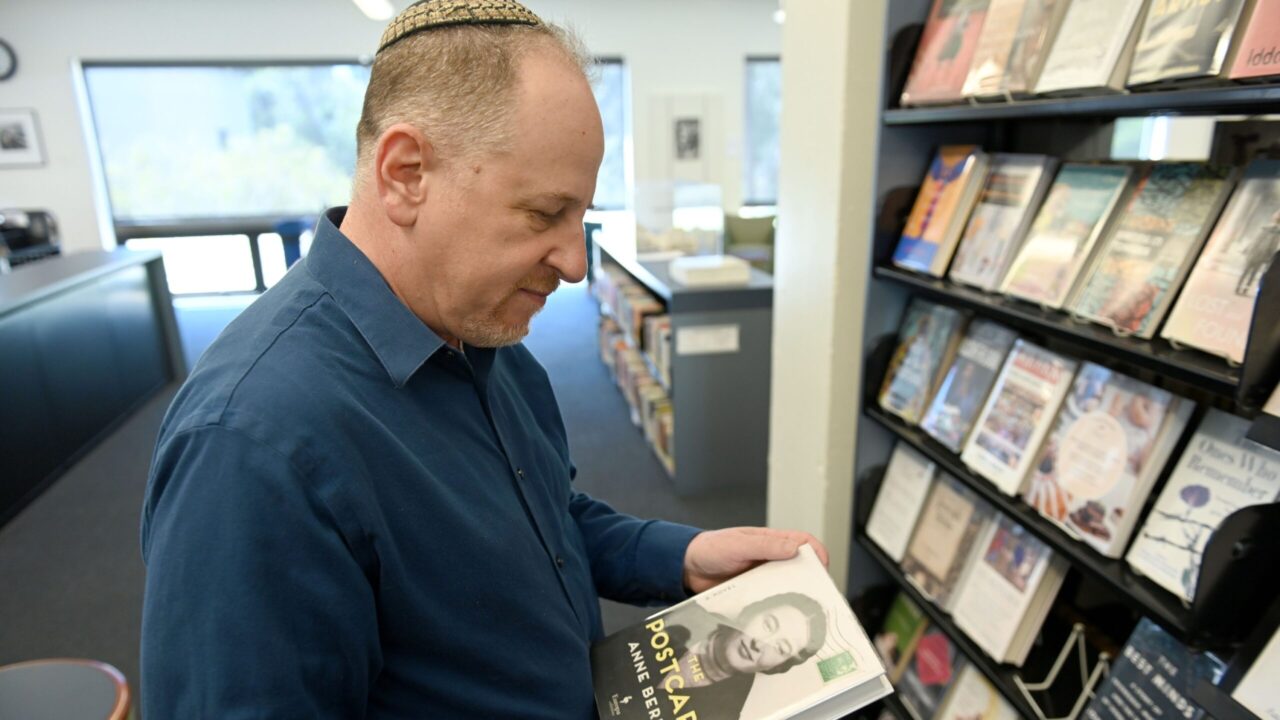
A few years ago, I attended a talk at the Jewish Community Library where academic Sasha Senderovich was speaking about his book “How the Soviet Jew Was Made.” Howard Freedman, the library’s director since 2009, had created a display of related works. Several times during the talk, Freedman leapt to his feet as Senderovich mentioned increasingly obscure Russian and Yiddish books. Each time, he returned with a copy and added it to the display, saying, “We’ve got that too, if anyone wants to borrow it!”
Freedman, 59, is quiet, unassuming and well-read — exactly what you’d want from a librarian. He’s exceptionally well-read in Jewish fiction, thought and history, which makes him an ideal fit for this Bay Area institution, based at the Jewish Community High School of the Bay in San Francisco.
Through his leadership, Freedman connects Bay Area readers to Jewish literature, history and culture, using the past to illuminate contemporary issues.
The library became an independent nonprofit in 2023 after a long period as part of Jewish LearningWorks. Today, it serves as the school library, a public lending library and a gathering place for literary events, with 40,000 titles. Freedman also oversees a mini-branch of the library in the form of a pushcart at the Oshman Family JCC in Palo Alto and programs ranging from the annual One Bay One Book series to the popular “Book Club in a Box,” which allows people to borrow 12 copies of the same book. He also writes “Off the Shelf,” a monthly column of book recommendations for J.
I caught up with Freedman in his office, piled high with books on nearly every surface, to discuss his career and the library’s role today. We also ended up talking about Soviet Jewry, racism in the Jewish community, and the past and present of undocumented immigration in America. This interview has been edited for length and clarity.
Do you have any early memories of books and reading?
I grew up in one of those homes with floor-to-ceiling bookshelves. It was a very book-oriented home. And I grew up with, especially, lots of children’s books, which were really important to me. My father used to take me to a Jewish bookseller, J. Roth. There’s actually a book that just came out about this bookseller, which is kind of crazy, “Unpacking My Father’s Bookstore.” I remember my father telling me, “If you ever want to buy a Jewish book, I will pay you back for it. Just buy it, and I’ll pay you back.” And so that was a really powerful statement for me of values.

You grew up in Santa Monica in the 1970s. What was that like?
It was very different from what it is now. It was much less fancy. It was a nice and fairly diverse place to grow up. I had a lot of Jewish friends, but I had a lot of friends who were not Jewish. I went to public schools.
There was a lot more that revolved around Israel [during that time], and there was the movement to bring in Soviet Jews, who hadn’t had the experience of Jewish ritual. We had a family that would come for Passover and other family occasions, like Shabbat every Friday.
But what was also happening at the very same time is that Jews were leaving Iran, and Los Angeles became the largest Iranian expatriate Jewish community in the world. And the same community that had been so welcoming to the Soviet Jews gave a very different sort of welcome to Iranian Jews with whom they didn’t jibe culturally. There wasn’t a sense of like, “Oh, we are all one people, come to my table.” And I saw what I view as just racism and pure bigotry, and that really disturbed me.
Did you have the chance to know your grandparents?
I did. My paternal grandfather had a very interesting life. He was from Jerusalem. His father was an Orthodox rabbi. He grew up in extremely painful conditions during World War I, when there was an epidemic of typhus and cholera, and starvation. It was just a horrible, horrible time there. His father had been drafted by the Turkish army. Two of his older siblings died, and his mother lost it and died by fire in the house, possibly suicide. And my father and his remaining two siblings ended up coming to the United States as minors illegally, under false premises.
Has that illegal status been on your mind a lot lately?
Absolutely. If he were doing the same thing today, he would be in violation of our laws. He would be sent to whatever horribly named facility they have set up, and he would be excluded from this country, and I wouldn’t be here. I absolutely identify strongly with the stories of many immigrants who are here. My grandfather never left [the United States]. He was always afraid. He never exited the country’s borders for the rest of his life because he was afraid.
That’s a shame that he was never able to go and see what Jerusalem, his hometown, became.
He died too young in 1975. The next year my grandmother and the descendants all went to Israel, to where he was from, so we could actually go where he never felt comfortable returning.
What is your relationship with Israel like these days?
It’s very complicated. Something that I feel I can do in the course of my work is to promote engagement with Israel through literature, which can be a different kind of experience than going through the mire of politics. It saddens me that more people aren’t exposed to it, because I feel like it offers something to hang on to. It can be very disturbing to read, but it has a very different quality than watching this sort of very frustrating set of developments [in the news].
That’s very similar to how I feel about Israeli film. It’s a window that can be distressing, but also, like, it could be a comedy or a slice of life drama.
In literature and film, when it captures life as lived experience, that can be Jews, it can be Arabs, it can be whatever it’s portraying. That is a very different quality than reading [nonfiction] books about what should happen. I think it’s important to be engaged at both of those levels.
Do the students here at JCHS make good use of the library?
Yeah. In fact, they use it more than they ever have, really.
What do you attribute that to?
One reason is that when the school started, they worked more pronouncedly from primary sources, meaning Torah and Talmud. They’ve moved to other areas of Jewish study, like Jewish history. They have a very serious senior thesis project that requires the use of materials from the library, and so the students use it in really creative and interesting ways. It’s a delight to see this collection that’s been built over so many years fall into their hands.
You host a lot of public events here. Is that how you bring the general community into the library?
It’s a really big part of what we do. We still try for a balance that’s 50/50 online and in person. We really love the sense of community that develops through in-person programs. The nice thing about in-person programs is that there’s sort of a twofer kind of thing, where somebody can come and enjoy the program and while they’re here, “Oh, well, I’ve been meaning to read this book,” or “I have an interest in this. Do you have anything on on this topic?”
What’s your life outside of Jewish community and Jewish books and all that?
I’ve always been very involved in music. I play guitar, banjo, harmonica and drums. Not necessarily at a level where you would want to hear me play, but that’s a big part of my life, especially with my kids, who also play music. Listening to a huge variety of music is my favorite thing to do.
One of the things that was really big for me in my early years in San Francisco was being drawn to Yiddish culture, which is something that wasn’t a strong part of my upbringing, and I ended up being the coordinator of something called the Yiddish Song Circle, which was a monthly group of people sharing Yiddish-language songs.
What’s your favorite book?
Can I say “Go, Dog. Go!”?
OK, what’s your favorite Jewish book?
“Only Yesterday” by S.Y. Agnon. It brings together Jewish tradition and modernism, and it also has one foot in the land of Israel and one in the diaspora. It’s a really difficult book, which means that it’s very satisfying to return to it.