

There just aren’t enough Jewish holiday movies or shows.
Actually, there seem to be almost none at all, especially ones for kids.
Sure, Passover has “The Prince of Egypt,” and Hanukkah gets its own “Rugrats” episode. But Purim? No such luck.
Frankly, I don’t understand this. An entire genre of children’s movies about princesses exists, and Purim’s main character is literally a queen. If Jews really ran Hollywood, you’d think Esther would have had her Disney moment by now.
This dilemma became alarmingly apparent when I was searching for a Purim movie or show to watch with my almost 4-year-old daughter last week. The few Esther adaptations I found were either not kid-friendly or just … bad.
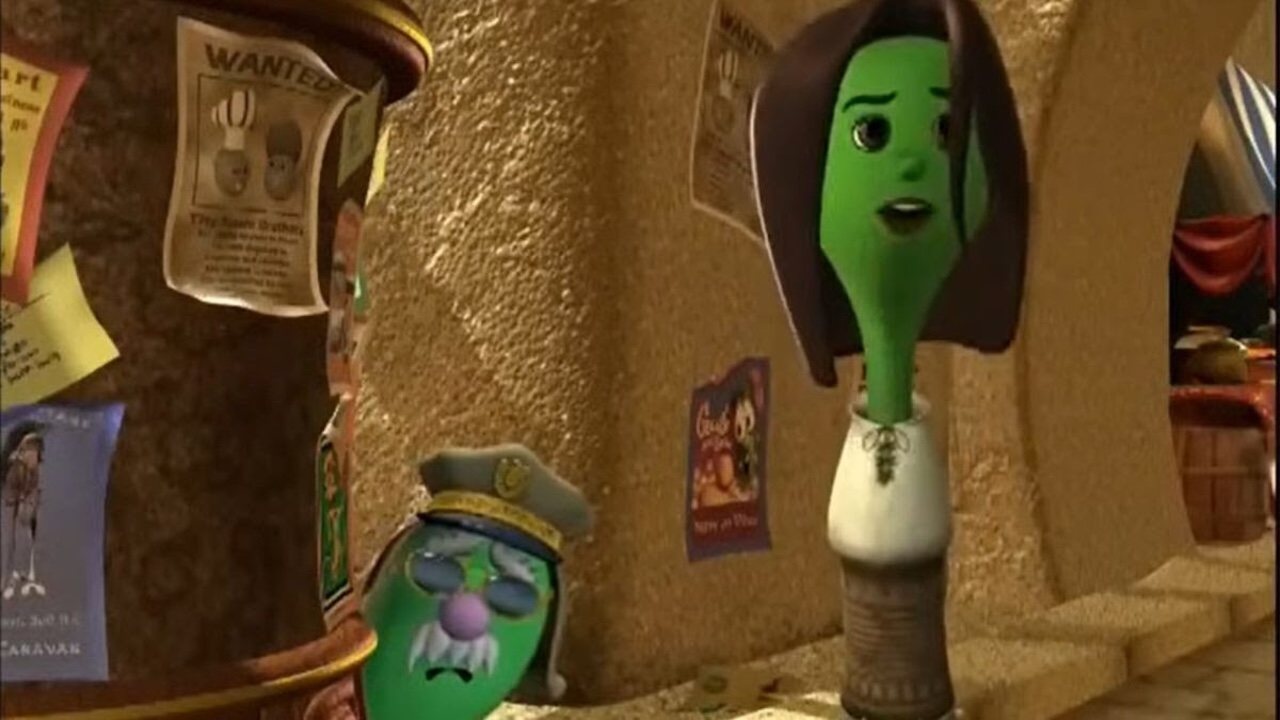
Then I remembered a strange VHS tape from my childhood: VeggieTales’ “Esther: The Girl Who Became Queen.” Miraculously, it is free to watch on YouTube.
If you’ve never encountered VeggieTales, it’s a wildly popular Christian franchise that first arrived on videotape in the mid-1990s and is still producing movies today. It stars anthropomorphic vegetables who live out Bible stories and parody pop culture. I know this sounds bonkers and, trust me, it absolutely is. (It’s actually so much weirder than I remembered.) But hear me out.
Obviously, animated Christian vegetables are not the ideal storytelling vehicle for Jewish kids. However, more than 25 years since its release, the VeggieTales Esther story remains one of the only Purim shows available. The 39-minute cartoon loosely “reimagines” Esther with nods to “The Godfather” and “Casablanca,” which is a sentence I never expected to write.
Immediately, my daughter had very important questions, like “What is she?” and “Where are their arms?” As a kid I thought Esther was a green bean, but upon researching these questions, I found out she’s a leek. Regardless, she is very green.
The plot includes sandwich-related royal drama, a villainous squash (or maybe he’s a gourd?), a pair of pea assassins and exile to the “Island of Perpetual Tickling.”
The movie begins with King Xerxes (Achashverosh) the zucchini in need of a new queen because Vashti (also a zucchini) refuses to make him a sandwich at 3 a.m.
The next day, Esther the leek is walking with her cousin Mordechai the grape. Haman the squash/gourd comes along to collect all the eligible maidens for the king and demands that Mordechai bow in his presence. Mordechai refuses, and Haman becomes furious. He then takes all the maidens to the palace, where Esther sings a song and is chosen queen.
One day, two peas attempt to assassinate the king by dropping a piano on his head, but Mordechai and Esther save him just in time. Haman banishes the peas to the “Island of Perpetual Tickling” for their crimes. A grim reaper character with a giant feather appears, tickling the peas out the door and scaring my daughter, who clung to my arm as I tried not to laugh.
Though the king believes he is now safe, Haman convinces him he’s actually still in danger through an antisemitic song that has no business being as catchy as it is, with lyrics describing a “sneaky little family who do sneaky little things, who stick their sneaky noses into matters of the king.”
Unaware that Haman is talking about Mordechai and his family, the king authorizes an edict to have them banished to the Island of Perpetual Tickling. Mordecai appeals to Esther to reveal Haman’s evil plans to the king, but Esther is scared.
Mordecai reminds Esther that she never needs to be afraid to do what’s right. Esther is still fearful but eventually redeems herself as she finally embraces her position as queen. She eventually reveals that Mordechai is her cousin and that Haman has been plotting against him and his family, which includes her.
The king, who respects Mordechai, adores Esther and would never harm either of them, banishes Haman to the Island of Perpetual Tickling, along with anyone else who dares scheme against his queen and her family.
Despite the entirely Jewish plot, Jews are not named at all in the show — a detail I somehow overlooked as a kid. Faith in God comes up multiple times, but the show doesn’t mention Jesus.
The show’s absurdities and omissions aside, its core message reigns: You should never be afraid to do what’s right. That’s a lesson worth teaching, even if it comes from armless, talking vegetables instead of a Disney princess.