

For Bay Area Jews who fled Iran around the time of the 1979 Islamic Revolution, the decapitation of what they described as a murderous and destabilizing regime presents new hope for freedom in a country with which they feel strong cultural ties, but in many cases cannot even visit.
They are sharing a sense of overwhelm over the prospect of their country liberated from its oppressive theocratic government.
“I feel elated,” said Sharam Sasson of Alamo, a 71-year-old retired businessman who fled Iran in 1978, a year before the revolution toppled the Pahlavi dynasty and established the Islamic Republic.
Others expressed a mix of emotions, from jubilation to anxiety, about what’s to come after the killing of Ayatollah Ali Khamenei and other high-ranking Iranian regime officials by Israeli and American forces.
The promise of a destructive and lengthy war with Iran loomed as the U.S. sent more troops into the region and Iran carried out deadly counterstrikes, including an attack on the Israeli city of Beit Shemesh that killed nine. Iran’s government pledged the country is prepared “for a long war.”
Political reactions to the war reflected existing political fissures in the U.S., as opponents described a reckless campaign with unpredictable consequences launched by a rogue administration. Many Democrats sharply criticized the Trump administration’s decision to launch attacks on Iran without congressional approval, worried that a regime-change war would lead to the kind of quagmires seen in Iraq and Afghanistan. Gov. Gavin Newsom described Trump as a “wrecking ball president” who launched an “illegal, dangerous war” that would endanger the lives of Americans. Six U.S. servicemembers had already been announced killed in action by Monday afternoon.
The Iranian government has pledged repeatedly to destroy the U.S., which it calls “Great Satan,” and Israel, “Little Satan,” and finances terrorist groups like Hamas and Hezbollah.
Prior to 1948, about 150,000 Jews lived in Iran, where a Jewish presence dates back to Biblical times. Many immigrated to the new State of Israel, and by the 1970s some 62,000 remained. More fled after the Islamic Revolution, still due to antisemitism and extreme hostility to Israel. Today only about 15,000 Jews live in Iran, most of them in Tehran. While the country’s religious minorities are technically protected, Iran practices Sharia law and severely restricts civil liberties. Iranian Jews are not allowed to travel to Israel.
Sasson, who attends Chabad in Walnut Creek and practices Sephardic Jewish traditions passed on from his parents and their ancestors, has not stepped foot in Iran for 48 years.
While the U.S. campaign against Iran poses risks, Sasson said he believes not intervening poses even greater risks. As a recent example he pointed to the violent crackdown against Iranian protesters starting in late December and noted a regime that has long been “hell-bent” on developing nuclear weapons.
“We can kick the can down the road and face the consequences in the future, or take advantage of the opportunity to once and for all help bring a democratic government to Iran that will cooperate with the free world,” he said.
Negin Ashoori of Oakland was in tears when she read the news that Iran’s supreme leader had been killed.
“I was like, it’s done. This villain, this person that has hurt us for so long, is gone,” said Ashoori, who was 3 years old when her family left Tehran in early 1989, just before Ayatollah Khamenei came to power.
“Now there’s so much hope that there’s going to be a better future,” she said, thinking about her sons Elijah, 3, and Ethan, 5.
“Having that possibility of taking them to the country where their mother was born, and showing them where I have not gone back since then … having hope that the people of Iran are going to be free again, and we could go there,” she said. “I was listening to Persian music all day.”

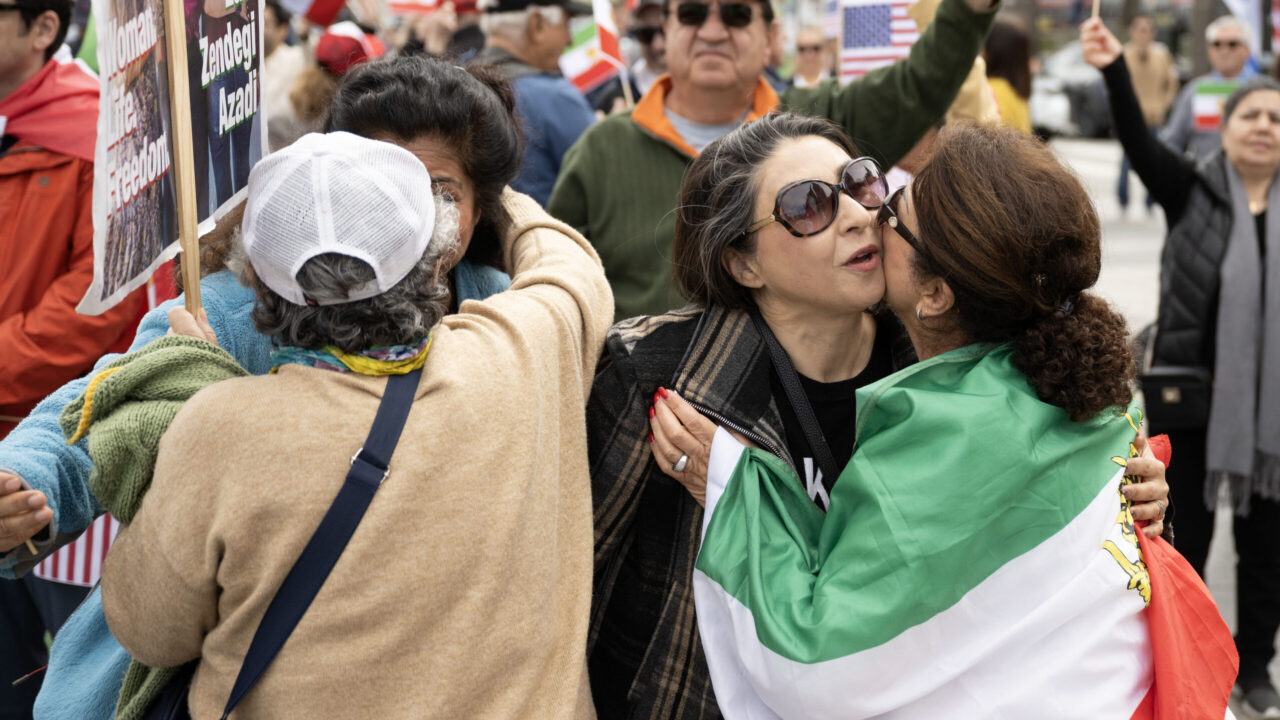
On Sunday, hundreds of anti-regime demonstrators poured into downtown San Francisco, filling the plaza outside the Ferry Building. Iranian music blared from speakers, as did “YMCA” by the Village People, one of President Donald Trump’s rally songs. Demonstrators waved dozens of flags including the U.S., Israeli and pre-revolution Iranian Lion and Sun flags. People hugged each other as drivers on either side of the plaza honked horns in support.

Other protesters also took to the streets, denouncing U.S. and Israeli strikes and condemning the war. “I’m here to call for no war in Iran, no foreign intervention in the country,” said Yasmine Mortazavi, an Iranian American organizer for the Party for Socialism and Liberation, at a protest that drew hundreds to the Federal Building in San Francisco, according to Mission Local.
The Jewish community is divided on the use of force by the Trump administration, the Jewish Community Relations Council Bay Area said in a statement, noting that Jewish institutions across the region could face “heightened security threats” as a result of the war.
“We stand with the Iranian people yearning for freedom. … We mourn the casualties and pray for the safety of Israeli, Iranian, and Middle Eastern civilians caught in the crossfire, as well as U.S. and Israeli service members,” read the statement, issued on Monday. “The Iranian regime, led by Ayatollah Khamenei from 1989 until his recent assassination, has been a leading sponsor of global terrorism and responsible for the deaths of tens of thousands of people.”
Natalie Todd, a clinical psychologist in Concord, is a second-generation Persian Jew who over the last two days has had “emotional” conversations with her parents, who fled Iran around the time of the Islamic Revolution. “I think it’s sort of surreal for them,” she said.
Todd yearns to someday visit her parents’ native country safely. “I speak Farsi and make Persian food, and my parents are very connected to the Persian community in Los Angeles,” she said. “To be able to go to the source of that would be incredible.”
Todd said she has been referencing a line from the Passover seder in conversations with friends about the prospect of a free Iran, and the potential to celebrate Passover in the country of her heritage. “Next year in Tehran,” she said.