
Before Oct. 7, 2023, Rina Naor was an Israeli Jewish civilian working in the tech industry and raising her family in Herzliya. She never considered herself an activist.
But the Hamas attack and the days that followed in Israel taught her a valuable lesson: When structural and governmental systems collapse, as they did in those dark days, civilians can step forward to fill the gap.
“Civilian society literally saved the day,” she said, describing how volunteers cooked and delivered meals to displaced people in the south who needed food, and ensured people could get their prescriptions — just two examples of many.
“After that, I understood that when you feel like things are out of control, my way to feel like I am in control is to do,” she said.
Naor hasn’t stopped “doing” since. She left her tech job to become a full-time volunteer. Her role now is chief partnership officer with the Gaza Children Village, a project started by Dr. David Hasan, a Palestinian American surgeon at Duke University who was in the Bay Area in November for the Z3 Conference.
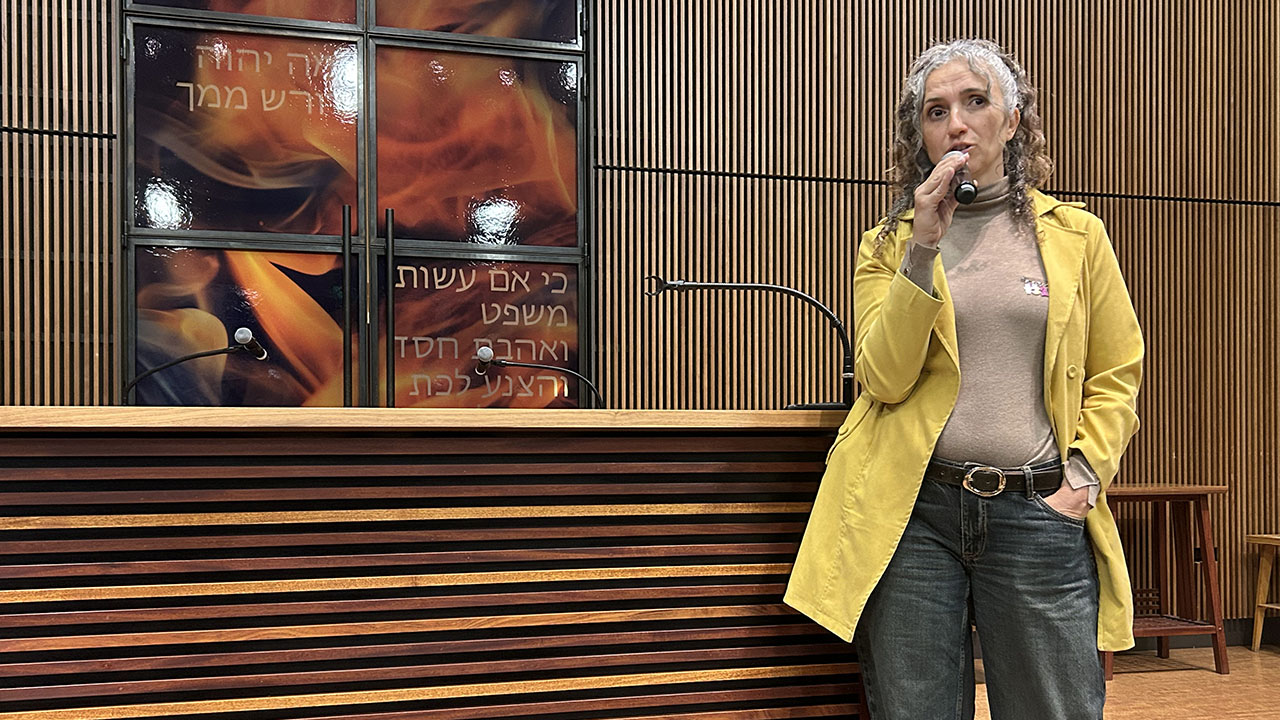
She discussed their work during recent Bay Area fundraising appearances, including at Conservative Congregation Netivot Shalom in Berkeley and Reform Temple Sinai in Oakland. At Sinai, she addressed members of the “Coexist” committee, formed during the Israel-Hamas war by congregants who believe that “it’s necessary in Jewish ethics and for long-term peace to care about the lives of Palestinians as well as Israelis,” said Ilana DeBare, a Coexist committee member. “We reject the binary that you have to be for one or the other. It’s not a contest; no one will win until everyone is taken care of.”
Naor said her shift from volunteering in Israel to quitting her job to help Gazans was sparked by one particular article she read. Months into the conflict, she read a May 2024 piece about Hasan in the left-leaning Israeli newspaper Haaretz. The story described the suffering he had seen in Gaza where he’d volunteered as a neurosurgeon, and how he had paid locals to look for Israeli hostages after hearing some were hidden in hospitals. Seeing his concern for people on both sides inspired Naor to contact him, and they soon began working together.
Their first endeavor was Lumiflies, which supports peace-building projects between Israelis and Palestinians. But those longer-term efforts to foster trust and coexistence take time. Meanwhile, the humanitarian crisis in Gaza needed urgent intervention, she said.
“None of us know what the solution will be,” she said about resolving the broader conflict. “It’s not our domain. So we agree not to agree. And we start taking action and do.”
Action is what led her to the Gaza Children Village, the network of schools and orphanages founded by Hasan. Naor oversees the partners who provide the children with physical and psychological care, and helped launch a women’s center offering safe spaces, education and economic opportunities for vulnerable women, many widowed, single mothers or adoptive mothers of orphaned children.
It’s a large portfolio, especially considering she is neither a psychologist nor social worker and has never been to Gaza. She stressed in her talk in Oakland that GCV isn’t reinventing the wheel. The organization partners with established, trusted nongovernmental organizations on the ground in Gaza to open new schools, orphanages and women’s centers, which are mostly funded by Jewish donors.
As the New York Times recently reported, 9,000 students are attending school at five campuses in southern Gaza. They receive psychological and medical care plus two hot meals daily, courtesy of World Central Kitchen.
Plans are already underway to build additional schools for thousands more children. The organization also surveyed a small group of Gazan women to identify their most pressing needs.
“The first immediate need is that women want a safe and clean place to take a shower,” Naor said. “They also want a place to either be alone and pray, or read a book, or meet with other women.”
With their first center, “we’ve reached 40 women so far, and we are very ambitious,” Naor said. “We want to reach 1,000 per center. Within a year, we’d like to reach 5,000 women.”
Naor was asked by an audience member how Israelis were responding to her efforts, given their own deep trauma from the war. She acknowledged the challenge, but repeated her motto: “Arguing won’t solve anything. Just do.”
Her message seemed to resonate with the Temple Sinai attendees, many of whom asked how they could help and where they could donate.
“I have always felt like I’m pro-human rights for everyone,” said Deena Levine-Lipsett, who attended the Feb. 25 event. “Pro-human rights means that you see beyond the political and believe in justice for both sides and meeting the humanitarian needs of everybody.” She said that’s why she found Naor so inspiring.
Fellow attendee Michael Goldstein agreed. He shared that he has friends who don’t see the conflict the way he does.
“I think that was a big takeaway,” he said. “To focus on what we can actually do, rather than just argue.”