


A multi-day harassment campaign this week targeted Jewish organizations and student leaders across Stanford University. Originating from an encrypted Proton email address with the moniker “Exposing Stanford Jews,” the messages contained threats of violence, baseless accusations of misconduct levied against Jewish student leaders, calls for student organizations to rid themselves of Jewish members, and threats of rape against Jewish women on campus. As Jewish students at Stanford, we are troubled.
The emails — conspiratorial in tone, targeting an ethnic minority, and invoking genocidal imagery — bear the hallmarks of dangerous fascistic rhetoric. They are a reminder that Jews on college campuses are under attack by the fringes of both the left and the right.
For much of the past two years, antisemitism on American campuses has been associated with the far left. Hostility toward Jews has often been expressed through the language of anti-Zionism and Palestinian liberation. What makes these emails distinctive is their origin on the opposite end of the political spectrum. Right-wing antisemitism, of course, is nothing new, but it has recently resurfaced with renewed visibility in parts of the populist right. As the political “horseshoe theory” foretells, the far right and the far left are now converging in their embrace of antisemitism, even in the uppermost echelons of American society and academia.
The email attacks began on Sunday morning. Six staff members on the Stanford Review, a conservative-leaning student publication, received an email titled “Stanford Moderates & Conservatives: STOP JEWISH INFILTRATION.” The message contained a single link to an article from the Occidental Observer, a white nationalist publication, equating Jews with vampires and alleging they share with the left a hatred of “white men, Christianity, and Western civilization.” Notably, the message was sent only to non-Jewish Review staffers, suggesting an attempt not only to stigmatize Jews but also to recruit their peers. (One of us, Dylan, is managing editor at the Review and did not receive one of the emails.)
At the same time, Jewish students in leadership roles across student life received individualized threatening emails sent from the same address. Multiple students told us the messages were part of a broader harassment campaign. We were able to confirm the details of the emails with those students, who asked to remain anonymous out of fear for their safety, saying the emails contained highly personal details. In at least one case, the sender tied a student leader’s Jewish identity to a baseless accusation of financial misconduct.
Stanford Chabad also received an email threatening a “Holocaust 2.0.” According to Chabad Rabbi Dov Greenberg, a second email sent to Chabad Wednesday afternoon referenced coverage of the incident by the Stanford Daily, the student-run newspaper on campus. The message repeated calls for violence against Jews on campus while claiming the sender had a First Amendment right to issue these threats.
According to Review staff members who received the email and wished to remain anonymous due to fear of reprisal, Jew hatred is surging in far right political discourse on campus. In conversations with conservative students, multiple Review staffers told us they noticed a “dangerous convergence” towards identity politics and bigotry.
The messages circulated as international news outlets reported the death of Iran’s Supreme Leader Ayatollah Ali Khamenei due to American and Israeli strikes. Geopolitical events like these often revive conspiratorial claims that Jews secretly dictate the U.S. Middle East policy. Even thousands of miles removed from the conflict, Jews become convenient stand-ins for forces they do not control.
RELATED: FBI investigating threatening emails sent to Stanford Jewish leaders
Antisemitism cloaked in isolationist rhetoric is not unique to this moment in American history. In the 1930s, Father Charles Coughlin built a mass audience — estimated at 30 million people, or a quarter of the U.S. population at the time — by promoting conspiratorial claims that blamed Jews for national decline.
Today, demagogues capitalize on a predictable truth: antisemitism is portable. It fits easily into any movement where simplified narratives and grievance politics dominate discourse. On the populist right, Jews are cast as the hidden architects of globalization, war and cultural decline. On parts of the activist left, Jews are recast as embodiments of colonialism or uniquely illegitimate nationalism.
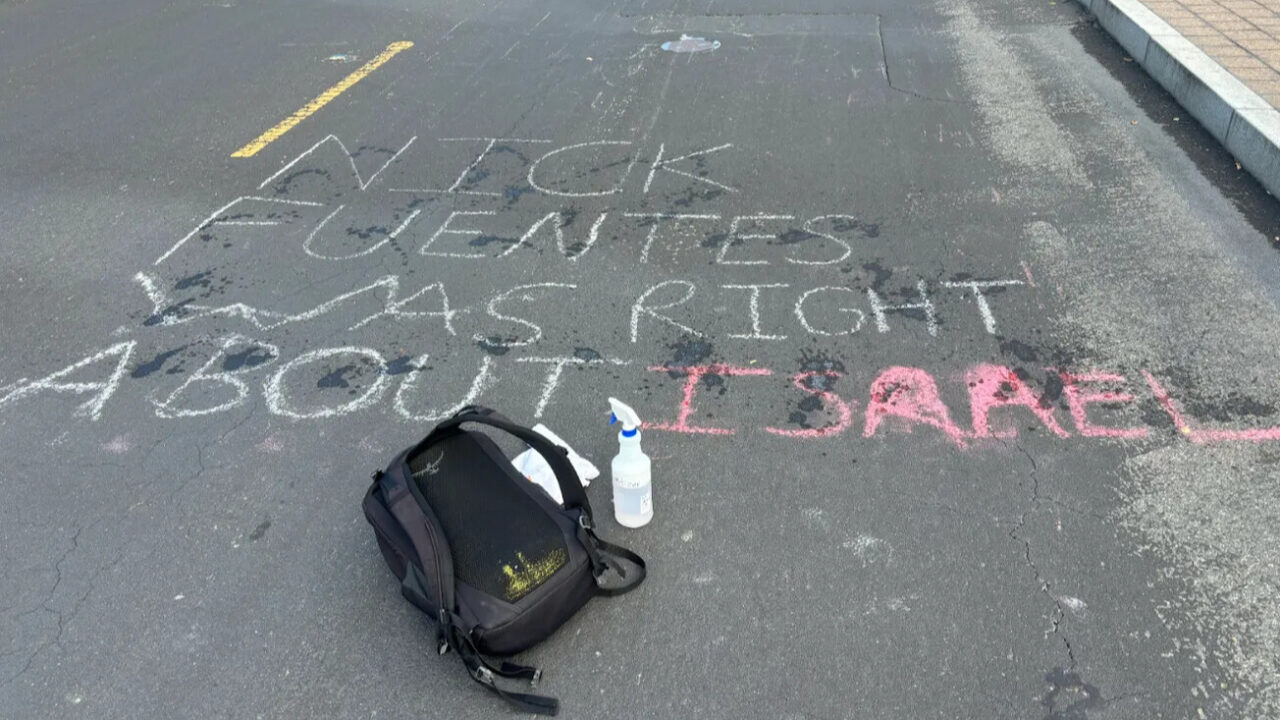
Antisemitism at Stanford has taken multiple forms in recent years, from graffiti supporting far right tastemaker Nick Fuentes to a poster portraying slain Hamas leader Yahya Sinwar as a symbol of liberation and martyrdom.
Stanford’s response of stern condemnation and federal investigation may address the immediate threat. The broader challenge is cultural. Across the political spectrum, fringe movements increasingly package extremist ideas alongside legitimate grievances making them harder to dismiss. In an era of soundbite politics, grievances travel faster than productive dialogue. In this environment, antisemitism is again finding fertile ground.
Institutions cannot counter decentralized radicalism through ritual condemnations nor reasoned debate alone, and Jews cannot afford merely to point it out. The solution does not lie in McCarthyist repression, which risks driving radical movements underground and eroding the very freedoms institutions seek to defend. Nor can leaders simply ignore the legitimate material concerns of economically disadvantaged voters.
The instinct in moments like these is often to become defensive about Jewish life. But the stronger response is to become generative. As stated by New York Times commentator Bret Stephens, the solution lies in bolstering pillars of Jewish life to forge a positive and robust Jewish presence in the United States. Importantly, this work must not wait for validation from others and simultaneously refrain from becoming isolationist. Jews will not win on an island; coalition building and allies are ever more important.
For institutions, the task is different: drawing clear red lines and taking decisive action against perpetrators when they are crossed. Father Coughlin was eventually ordered to stand down by his bishop. The Catholic Church eventually drew those lines. In a recent address on the resurgence of antisemitism among self-described Christian conservatives, Catholic public intellectual Robert George argued that Christians must resist what he calls “antisemitic temptations” within their own ranks.
He also modeled what enforcing moral red lines looks like in practice. George himself recently resigned from the board of the Heritage Foundation after President Kevin Roberts defended Tucker Carlson’s interview of far right political commentator Nick Fuentes.
If the forces fueling antisemitism are left unchecked, the institutions responsible for safeguarding American democracy risk becoming the very platforms from which democracy is undermined. On the 250th anniversary of the Declaration of Independence, America’s exceptionalism rests in the enduring defense of its founding principles.