

When members of Peninsula Temple Beth El in San Mateo wanted to take a stand against the federal government’s crackdown on undocumented immigrants, they contacted local nonprofits already working on the issue to ask what they needed.
The answer: money, attorneys and Spanish speakers.
“We didn’t have all that,” said PTBE member Nancy Bott. “But we realized we have a school, Fiesta Gardens International, right near us, mostly Spanish-speaking. Could we support them?”
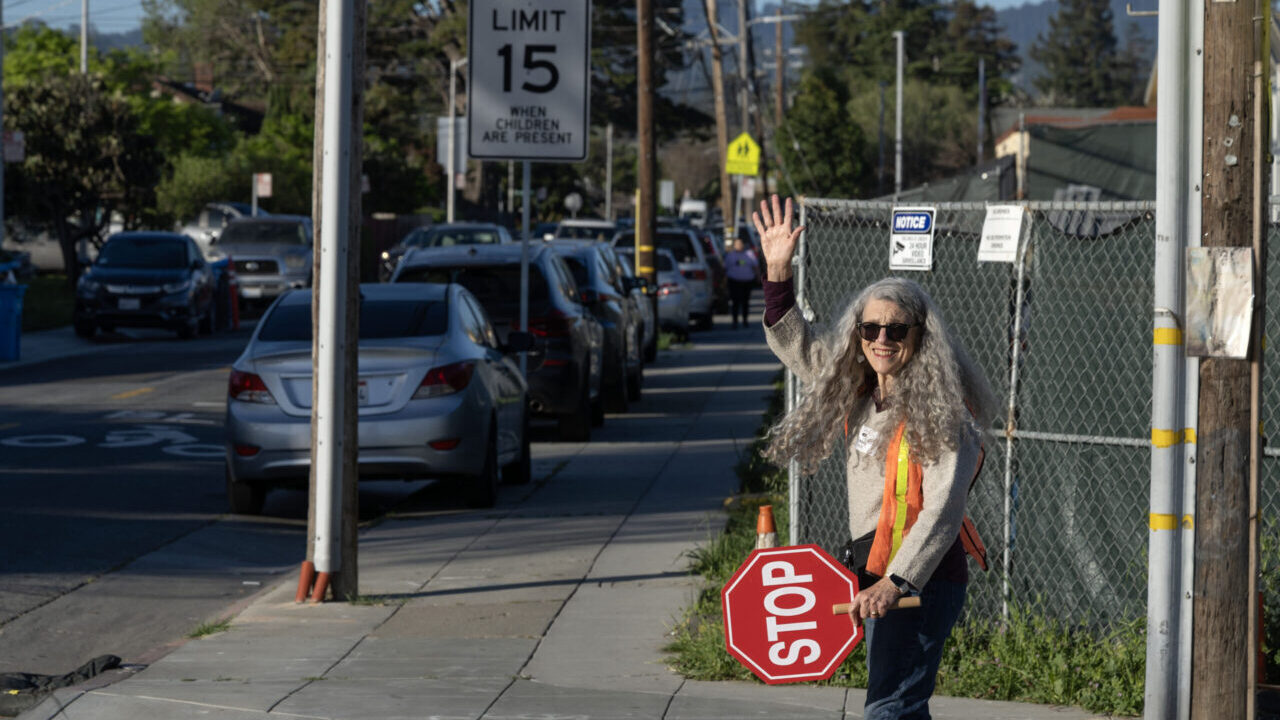
The week before classes began in August, Bott visited the school and spoke with the vice principal, who told her about four dangerous intersections that children regularly cross. There was money to pay for crossing guards at only one of them, the vice principal said. Could the synagogue provide others?
Well, yes, it could. Bott organized a team of volunteers who each serve as crossing guards one morning a week, from 7:45 a.m. until classes start at 8:30.
The volunteers serve a second function as well: They act as lookouts in case U.S. Immigration and Customs Enforcement agents ever show up. “Our job is to stay calm and notify the school, so they can go into lockdown,” Bott said. So far, that hasn’t happened, but the volunteers are ready.
Bott was describing her synagogue’s program during a March 11 webinar organized by the Jewish Community Relations Council Bay Area. “Jewish Values in Action: Supporting Immigrants Across the Bay Area” featured speakers from four Bay Area Reform synagogues who presented the actions their congregations are taking. They include:
- Raising money to pay legal fees for undocumented immigrants.
- Accompanying people to immigration court to help them navigate the legal system.
- Creating a new food bank open in the evenings.
- “Adopting” an immigrant family.
And, of course, the volunteers continue to serve as crossing guards outside a school with 83% Latino enrollment.

“The school and parents have been demonstrably thankful for our presence,” Bott said. On March 23, school administrators and the PTA formally thanked the PTBE volunteers with an appreciation breakfast.
“We may not be solving a huge problem, but we are interacting with a community that is scared and letting them know they are not alone,” Bott said.
“Immigration is at the forefront of the national and local conversation,” said Jessica Blitchok, JCRC’s director of community partnerships, as she welcomed the online audience on March 11.
‘Regardless of legal status’
Noting that increased federal enforcement of immigration policies has increased fear among a vulnerable population, Blitchok outlined the Jewish values around helping the stranger embodied in the JCRC’s 2025 policy statement on the topic. Overall, the lengthy policy “calls for an immigration system that ensures the dignity, safety, and rights of all individuals — regardless of legal status.”
Blitchok said the webinar would highlight concrete actions being taken by local synagogues to live out these values.
“Many people who want to help ask a simple question: Where do I begin?” she said. “By sharing these initiatives … we hope to illuminate the breadth of work underway, and to inspire others to find their own pathways for involvement.”

Rabbi Aaron Torop described the food bank organized by his congregation, Temple Isaiah in Lafayette. It exists alongside another food bank in a heavily immigrant neighborhood but is the only one open in the evenings. Some synagogue volunteers stock the goods and hand out food, while others buy and deliver groceries to families unable or too frightened to come to the food bank in person.
Another Temple Isaiah project works with a local church to send volunteers to act as a physical presence at a Home Depot in Concord where many immigrants gather to look for work, putting them at risk of ICE raids. Although the nation’s attention focused on the ICE surge in Minneapolis earlier this year that led to the shooting deaths of two Americans, increased raids have continued across the country, including in California.
“We are the eyes and ears on the outside,” Torop said, explaining that direct services like food banks need to be complemented by the “slow work to create safe conditions in a neighborhood.”
How to start
Synagogues that want to get involved should go through several steps before taking action, Torop and the other speakers said.
First, find out who wants to volunteer, assess their skills and mobility levels (not everybody can stand on a street corner, Bott noted) and determine whether they want to give money or provide direct service. On top of that, Torop pointed out, find what level of risk volunteers are willing to face.
“The vast majority of opportunities have been 100 percent safe, but the risk is still out there,” he said, particularly for programs that involve volunteers warning immigrants of an ICE raid, which can implicate the volunteers in “obstructive” activity.
“Still,” Torop added, “whatever risk I face, it’s riskier for those I’m helping.”
Torop also noted the importance of working with organizations already helping local immigrants. “They’ve done this work for decades. They have the experience,” he said. “There’s no need to reinvent the wheel.”

Stewart Florsheim spoke for Temple Sinai in Oakland, where he is co-founder of the Immigrant Advocates Work Group, established in September.
He said that after President Donald Trump’s first inauguration in 2017, Sinai “affirmed our solidarity with undocumented immigrants.” Sinai explored becoming a sanctuary synagogue, he said, but realized it did not have the physical facilities, such as showers, to do so.
Motivated by ICE raids
Last year, motivated by increased violence during ICE raids, Sinai’s Immigrant Advocates Work Group was created. It runs educational events, partners with local nonprofits such as Friends of La Pena Immigrant Rights and sends out a monthly digest to 80 interested synagogue members listing volunteer opportunities.
Eight families at Sinai recently “adopted” an immigrant family, he said, working with the Interfaith Movement for Human Integrity’s Nueva Esperanza Accompaniment Team to “walk alongside” the family for six months to help find attorneys, organize needed documents, enroll in English classes and locate food banks and other resources, for example.
Florsheim also acts as a volunteer court navigator, showing up in immigration court once a month to help people seeking to remain in the U.S. The volunteer work is part of an initiative organized by the Interfaith Movement for Human Integrity and the Contra Costa Immigrant Rights Alliance.
“If they come with kids, we give them books so they have something to do,” he said. “When they hear ‘next steps,’ we make sure they understand what that means. We tell them about low-cost resources available to them.” Afterward, the volunteer connects the client with an on-call attorney to provide vetted legal help. “Many of them get scammed,” he said.
Fewer immigrants are showing up in court to support their peers, Florsheim said. “The courtroom used to be full to capacity, but now it’s pretty empty. People are scared to go.”

Suzan Berns spoke for Congregation Rodef Sholom in San Rafael, which organized its Immigrant Rights Team in 2017 to help undocumented immigrants and then reinforced that effort after the 2024 election.
Immigrants, many of them Latinos, make up about 20 percent of Marin County, according to U.S. Census data. The synagogue has hosted “know your rights” training sessions, partnered with local nonprofits in the field and participated in a trip to the U.S.-Mexican border to better understand what goes on there, she said.
Fundraising to aid immigrants
The team also set up an Immigrant Rights Legal Fund to raise money for legal fees, which “we recognized was the biggest need,” she said. The fund helps Marin County immigrants, including for those seeking permanent status, citizenship or release from detention. Giving money is a way that people who can’t offer direct service can still be involved, Berns said.
Since January 2025, the fund has raised $11,746 and used $4,350 of it to pay for attorneys. The fund helped one 19-year-old undocumented immigrant who arrived in Marin County as an unaccompanied minor and couldn’t afford an attorney. It also helped a woman whose son was detained when he applied for asylum and got scammed by the first lawyer they hired.
Most gratifying of all, Berns said, was when the team supported a parent from a nearby school who was detained. “At his trial we filled the courtroom,” she described. “He was released, and the word we got was that it was because of us.” The man will speak at the Rodef Sholom’s Immigrant Rights Shabbat in May.
In closing the webinar, JCRC’s Blitchok reiterated that “meaningful action can take many forms,” be it advocacy, direct action or raising money or awareness.
“Sometimes it can seem overwhelming, but we all do what we can,” said Florsheim.
“Everybody can do something,” agreed Torop. “Find something you find inspiring and get to it, so we can all be part of creating safer, more inclusive communities.”