

While many pockets in San Francisco retain their Victorian charms, one area decidedly does not: the seven-block section of Geary Boulevard between Laguna and Divisadero streets. Wider than a highway and almost as tricky to cross, what is now the Geary Expressway once served as a main corridor for bustling African American, Japanese American and Jewish communities.
Then urban renewal took a whack at it.
Starting in the late 1950s, the San Francisco Redevelopment Agency undertook a massive and controversial transformation of the Western Addition and Fillmore neighborhoods. Over a 25-year span, cable cars were replaced by SFMTA buses, massive retaining walls were built to line the thoroughfare, and Fillmore Street was connected by a bridge suspended over the underpass.
The agency’s then-director Justin Herman oversaw the leveling of 28 city blocks. Nearly 900 stores were put out of business, 2,500 “blighted” Victorian buildings were flattened, and thousands of residents, mostly African American, were forced out of their homes, and many out of the city.
The San Francisco County Transportation Authority (SFCTA) is hoping to make past amends and reunify neighborhoods, starting with the Geary-Fillmore Underpass Study and Community Council. The stated aim of the council, paid for by a $2 million grant from the U.S. Department of Transportation, is reconnecting the Japantown, Fillmore and Western Addition neighborhoods, “communities that were divided and harmed by the construction of the Geary Boulevard/Fillmore Street underpass in the 1960s.”
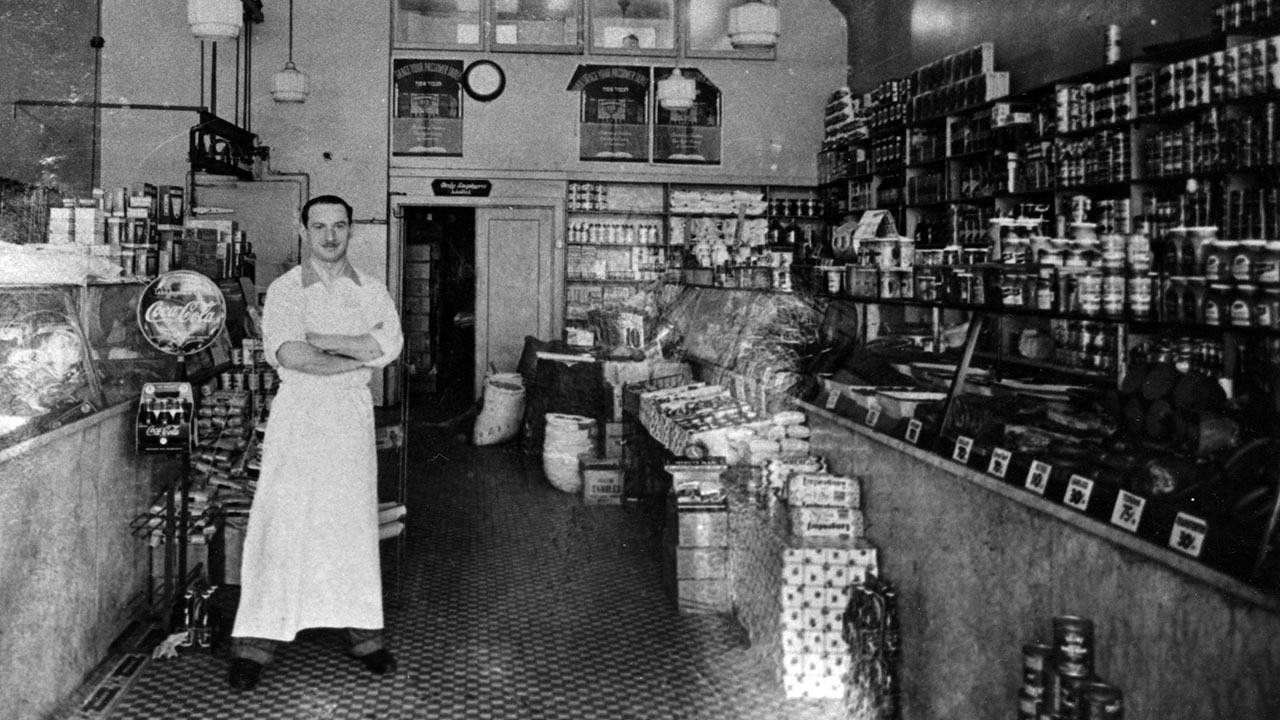
For San Franciso Jews, the Fillmore–Western Addition was built up after the 1906 earthquake and fire, becoming home to such institutions as Langendorf Bakery on McAllister, Diller’s Kosher Restaurant on Golden Gate Avenue, Orthodox Congregation Keneseth Israel on Webster Street and Jefferson Market, the kosher “fresh-chicken headquarters” for San Francisco’s Jewish community on Buchanan Street. “The place bulged with screeching chickens,” according to FoundSF.org. A 2009 J. story about the historic Jewish neighborhood reported that, within two square blocks “there were two synagogues, three kosher restaurants, four Jewish bakeries, five kosher meat markets, three Jewish delicatessens and one Jewish liquor merchant.”

(Aaron Levy-Wolins/J. Staff)
Congregation Sherith Israel is on California and Webster streets, close to the impacted area. Two of its longtime members sit on the council. Nancy Sheftel-Gomes, the synagogue’s former education director, is happy to be part of the solution.
Sheftel-Gomes already knew several of the council members from the African American and Japanese American communities, which were disproportionately harmed by the urban renewal. The group had been meeting together informally for some time and developing a vision for the future of the neighborhood.
“The creation of a shared vision is very powerful but no guarantee that the recommendations will actually come to fruition, and that is on everyone’s mind. The biggest impact will be the connecting of the communities,” she said.

““There is almost nothing left of the old Jewish community of the Fillmore,” Sheftel-Gomes said. “For the Jewish community, in a city where there is no Jewish neighborhood, there is an opportunity to connect the dots between the key institutions: Sinai Memorial, JCHS, Jewish Community Library, JFCS, the proposed expansion of the Holocaust Center and Sherith Israel, to make our history more visible.”
The council is tasked with envisioning a new Geary corridor plan and coming up with recommendations for up to six key sites “to expand housing, open space or other community needs.” One option: dismantling the Geary underpass altogether.
Another Jewish member of the council, Howard Wexler, 85, grew up in the South Bay but remembers driving into the city with his mother to shop at the kosher butchers. He later served on the city’s Redevelopment Commission under the late Mayor George Moscone. Even then, he worked to mitigate the neighborhood impact of the multilane Geary Expressway.
Now he hopes the council and the SFCTA will envision a new future for the area. But he has his worries. “The Biden administration granted $2 million for the study,” he said. “But in the current political climate, we may see only cutbacks.”
Nevertheless, the council held its first meeting on Feb. 9. “We are undertaking this study with community partners to repair past harms and to ensure that planning decisions are informed by the people who know these neighborhoods best. I am very heartened by this effort,” said David Long, senior transportation planner for the SFCTA.
“This study is a unique opportunity to thoughtfully plan for the future of a vital corridor connecting the Black, Jewish and Japanese communities,” Long said. “The expansion of Geary Boulevard during the era of urban renewal displaced residents and fundamentally reshaped these neighborhoods, creating a physical divide that persists today.”
For Jews, much of the dispersal of the Fillmore-area Jewish community was voluntary. Upward mobility and growing Jewish communities across the Bay Area beckoned. But for the other two minority communities, it was a different story.
For Japanese Americans, who had only recently returned home after the trauma of the internment camps during World War II, their community was severely impacted by the Geary Boulevard project, cutting it off from the Western Addition.
Congregating in the Western Addition, the city’s Black population had built what was dubbed the Harlem of the West, with a thriving jazz scene among its crown jewels. Wielding the power of eminent domain, the Redevelopment Agency forced as many as 30,000 residents out, with the promise of future housing.
For most, that future never came. Today, African Americans make up only 5 percent of the city’s population. For Eric McConnell, the project is personal. He grew up in the Martin Luther King–Marcus Garvey Square Cooperative Apartments in the Western Addition. He knew many people who were forced out by redevelopment.
He hopes the council will submit achievable goals to “repair the harms” when it completes its work next year. Until then, the group will continue to meet regularly to hammer out those goals. Though he, like Wexler, is concerned about the city’s ability to afford the price tag.
“I do think the staff will make every effort to enact the wishes of the council,” he said. “However, the reality is, staff are limited in their power and influence. So we’ll have to wait and see what actually gets implemented, especially given the fiscal circumstances the city is faced with.”
Wexler has his doubts about the ability of the city government to make it happen. But he also has his hopes.
“If we can find a way to build something meaningful and productive that will reunite the communities on both sides of the former ‘Great Geary Ditch,’” he said, “and bring the Black, Japanese, Jewish and everyone else living in this area closer together with more open space, housing and retail, I believe we will be doing the work of tikkun olam — repairing the world — here in our neighborhood.”