

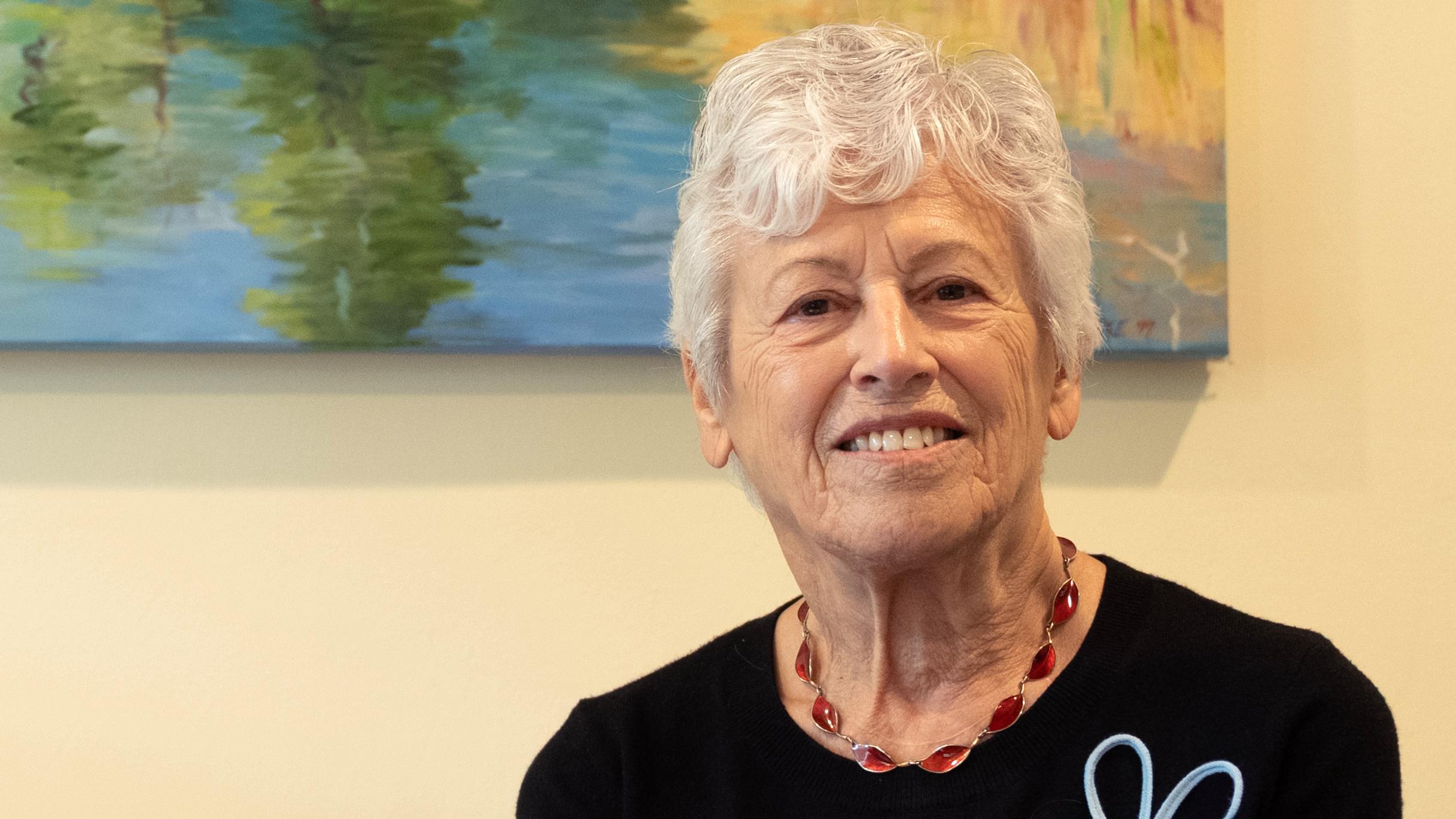
Jeannette Ringold has spent much of her life trying to piece together what happened to her and her family during the years she was a hidden child in the Holocaust.
She was born in Amsterdam on Dec. 20, 1939, just five months before Nazi forces invaded the Netherlands. She came from a long line of Dutch Jews, with her family history stretching back to the 1600s on her father’s side and the 1700s on her mother’s. But by the time Ringold was a toddler, the country her family had lived in for centuries was turned completely upside down.
As Nazi control tightened, danger for Jews in the Netherlands escalated quickly. In 1942, when Ringold was not yet 3 and her brother was only 3 months old, their parents made the impossible decision to give both children to the Dutch resistance. It would be the last time either of them saw their mother and father.
Ringold and her baby brother, Abraham Benjamin, were smuggled from their home in Amsterdam and taken east, likely by train, into hiding further out in the country.
Now 86, she remembers none of that journey.
“It probably was such a shock,” the Menlo Park resident said in a recent interview. “We don’t know how, and we don’t know who actually took my brother and me. There’s no record of it.”
What followed was a childhood defined by movement and secrecy.
Her brother’s Jewish-sounding name was changed to Peter and he was placed with one foster family, where he remained throughout the war. Ringold kept her name, but that was the only reminder of her family she was allowed to keep as she was passed between at least seven households.
The limited knowledge she did have of her true identity was quickly snuffed out for fear that she would accidentally reveal herself and endanger her foster family. For everyone’s safety, she was forbidden from talking about her family or mentioning anything about her Jewish background.
“I was proud of my father, that he could sing in the synagogue…and I had a little suitcase and in it was my Shabbos dress. I was very excited to see my Shabbos dress. Guess what happened to the Shabbos dress? It disappeared,” Ringold recalled. “Anything that I remembered just disappeared.”
One foster family crafted a simple cover story for her. She became a niece from Rotterdam, a city that was leveled in a devastating Luftwaffe air raid in 1940. The German bombing had destroyed nearly everything, including all government records, so it was difficult to trace residents’ identities. With her blond hair and very Dutch nickname “Netteke,” she played the part well.
Each move carried risk, but staying in one spot for too long was even riskier. Food was scarce, ration coupons were limited, and harboring a Jewish child could be punishable by death or deportation to a concentration camp. Sometimes she had to be relocated because neighbors grew suspicious. Once while she was playing outside in a sandbox, passersby pointed to her and called out: “Would you like to see a Jewish girl?” Once again, she had to disappear.
“You just have to be adaptable,” she said. “You have to take what people give you.”
Her earliest memories during her time in hiding are fragments. She recalls when she first entered the house filled with crosses belonging to her final foster family, a Roman Catholic couple she called Uncle Theo and Aunt Marie, and a Nativity scene she played with because toys were scarce.
“There was a lot of bombing going on and I remember being carried downstairs from my bed to the cellar, which was used as a bomb shelter, and there was a little niche,” she said. “I remember them putting me in this niche because that was safe.”
She remembers her time with Uncle Theo and Aunt Marie as mostly positive, despite the ever-present shadow of danger looming over them as the war raged on.
One outing, which Ringold thought was just a day shopping with Aunt Marie, turned out to be a close encounter with a German soldier. Unbeknownst to Ringold, Aunt Marie had realized they were being followed as they went from store to store.
“She didn’t know what to do — she told me this later — so she decided we would go to the railway station, and she bought us a cup of hot cocoa,” said Ringold. “We sat and drank it and she said she knew that if the soldier was still there, that was it. But by the time we finished, the soldier had disappeared, which was good, because she was ready to buy us a ticket to leave town.”
Near the war’s end came the brutal “Hunger Winter.” The danger intensified as people grew desperate for food and respite from the cold.
“War is horrible, and war against people who are just living, not even soldiers, is unforgivable,” she said, describing how perilous it was even to gather wood to build a fire because the Nazis were rounding up anyone they could.
Uncle Theo had been heavily involved in the resistance, so the family eventually fled town on foot to a farm seven miles away. She, stubborn and 5 years old, refused to ride in a baby carriage and chose to walk through the snow instead.
“It’s hard to remember how I did it, but I just accepted it as normal,” she reflected. “Things were not normal, but who knows what normal is in a war like that.”
Shortly after their arrival at the farm, everything changed once again. “We were having lunch and there was a lot of commotion at the village blacksmith,” she said. “It was the Canadians on tanks liberating the town.”
In the months after the war, she was located by an uncle, one of few surviving relatives, and brought back to Amsterdam. She was 5½ years old. She barely understood who he was and didn’t even remember she had a brother.
The reunited siblings were raised by their uncle and aunt in Amsterdam for nearly a decade.
In 1954, when she was 14, her life shifted again when her uncle and aunt decided they would all move to the United States. However, because adoption wasn’t legalized in the Netherlands until 1956, it was not possible to bring the children along as dependents. After a family friend in the U.S. appealed their case to Congress, a bill signed by President Dwight D. Eisenhower specifically for Ringold and her brother allowed the family to immigrate together. They settled in San Mateo, where she would build a life far removed from wartime Europe.
Ringold became a French scholar, later earning a Ph.D. in Romance languages and literatures. She met her husband, Alan, at a Brandeis Camp Institute summer session after her freshman year in college. After three years of correspondence, they married and later settled in Menlo Park, where they raised two daughters. She taught for several years, including at UC Berkeley and Stanford, but found her calling as a literary translator. Through her translation work, which has included books on the Holocaust and hidden children, she began piecing together the story she had lived.
Learning the truth came slowly, over decades and through accounts by relatives, neighbors, her former foster families and lots of research conducted by Ringold and her brother.
“It took a long time because I didn’t really get a lot of help. People were not willing to talk about the war,” she said. “It was not a pleasant subject, to put it mildly.”
After ensuring their children’s safety, her parents had attempted to escape to Switzerland, but they were turned back at the border by a Swiss immigration policy that barred adults without children. They were later arrested, sent to a transit camp near Paris and deported to Auschwitz, where they were likely killed upon arrival.
Across her extended family, the losses were staggering: 283 relatives murdered.
“I have the passports of my grandparents, and it shows that they tried everything,” Ringold said. “They had a visa with a number that was so high for the U.S., they would have had to wait three years.”
Despite collecting visas for a number of other countries, including Chile, El Salvador, Mexico, Portugal, Thailand and Uruguay, Ringold’s maternal grandparents were unable to make it out of the Netherlands in time. They died in Bergen-Belsen.

Of the 6 million Jews killed in the Holocaust, approximately 1.5 million were children. However, tens of thousands like Ringold survived the war’s horrors by being sent away by their parents to be hidden with Christian families, with their true identities concealed.
Ringold says that for decades, the experiences of hidden children like her were overlooked, so she didn’t have much interest in publicly sharing her experience. That changed in 1991, when she attended the first international gathering of hidden child survivors in New York. Organizers expected a few hundred attendees, but more than 1,600 came from 28 different countries.
“People realized then that children were also victims,” Ringold said. “Before that people didn’t really take us very seriously.”
Now, Ringold shares her story through the JFCS Holocaust Center’s speakers bureau and spends time connecting with other survivors. She currently runs a group for South Bay hidden children and has spoken at numerous schools, including at Branham High School after an incident in December where eight students posed in the shape of a swastika and posted a photo to social media with a quote from Hitler. Last year, she was honored by the California State Senate as a survivor.
“Jeannette’s resilience and humanity deeply move the students and communities she reaches through our speakers bureau each year,” said the center’s director, Morgan Blum Schneider. “It is a profound honor for the JFCS Holocaust Center to support and elevate Jeannette’s work and the legacy she carries forward.”