
In the same January week that a New York Magazine article suggested the pumpernickel bagel might be an endangered species, Oakland’s Poppy Bagels announced it was adding the dark rye–flavored, old-school bagel to its lineup.
“We had been working on our recipe long before the article came out, so it was funny to read about,” said Poppy owner Reesa Kashuk. “The timing was pure coincidence.”
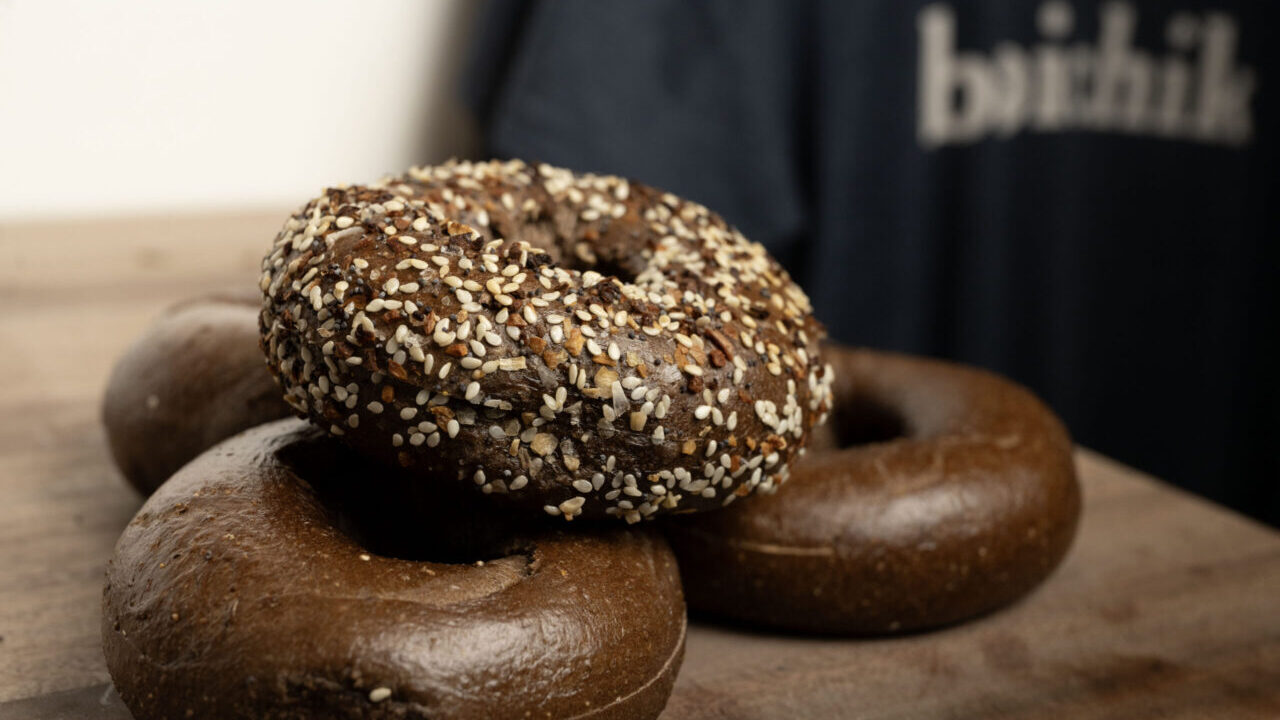
The pumpernickel bagel, food historian Mitchell Davis said in the New York article, is a marriage of the bagel, originally from Poland, and German-style dark pumpernickel bread. It’s denser and has a much more distinct flavor profile than its blander and blonder siblings. While traditional specimens achieved their trademark dark color from a longer baking time, newer versions might add cocoa, molasses or coffee to the dough, which is made with rye flour and sourdough starter. And as is the case with its rye bread cousin, caraway seeds are mandatory.
Pumpernickel bagels are nowhere near as popular as more traditional flavors, but they do have their fans, and they are a vociferous bunch. While that doesn’t necessarily translate into sales, they make up for their numbers by letting their enthusiasm for the niche flavor be known to bagel shop owners.
When Kashuk began Poppy as a pop-up in 2019, pumpernickel was part of the lineup; it had to be, it was one of her favorites. But when she opened the shop in Oakland’s Temescal district just over three years ago, she needed to streamline her process. It seemed easiest to drop pumpernickel, as it was the only one of the bagel varieties that used a different dough.
When she did introduce a flavor on the menu that required its own dough, it was cinnamon-raisin, which she thought would have general appeal.
But pumpernickel wouldn’t leave her alone.
While the magazine piece offered one possible reason for its drop in popularity — that its dark color doesn’t photograph well — Kashuk begged to differ.
“The color is so striking,” she said. “I’m a visual eater, and I think that rich, dark brown is beautiful. I love the balance of the rye and caraway, and it has a completely different flavor profile. It also goes really well with smoked fish. Whitefish salad on a pumpernickel bagel fills a void. It’s just a different taste experience.”
Pumpernickel sales represent less than 10 percent of her overall business, Kashuk said, but that’s still around 250 bagels a week, and now that they’ve got production figured out, it’s not difficult to keep them coming.
“As long as people keep buying them, we’ll keep making them,” she said, noting that she stopped offering bialys because they just didn’t sell.
Around the same time that Poppy introduced pumpernickel, Boichik Bagels announced it was discontinuing its pumpernickel raisin swirl bagel. But Boichik fans need not worry; that was the least popular of the four varieties of pumpernickel that Boichik offered. The other three are still on the menu: regular pumpernickel, “pumperthingle” (everything on a pumpernickel), and caraway and salt.

“Pumpernickel is a real nostalgic flavor and a real taste of New York,” said Emily Winston, Boichik’s owner. “It’s definitely not a big seller, but it does have its fans.” Like Kashuk, she isn’t bothered by the sales; it’s one of her favorites, too.
Pumpernickel bagel sales represent around 7% of bagels sold in all 12 Boichik stores in the Bay Area and Los Angeles, and around 4% of sandwiches are made on pumpernickel.
While it did pain her to say goodbye to the pumpernickel raisin swirl, Winston promised the other pumpernickel varieties wouldn’t meet the same fate.
“It has such a rich depth of flavor, and is just delicious,” she said. “I have no intention of ever ending pumpernickel.”
While Kashuk and Winston are firmly in the pro-pumpernickel camp, many of the Bay Area’s bagel businesses that opened in the last few years decided right out of the gate that it’s not worth it to sell a flavor that few people want. Loveski doesn’t carry them, nor does Schlok’s.
“We have never done pumpernickel bagels,” Zack Schwab, co-owner of Schlok’s, said by email. “Nothing against them. I can’t say we never will, but it’s pretty unlikely. Pumpernickel has its loud fans, but it’s a pretty niche flavor, and the minimum batch size of our mixers would be too many pumpernickel bagels to sell per day.”
This seems to be the prevailing attitude of many area bagel shops, but the good news is that die-hard pumpernickel fans still have plenty of places to get their pumpernickel fix.
Pumpernickel bagels can be found in the city at Wise Sons and the Laundromat. In the East Bay, along with Poppy and Boichik’s, try Bagel Street Cafe in Oakland, Berkeley Bagels in Berkeley and Noah’s Bagels (many locations). In the South Bay, they are available at Boichik Bagels and Izzy’s Brooklyn Bagels in Palo Alto, and in the North Bay, at Drewish Deli in Healdsburg (though it’s just called rye there) and in Petaluma at the Bagel Mill.
Marla Arzate, manager of Izzy’s, said that while pumpernickel isn’t as popular as other offerings, the customers who buy it often order two dozen at a time, to put in the freezer.
At the Bagel Mill, they call them “marble rye” bagels, but it’s more or less the same idea.
“It’s a popular yet decisive flavor,” said Bagel Mill owner Glenda Dougherty Manning. “The people who love it, love it, and often buy a dozen at a time. We also offer a very popular marble rye ‘everything’ bagel on Saturdays.”
SMALL BITES

I first wrote about Elianna Friedman for this column in 2014. At the time, she was living in San Francisco and was the founder of Bay Leaf Kitchen, a cooking camp for children (she also taught at Berkeley’s Congregation Beth El and led sessions at the Ferry Building Farmers Market).
The news of her untimely death from an infection on April 8 at age 42 in Spain has sent shockwaves through the local food community. She and her husband, Jesse, whom she met through a Reform youth group in high school, left the Bay Area in 2018 and were living in Spain with their 5-year-old daughter, Adina.
At a 2015 conference in Colorado for Jewish food professionals, Elianna, chef Ezra Malmuth and I decided to collaborate on a dinner for Jewish food professionals. That dinner later sparked the idea for “The Illuminoshi: The Not-So-Secret Society for Bay Area Food Professionals.” Elianna was a big part of it, always willing to help and support in whatever way was needed. She was calm, steady and enthusiastic and always ready to roll up her sleeves, wash her hands and cook. She certainly left her mark on the Bay Area food scene in the decade that she lived here and will be deeply missed.