
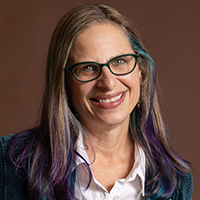
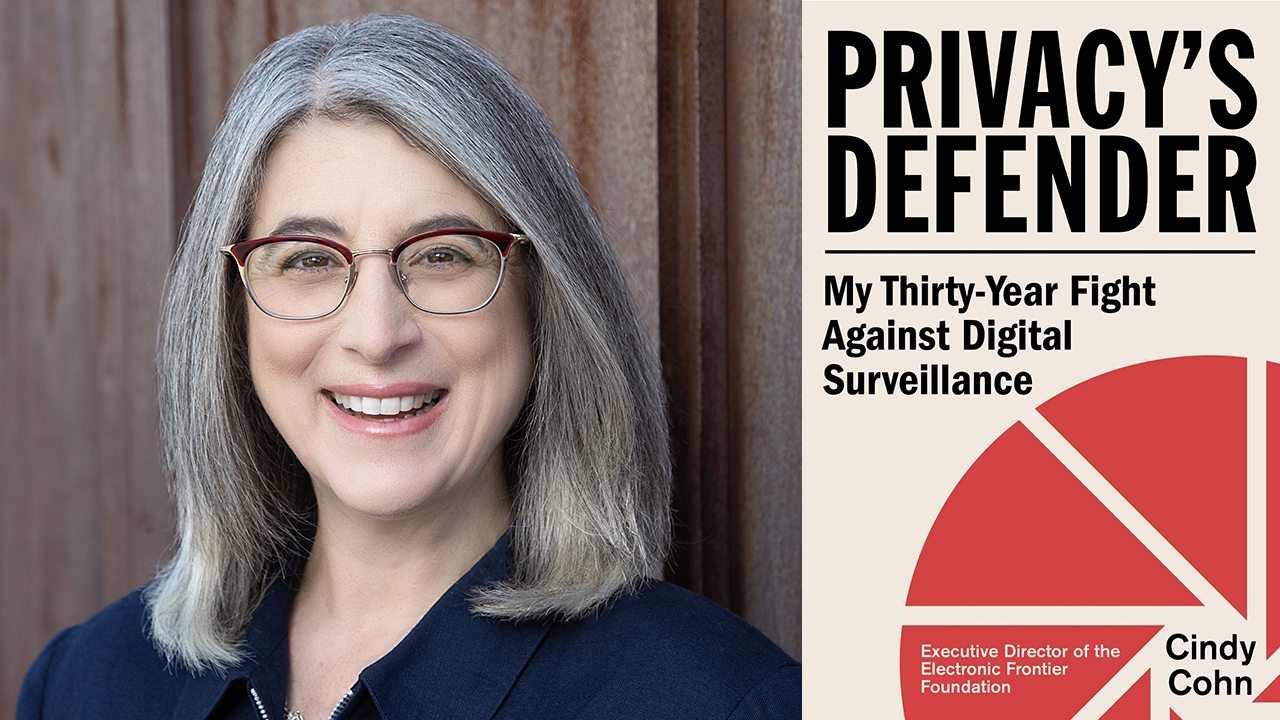
Cindy Cohn showed up on Zoom wearing a custom T-shirt — the same one she gave to Jon Stewart before her appearance this spring on “The Daily Show” — that read: “Let’s sue the government.”
Cohn, 62, is executive director of the S.F.-based Electronic Frontier Foundation, which was founded in 1990 to defend civil liberties in the digital realm, particularly focused on safe-guarding privacy and the protection of free expression. A former human rights lawyer, the San Francisco resident is considered a pioneer in privacy and surveillance law through her work with EFF.
Cohn’s been with the nonprofit for 26 years and plans to step away this summer. She’s also written a new book, “Privacy’s Defender: My Thirty-Year Fight Against Digital Surveillance,” that was published in March.
She’s leaving EFF because she wants to “get a little closer to the fight,” whether that means heading back in the courtroom or writing briefs.
“Luckily or unluckily, there is a lot of need for people who want to sue the government right now, so I am hopeful that I can throw in my talents and continue to be some help,” she said.
This interview has been edited for length and clarity.
You grew up in a small town in Iowa where yours was one of the few Jewish families. How has this shaped your life and work?
The experience of growing up Jewish in a town where there weren’t very many of us really gave me a deep understanding about what it was like to be an outsider, and that informed so much of my work.
We were not very religious, but there was the idea that you would always question everything and that it was OK not to know. My father always said he was fundamentally agnostic, and I think there is something very Jewish about that.
Our town was very Christian. We weren’t discriminated against in an intentional way, more casually ignored. I was in the choir [at my public high school]. The choir director was a very devout Catholic with a love of sacred music. He planned an Easter concert in a church. I was uncomfortable and complained. He replied that if I didn’t participate, it would affect my grade. I told my best friend’s father, Mr. Lewin, and he spoke to the principal and got me excused from the concert with no consequences.
That my uncomfortableness was validated was one thing, but more importantly, he stood up for me and got me protected. That really solidified for me that that’s the role I wanted to play for other people. It seemed small in the moment, but it really created a frame for the whole rest of my life.
You were a human rights lawyer but became a digital privacy pioneer. How did that happen?
I had just come back from a stint at the U.N. in Geneva and, by accident, I met a bunch of early hackers. They showed up to a party at my house in the Haight, and we became friends. This was the early 1990s, before the World Wide Web, and they were thinking about what the world would look like when everybody got this technology that they were using. And I started thinking about all the ways that this same technology could help human rights.
Did you know that you were on the precipice of something huge, or was it more the new and exciting that drew you in?
Both. The prospect that the entire world would be able to talk to each other no matter the distance and for free — I knew it was going to be revolutionary. I did not anticipate the rise of the surveillance, though, or the way that it would really be marshaled against people.
Let’s talk about Bernstein v. United States, which originated at UC Berkeley in the early 1990s. You’ve said it became the basic building blocks of internet freedom work. Can you give a summary of why that was important?
The case was aimed at freeing up encryption technology from government regulation. We knew people were going to need privacy and security in the digital age, and that it wasn’t magically going to happen unless we fought for it. We were not starry-eyed about the fights that it would take to build a better digital future.
Encryption is the way that we have privacy and security in the digital world. We set about translating what was going on in this kind of very not-visible digital environment to the legal world. We were almost always trying to get judges and the courts to understand a world that they may not really live in.
You say up front that you are trying to recruit more activists. How do you want people to be involved in the fight to protect privacy?
So many ways.
To back up a little bit, I think of privacy as a way that people with less power get protection against people who have more power. It’s critical to a functioning government that we can organize and talk to each other. If the people who have more power over us — whether they’re corporate or the state — if they know everything and can track everything we’re doing, they have more power. You don’t need any special expertise to help, but what you need to do is think about: What can you bring?
Privacy is a team sport. Get your group chat onto Signal and off Facebook Messenger. People who are good writers and speakers need to help educate other people. We need new user interfaces. We need good art. We need cultural things. Our society has gotten itself stuck in this surveillance state, both on the consumer side and on the governmental side. We’re losing our privacy and I think it’s going to take everybody standing up and finding ways to use their skills and their gifts to try to bring us back.
What makes you hopeful about the future?
There are many more people seeing what I’ve been worried about now. It’s horrible that it took an authoritarian government to get people to be worried about government surveillance. I have felt like a Cassandra for a very long time, but I’m hopeful that we can actually marshal some change.