

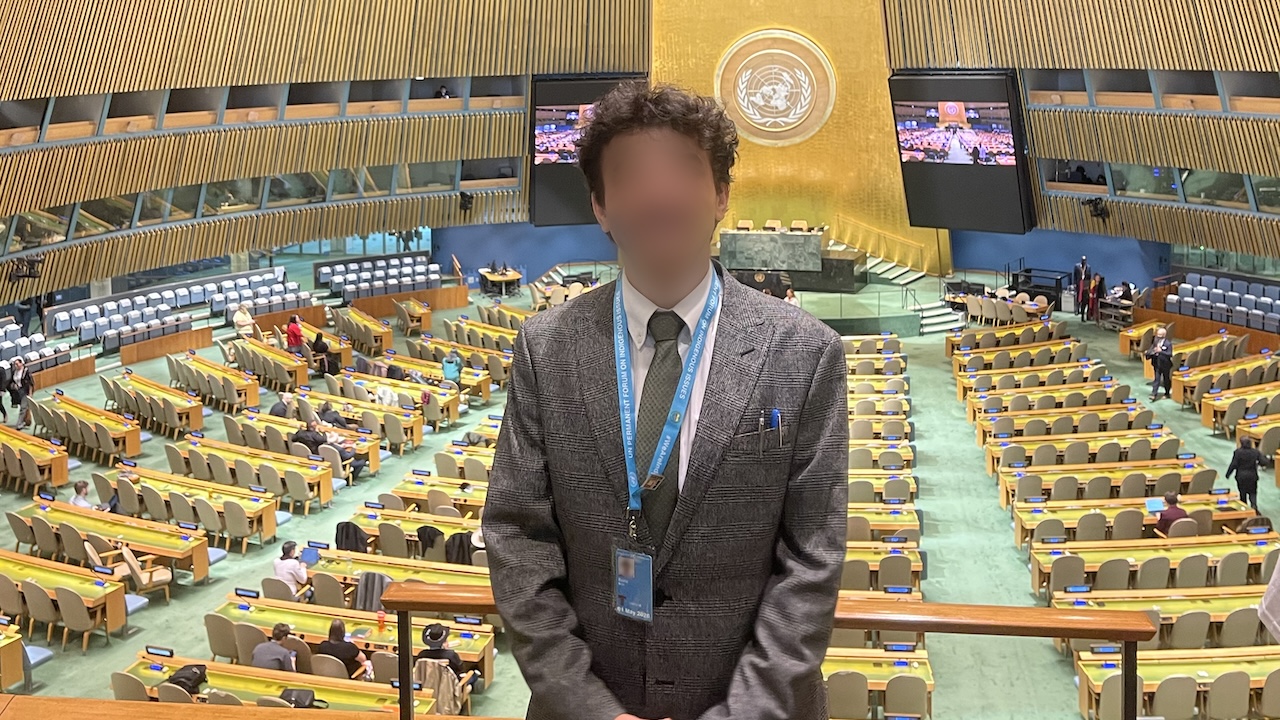
Mark Basta was 7 years old when the 2011 Egyptian Revolution broke out.
The uprising led to the overthrow of longtime president Hosni Mubarak after decades of authoritarian rule, and was driven by demands for democracy, economic reform and an end to corruption and police brutality.
“That was kind of the first major thing that I learned about the country,” Basta recalled. “People didn’t really know what was going on. It all happened very quickly. What I remember was more of a feeling of fear during that time with all the uncertainty around it.”
Basta was born into Egypt’s Coptic Christian community, an ethnoreligious minority considered descendants of the ancient Egyptians. Copts have long faced discrimination in their home country.
He came of age during one of the country’s most turbulent political periods — from the fall of Mubarak to the short-lived rule of the Muslim Brotherhood to the rise of the Abdel Fattah el-Sisi’s authoritarian regime — an experience that shaped his understanding of what it means to belong to a minority community in the Middle East.
After recently graduating from UC Berkeley, Basta now works as the Arabic outreach manager for a Bay Area-based organization focused on preserving and sharing the history of Jews from the Middle East and North Africa.
At JIMENA: Jews Indigenous to the Middle East and North Africa, he leads efforts to translate and make educational materials about Mizrahi Jewish communities accessible for Arabic-speaking audiences.
He stepped into the role after Hadeel Oueis, who served in the position for a decade before becoming a political writer and editor-in-chief of Jusoor News, a media outlet covering the Middle East.
Basta immigrated to the United States from Egypt in 2017. At Berkeley, he studied political science and public policy while becoming involved in nonprofit advocacy and diaspora organizing. Through volunteer work with Coptic Solidarity, he began collaborating with other minority advocacy groups, including JIMENA, which eventually led to his current role.
In this conversation with J., Basta discusses growing up in Egypt, the parallels he sees between Coptic and Jewish experiences and why he believes minority voices are still too often overlooked in conversations about the Middle East.
This interview has been edited for length and clarity.
What was it like growing up in Egypt?
I was born in Upper Egypt, then lived in Suez for part of my childhood before eventually moving to Heliopolis in Cairo. Heliopolis had a larger Coptic community and more religious diversity. It was where I first became curious about the history of Jewish communities in Egypt, because there was a synagogue in the neighborhood.
I was old enough during the Arab Spring to understand that something major was happening, even if I was still a child. A lot of what I remember from those years was fear and uncertainty. The police force had effectively collapsed during parts of the unrest, and there was a sense that things were becoming unstable very quickly.
How did the Arab Spring affect the Coptic community?
The Coptic community has long faced discrimination and periodic violence, but the years surrounding the Arab Spring intensified that. During the presidency of Mohamed Morsi and the rise of the Muslim Brotherhood, many Copts felt especially vulnerable and were in opposition to the government.
One major turning point was the Maspero massacre in 2011, when Egyptian military forces violently dispersed a Coptic protest, killing [as many as] 28 demonstrators and injuring hundreds of others. In almost every Coptic family there’s someone who was murdered in one of those protests during this time. On June 30, 2013, one of my cousins got shot by a counter-protester, so it affected us directly too.
How have those experiences shaped your understanding of the Middle East and activism in the diaspora?
Working in diaspora advocacy has shown me how much minority communities across the Middle East share similar experiences with hatred and prejudice, even if the specifics differ. Whether it’s Copts, Assyrians, Armenians or Jewish communities, many of us have faced different forms of marginalization, erasure or violence.
Another thing I’ve learned is how important alliances are. Smaller communities often struggle to advocate effectively on their own, especially after decades of authoritarianism that discouraged political engagement. Diaspora communities have more opportunities to collaborate and support each other, and those partnerships can make advocacy more sustainable and effective.
What was your experience like at UC Berkeley, especially regarding conversations about the Middle East?
It was complicated. Early on, I tried to become involved with Middle Eastern student organizations and raise awareness about non-Arab minority communities in the region, including Copts. I often felt that those perspectives weren’t especially welcomed or understood. There was pressure to fit into certain political narratives, and sometimes people interpreted my insistence on distinguishing Coptic identity from Arab identity as hostility, which wasn’t the case at all. For me, it’s about recognition and historical accuracy.
Eventually, I stepped back from a lot of campus-based Middle Eastern activism and focused more on nonprofit and advocacy work outside student organizations.
How did you become involved with JIMENA?
I met [JIMENA founder] Sarah Levin through my volunteer work with Coptic Solidarity. The organization had been building partnerships with other Middle Eastern minority groups and civil society organizations, including JIMENA.
We collaborated on events and conversations around minority issues in the region, and eventually I learned about the Arabic outreach manager position. Since I already had experience with outreach and digital advocacy work, the role immediately interested me.
What does your work as an Arabic outreach manager involve?
A major part of my work involves translating JIMENA’s educational materials, oral histories and archival resources into Arabic and adapting them for Arabic-speaking audiences online.
The goal is to make information about Jewish communities from the Middle East and North Africa more accessible to Arabic-speaking Jews who are refugees and now live abroad, but also to people in the region who used to be able to coexist naturally with the Jewish communities there.
Some people react very negatively, but many others engage with curiosity, share personal memories or express that they had never learned this history before. That’s important because in many countries, including Egypt, the history of Jewish communities has largely disappeared from education and public discourse.
Do you see parallels between Coptic and Jewish experiences in the Middle East?
There are a lot of parallels. The “othering” of the Coptic community is very similar to the pattern of “othering” the Jewish community has faced, especially in the 20th century.
For Jewish communities in Egypt, this often led to expulsion and accusations of foreign allegiance. Copts have also frequently been portrayed as outsiders or associated with Western influence, which is very ironic given that Christianity was founded in the Middle East. So there are common struggles and common rationale for the prejudice against both of our communities.
What do you think Americans often misunderstand about minorities in the Middle East?
A lot of Americans simply aren’t aware that these minority communities exist. Discussions about the Middle East are often framed in very broad categories that flatten the region’s diversity.
Another issue is that advocacy around communities like the Copts sometimes gets filtered through American political frameworks in ways that don’t fully reflect the realities on the ground. Usually, progressive politics frame Coptic troubles from the human rights perspective, but they don’t want to talk about it as Christian-targeted discrimination. Meanwhile conservatives focus on the religious freedom aspect, and the fact that we are Christians and we’re getting wronged, but they overlook the human rights part. In the process, the complex reality of the situation gets lost.
What changes would you like to see in conversations about the Middle East?
I’d like to see more attention paid to minority communities and more nuanced conversations overall. In the American context, discussions about Egypt largely faded after the Arab Spring, even though many serious political and human rights issues remain unresolved. I also think people need to approach advocacy consistently. If human rights matter, they should matter for all communities rather than only when they align with a preferred political narrative.