

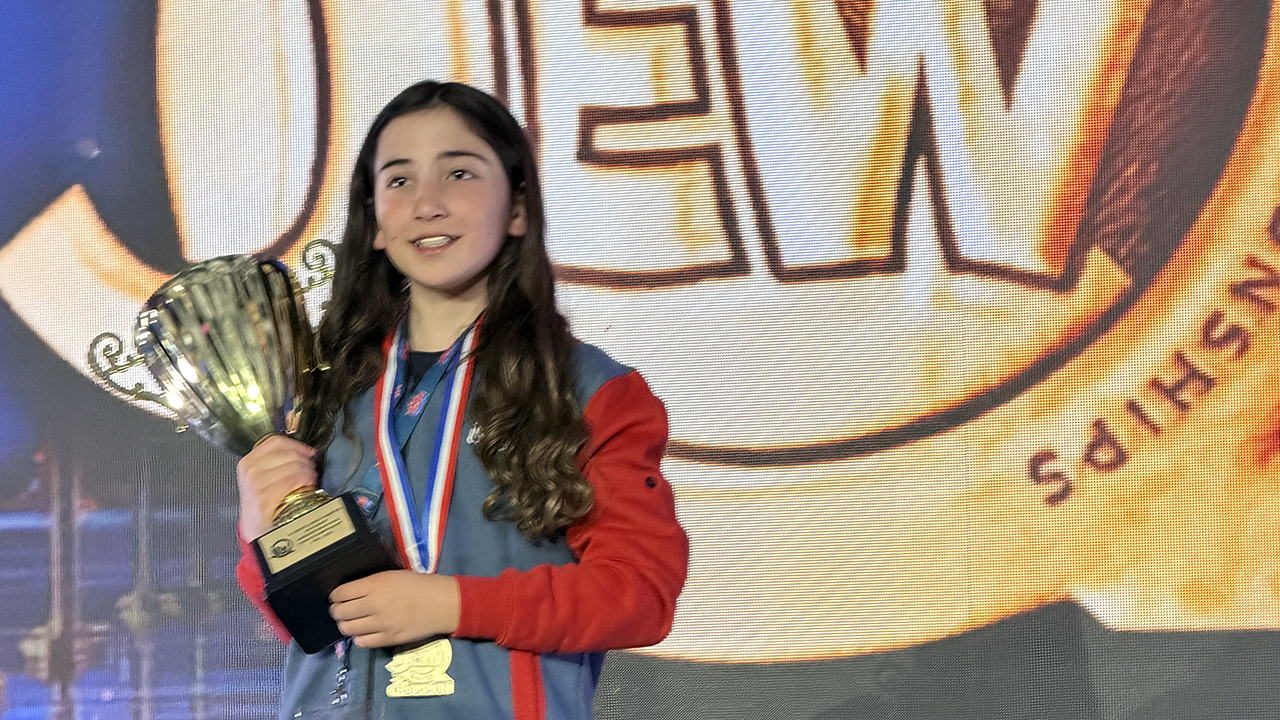
When Skylar Cohen heard her name announced as the global winner for all fourth-graders at the JewQ International Torah Championship this spring, she took a beat and then lit up.
“I felt excited — and then kind of surprised,” the 10-year-old Lafayette girl told J.
It even took a moment for the magnitude of her March 22 win to sink in for her father.
“I heard she won first place, and I thought, ‘Oh, you know, it’s just a small group of kids that travel to New York.’ I didn’t realize how many kids were involved,” said her father, Scott Cohen, who stayed home when Skylar and her mother flew to Brooklyn for the JewQ finals.
In fact, Chabad’s annual JewQ competition, which tests children on Jewish knowledge, drew 400 finalists this year out of 4,200 contestants in grades 3 to 8 from 25 countries. Since its inception in 2019, JewQ has attracted more than 29,000 competitors. All of them go to public schools or non-Jewish private schools and study for the competition with their local Chabad rabbis.
Children prepare by studying the same textbook, grade by grade, that covers Jewish law, history, holidays and customs, and Jewish heroes through the ages. They are tested periodically, and the winners of local and regional competitions are invited to Crown Heights for the final game-show style showdown.
The competition was wild, a Chabad version of “Wheel of Fortune” with side portions of “Jeopardy” and “Dancing with the Stars.” Hundreds of kids and parents, along with their rabbis and teachers, filled a huge auditorium with flashing lights, video projections and pounding Jewish music. The event kicked off with a line dance by six boys sporting black jackets, white high-tops and tzitzit, who got the audience riled up with shouts of “Give it up!”
First round: Two teams of third-graders had 90 seconds to grab food items off a table and drop them in buckets labeled with various blessings. Get as many of the right items in the right brachah bucket, and your team wins points.
Second round: The same kids were asked questions by their peers in classrooms around the world, projected on the big screen. From Leeds, England, a boy asked the first question: “We pray three times a day. In those prayers, what are we concentrating on?” (Answer: connecting to God, standing before the King of Kings, and asking for all our needs, especially Moshiach, or the coming of the Messiah — a very Hasidic response.)
As the grade levels progressed, the questions got harder.
Teams of fourth- and sixth-graders watched a fast-paced video from a recent Shabbaton and had to write down all the mitzvahs they noticed. Tzedakah! Kosher food! Lighting candles! They put their heads together and scribbled notes furiously.
Even tougher questions were put to finalists. List Maimonides’ 13 principles of faith. Name the 12 tribes of Israel. What’s the status of a Torah missing a letter? (Answer: invalid until fixed.)
How about this doozy: On what do we make the same blessing as seeing shooting stars? (Seeing lightning — but all of you knew that, right?)
“A lot of people’s Hebrew school experience can be not that exciting, a chore they have to do. So we gamified it. The idea is to harness children’s natural competitiveness and channel it toward education, Jewish knowledge,” said Rabbi Avi Winner, head of PR and marketing for Merkos 302, which acts as the R&D department for Chabad’s global outreach network.
Skylar, who attends Happy Valley Elementary School in Lafayette, prepared with Rabbi Boruch Hecht at Walnut Creek’s Chabad of Contra Costa. She’s been part of Chabad since she was 3. Her family are members of both Chabad and Temple Isaiah, a Reform congregation in Lafayette, where Skylar’s Israeli-born mother, Siena Naaman Cohen, teaches Hebrew.
Her mother didn’t share Skylar’s surprise at her first-place finish. “I am, as an Israeli, very competitive, the opposite of my daughter,” she said.
When Skylar isn’t learning Torah, she likes to read, mostly adventure books and historical fiction, and to write.
She joins two other Bay Area children who have been global winners in their age category: Gabriel Massey from San Francisco’s Chabad of Noe Valley, grade 6 in 2021, and Yael Jontof Hutter from Pleasanton’s Chabad of the Tri-Valley, in grade 5 in 2024.
Hecht began working with two local kids, one of them Skylar, for the 2025 competition. At the same JewQ event in 2025, Skylar won a medal based on tests she’d taken across several months.
In 2026, Hecht had seven students.
“Skylar rose to the top, and it was really impressive,” he said.
The purpose of the competition is to impart Jewish knowledge and a strong identity to children who don’t attend Jewish day schools, said Merkos 302 executive director Rabbi Mendel Kotlarsky.
“How do you get someone after a full day of public school to give a serious amount of time to this study?” he asked rhetorically. “So we set up a competition. If a kid is excited and competing for something, all of a sudden they own it.”
Some children, especially in rural areas, might be the only Jew in their class, Winner said, so studying and competing, by Zoom if necessary, gives them “knowledge and emotional resilience.”
There’s another goal, he added. For parents who can’t afford or aren’t interested in sending their kids to Jewish day school, the JewQ program gives kids a sense of being part of a global Jewish community and encourages their parents to do so too.
“The kids get excited, then the parents get excited and engaged,” said Kotlarsky. “That’s the goal: children owning their Jewish education and making it a priority for their families.”
Added Winner, “There’s nothing as empowering as knowing who you are and what you are proud of, the rich heritage within you.”