

This story was originally published in the Forward.
Anyone living in the five boroughs has likely seen the Chabad stickers on street corners proclaiming, alongside a photo of the Lubavitcher Rebbe, that the “Messiah Is Here!”
But this week, a different kind of redemption feels imminent in New York — and there’s a new face on the “Messiah” posters.
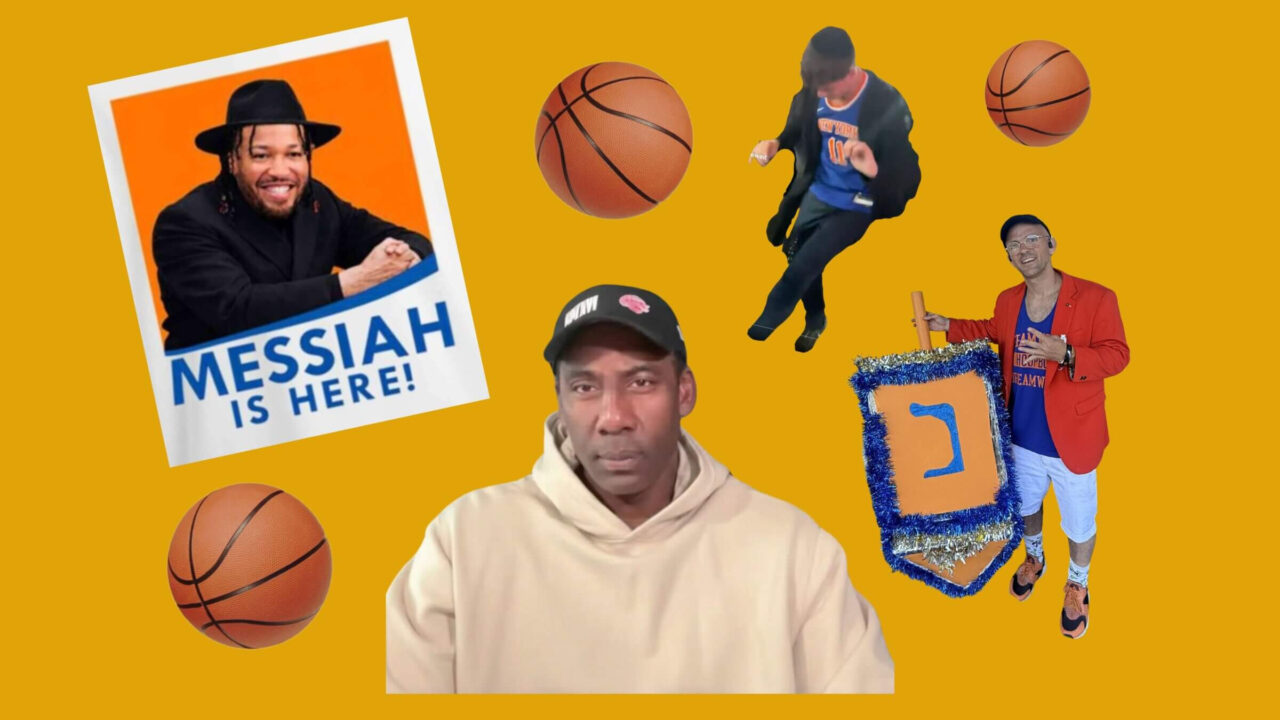
With the hometown Knicks two wins away from their first NBA championship in 53 years, fans mocked up a t-shirt featuring an image of star point guard Jalen Brunson superimposed on the Chabad sign, black hat, beard and all. (Including Brunson’s signature cornrows.)
The Brunson memes are just one Jewish piece of an unexpected Finals run uniting the five boroughs — and perhaps, even more astonishingly, its Jewish community. There’s been a giant dreidel spinning outside Madison Square Garden, Talmud-lined shelves displayed on sports broadcasts, and a Jewish-inclusive chant going viral. The team on the court has a Jewish aspect, too: Brunson is married to a Jewish woman — and apparently signed a ketubah at his wedding.
Home to an estimated 1 million Jews (a number that nearly doubles when including the full metro area), New York probably couldn’t have had a Finals run without Jewish undertones. After all, their last title-winning team was helmed by a Jewish head coach, Hall-of-Famer Red Holzman. The team’s Jewish history goes well beyond that.
But the Jewish presence has been unmissable — and in these times, unmissably welcomed — in the city’s sports hysteria.
“I seen Hasidic Jews break-dancing with Black kids,” the rapper Fat Joe told reporters Sunday. “This is the greatest unification of the city since 9/11.”
‘People in yarmulkes, people in turbans’
Though the first two games of the NBA Finals were played in Texas, the home of the Western Conference champion San Antonio Spurs, the center of the action for Knicks fans remained Madison Square Garden — the arena known as the basketball Mecca. (OK, that part’s not so Jewish.) The Knicks faithful assemble there after each game, Midtown descending (ascending?) into full-scale revelry.
That’s where a yarmulke-wearing teenager wearing a Brunson jersey was caught breaking it down like a 1970s b-boy, other fans encircling him and cheering him on. About as miraculously as a Brunson high-arcing fadeaway plunging through the net, the kippah stayed on.
Meanwhile, a fan’s improvised rallying cry was becoming an instant hit: “My mayor Muslim, my bagel Jewish, my Christian Dior, Knicks in four!” (My colleague Mira Fox has written eloquently on the chant.)
Outside MSG — and at the Knicks watch party at Bryant Park — is also where Rami Even-Esh, the Jewish rapper known as Kosha Dillz, plans to bring his human-sized dreidel Monday night, when the Knicks take on the Spurs in Game 3 (8:30 p.m. ET on ABC.) He did a “Knicks Shabbat” outside the Garden during Friday night’s Game 2, serving challah to passersby, and recorded a Knicks music video that featured people of Jewish and non-Jewish backgrounds.
“There’s people in yarmulkes, people in turbans — there’s no ‘anti’ stuff, so that makes it very Jewish for me, and it feels very authentic,” Even-Esh said in an interview.
And let’s not forget that the arena — with President Donald Trump expected in attendance — now has the security infrastructure of an American mega-shul.
‘Torah-cyclopedias’
This Finals’ Jewish imprint also extends to the court. The architect of this team, Knicks team president Leon Rose, was born to a Jewish family in South New Jersey. He later became an NBA super-agent whose clients included Allen Iverson and LeBron James, before taking on the challenge of restoring the ill-fated Knicks to their former glory.
The franchise had long been a vehicle for Jewish hoopers to make their imprint on the game. The first basket in NBA history was scored by a Jew, Ossie Schectman; the late 1970s and early 1980s Knicks featured Ernie Grunfeld, the son of Holocaust survivors.
But the team became a punchline under Knicks owner James Dolan, whose verbal sparring with an elderly Jewish fan once made national headlines. Only after Rose executed a series of transactions both shrewd (like inking Brunson, then seen as a mere second-fiddle, in free agency) and bold (like big trades for Karl-Anthony Towns and Mikal Bridges), the Knicks turned the ship around.
One of their latter-day stars, meanwhile, is Amar’e Stoudemire, who converted to Judaism after playing for the Knicks in the 2010s. Stoudemire is often seen wearing a black hat and a remote hit on a Barstool Sports talk show allowed basketball fans to see bookshelves behind him lined with seforim.
The background prompted a question from the program’s hosts: Are those encyclopedias? Stoudemire explained: “Those are my Torah-cyclopedias,” adding that the one book missing from the shelf was the one he is currently working through.
The Knicks’ success has presented a challenge for Jews like Stoudemire who observe Shabbat, as Game 2 of the Finals fell on Friday night.
It’s a common occurrence for Orthodox fans of teams like the Yankees and Dodgers — and one Knicks fans hope to get used to.