

Updated on June 15
Once a year, crossword obsessives from the West Coast gather at a Berkeley synagogue to compete, compare notes and celebrate a shared devotion to the game of black and white grids.
The setting feels fitting. Crosswords aren’t inherently Jewish, but Jews are overrepresented among those who make and obsess over them.
Among 24 Bay Area puzzle makers published regularly in the New York Times, about half are Jewish. Many say they see something distinctly Jewish in the craft itself.
“I’m actually surprised when I find out someone isn’t Jewish,” said Andrea Carla Michaels, a veteran of the local crossword scene with nearly three decades of involvement.
The local event, known as Westwords, takes place at Berkeley’s Congregation Netivot Shalom. The third annual Westwords is set for June 14 and will bring together solvers and constructors for a day of competition and camaraderie.
“It’s the best day of the year,” said Albany resident Rebecca Goldstein, a founder of Westwords and a cancer drug researcher. She noted that she loves the opportunity to spend time with “like-minded dorks.”

Westwords participants will tackle six original puzzles built specifically for the event by constructors who live on the West Coast. Points are earned for speed and accuracy. But the tournament is only part of the event’s appeal, according to Goldstein.
“It’s like camp,” she said. “You’re suddenly surrounded by people who love this one very niche thing as much as you do.”
The spectrum of puzzlers ranges from casual to cruciverbalist, which Merriam-Webster defines as someone who either “creates or is highly skilled at solving crossword puzzles.” (Note to Merriam-Webster: The preferred term is construct, not create, when referring to crossword puzzles.)
‘He was a god’
Michaels is one of this year’s puzzle constructors for Westwords. She began connecting local constructors in San Francisco when in the early 2000s she serendipitously discovered that Manny Nosowsky, one of the New York Times’ most prolific constructors, was a fellow San Franciscan. She knew nothing about him, but she was blown away by one of his puzzles so she decided to reach out.

“He had just written a puzzle that made my head explode. It was so clever and interesting. So I sent a letter to the editor and he forwarded it to Manny,” Michaels said.
That initial letter sparked a friendship and the start of monthly meetups for Bay Area constructors to socialize and exchange ideas.
Nosowsky, who was profiled by J. in 2006, had 254 puzzles published in the New York Times during his lifetime. He died on May 20 at the age of 94.
“He was a god in our community. We loved him,” Michaels said, shortly after attending his shiva. “He was so clever, and he didn’t even write his first puzzle until he was in his 60s.”
Over the years, the New York Times has published nearly 100 of Michaels’ puzzles. She also created holiday-themed puzzles for J. back in 2003 and 2004.
Michaels still constructs crosswords, with her latest appearing June 1 in the Wall Street Journal, but now she mainly spends her time collaborating and mentoring up-and-coming constructors, helping them hone their skills and break into the scene.
To construct a good crossword, one must first be good at solving them. And to be good at solving crosswords, she said, one must be able to wrestle with wordplay, know tons of trivia and manage to decode the subtle wit of the constructor while thinking creatively about language.
David Steinberg, a prominent puzzle editor, said the local crossword puzzle community is both collaborative and competitive.
“There are only so many publication slots,” Steinberg said. “But people are really supportive of each other. We all just love the craft.”
Like a chevruta
The focus on human connection may help explain the broad appeal of crossword construction. But for many, something about crosswords feels particularly Jewish.
Michaels points to the Jewish emphasis on questioning, debate and interpretation. Another puzzle constructor, Adam Wagner, who lives in Oakland, recalls learning about the concept of chevruta, a traditional Jewish method of two people studying text together. He sees parallels in the back and forth of collaborative puzzle construction. It reminds him of his sessions constructing puzzles with one of his regular partners.
“We’re constantly debating ideas, challenging each other, refining things,” Wagner said. “It feels very familiar.”
Although there are hundreds of distinct outlets that publish crossword puzzles — from magazines and newspaper syndicates to online subscription services and published books — one reigns supreme.
“There’s only one New York Times,” Goldstein said.

With over 10 million daily players across its platforms, the New York Times games section is one of the most visible outlets for crossword puzzlers. Getting published by the Times is extremely competitive. The paper receives about 175 crossword submissions per week, making its acceptance rate around 4%.
“It’s still the gold standard,” Michaels said.
Although The New York Times crossword is now considered the most elite puzzle, the paper initially refused to publish them, famously dismissing the brainteasers in 1924 as a “primitive sort of mental exercise” and a “sinful waste.” That stance changed after the 1941 bombing of Pearl Harbor, when editors recognized the value of crosswords as a welcome distraction from wartime news.
People have historically turned to crossword puzzles during stressful times.
The crossword puzzle itself was invented in December 1913, on the eve of World War I, when an editor at the New York World needed a new game for that paper’s “fun” section. Readers quickly became fans, seeing the puzzles as a refuge from the dark headlines across the rest of the publication’s pages.
It was sentimental
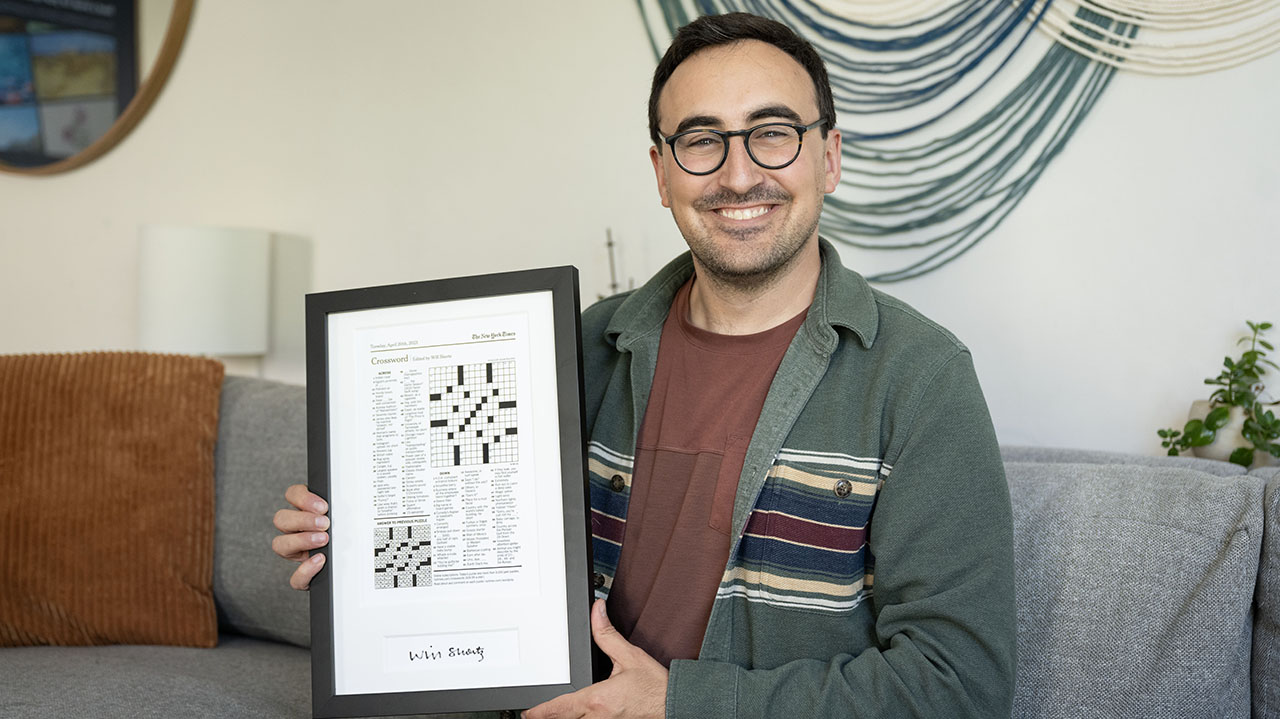
For Wagner, getting one of his crosswords published in the New York Times was the only option — he wouldn’t settle for less. Not just because of its prestige, but because of the sentimental connection he feels for the paper’s crosswords.
“That was the one that my mom used to solve when I was a kid, so that was the one that I really wanted to get published in,” he said.
Growing up in a Jewish family on Long Island, he watched his mother tackle the crossword each day, and he would occasionally chime in with a lucky guess. Years later, just before turning 30 and after some prompting by his therapist regarding life goals, he decided to try constructing one himself.

“I made three in a week,” he recalled. “They were terrible. But I was having fun being bad at it. That’s how I knew it was something worth pursuing.”
From there, the hobby became a discipline. Wagner taught himself the craft by obsessively studying puzzle archives. His first acceptance at the Times came on his 18th submission. Since then, he has had more than 30 puzzles published in the Times, including his latest on June 7. He became one of the New York Times’ most frequently published constructors in 2025. And in February, he won the Constructor of the Year award at the Orcas, which is considered the “Oscars of the crossword community.”
Wagner balances his puzzles with a day job at subscription platform Patreon, where he writes everything for the company from website content to marketing campaigns. Working in tech, Wagner has his finger on the pulse of one of the crossword community’s growing challenges: artificial intelligence.
Some cruciverbalists remain staunchly anti-AI, arguing against its use in both solving and constructing crosswords. They question why anyone would want to “automate away their own hobby” and are convinced that any puzzles made with AI will simply be “slop.”
Many constructors, however, see AI as a tool that can enhance their process.
“It gives me superpowers,” Wagner said, describing how he and other top constructors use it to search massive word lists or generate idea prompts. He insists that the artistry remains despite any use of technology.
“A crossword is a form of self-expression,” Wagner said. It is a very human art form in the sense that you’re connecting with the constructor when you solve it.”
A crossword prodigy
Steinberg, who lives in Palo Alto, is considered a crossword prodigy. He was introduced to the form by his father, who solved puzzles, and a school librarian, who printed copies of the New York Times crossword for students. He was constructing his own and submitting them to the New York Times by age 12.
At 15, he became the youngest published constructor in the Los Angeles Times and the youngest known crossword editor ever for a major newspaper, when he took a job with the Orange County Register.
Today, at 29, Steinberg is the editor of the Universal Crossword, a daily puzzle published by Andrews McMeel Syndication that appears in many major newspapers. He also continues to construct his own: In late May, he had his 113th puzzle published in the New York Times.
Steinberg’s role at Universal Crossword involves selecting submissions, working with constructors on revisions and refining clues to ensure they’re accurate, engaging and appropriately challenging.

“It’s really about picking the best of the best,” he said, “and then making sure the puzzle feels fair and fun for solvers.”
Fairness, in crossword terms, is harder to define than it sounds. A puzzle feels unfair when clues are too obscure, rely on references outside most solvers’ experience or technically work but require too much of a stretch. Goldstein published a clue that tested those edges: “wish made over candles?” with the answer “Shabbat Shalom.” For Jewish solvers, it lands immediately. For others, maybe not so much.
What makes a great crossword?
“For themed puzzles, it’s all about freshness,” Steinberg said. “The ones I get most excited about are the ones I’ve never seen before, something that twists language in a new way.”
He points to a recent puzzle that he enjoyed solving titled “What A Snooze.” It played with expectations by asking solvers to think outside of the box — literally — by imagining an invisible row of Z’s above the top of the grid to make all the other answers legitimate.
“Some people thought the puzzle was broken,” he said. “But once they got the theme, it clicked. It’s fun to break the rules every once in a while.”
A crossword resurgence began at the start of the Covid lockdowns in 2020, when many new cruciverbalists first took a deeper interest in the craft. Michaels said it is not hard to imagine why a bump in popularity came during a time of turbulence.
“You can solve a grid’s problem and make everything fit together and have a nice solution, whereas the world at large is pretty much out of our control and only getting more so,” Michaels said. “A puzzle is something you can sort of control and enjoy and have those little ‘aha’ moments.”
For most constructors, the heart of a puzzle lies in its theme, the conceptual thread that ties together its longest answers. A key component is the “revealer,” a special answer that explains the puzzle’s hidden trick, tying together all the themed entries.
Wagner describes the construction process as “turning over rocks in the English language and looking for weird bugs,” searching for unexpected connections between words and phrases.
Wagner suggests that puzzle-solving itself mirrors a core aspect of Jewish tradition: the search for meaning through connection.
“To be Jewish is, in some ways,” he said, “a constant act of puzzle solving.”
Update on June 15: Manny Nosowsky’s age at the time of his death has been corrected.