

“AIDS is not just God’s punishment for homosexuals. It is God’s punishment for the society that tolerates homosexuals.”
These words were spoken by the televangelist Jerry Falwell multiple times in the 1980s and ’90s. People nodded. Politicians listened. Kids like me tried to make ourselves disappear. Another televangelist, Pat Robertson, advocated for quarantining people with AIDS and stopping the epidemic by ending homosexuality.
They were the most powerful religious leaders in America, with a direct line to the White House. President Ronald Reagan did not say the word AIDS publicly until 1985, four years into the epidemic, when tens of thousands were already dead.
Before you exhale and tell yourself that it’s ancient history, consider this. In 2026, Joel Webbon, a Christian nationalist pastor with over 100,000 followers on social media, blamed Jewish people for turning America into what he called “a very gay nation.” Anti-gay and antisemitic. In the same breath. This year.
Today, the voices of hate have changed. But their argument has not.
I grew up gay in Sacramento in the late 1980s and could not say it. Not to myself, not to anyone. Being gay looked like a death sentence. I watched the AIDS crisis unfold on television, half paying attention and half terrified.
In 1978, a California ballot proposition sought to fire any gay or lesbian teacher in the state. Harvey Milk, a San Francisco supervisor and one of the first openly gay politicians in the country, helped defeat it. Three weeks later, he was assassinated.
In 1979, police raided a gay disco at 1225 K St. in Sacramento, returning the next night to destroy the bar’s entire stock of beer and wine. No bartender or customer had broken any law. But police could arrest gay men on the spot, publish their names in the newspaper and end their careers.
The message to a kid trying to figure out who he was could not have been clearer: People like you are not safe here. I was scared straight. Not metaphorically. Literally. I believed I had to choose between being who I was and having the family, career and community I wanted. I carried that alone.
What I did not know was what my fellow Jews were already doing just 90 miles away.
On Kol Nidre in 1985, two rabbis in San Francisco delivered simultaneous sermons that would change Jewish life forever. At Congregation Emanu-El, Rabbi Robert Kirschner preached about his visit with a young Jewish man dying of AIDS. He told his congregation this man deserved compassion, not judgment. A few miles away, Rabbi Yoel Kahn delivered his first High Holiday sermon at Congregation Sha’ar Zahav, the city’s gay synagogue. He called the sermon “AIDS is our Earthquake” — not God’s punishment, but a natural disaster that demanded a human response.
Those two sermons, on the same night, revealed something profound: While many preachers called AIDS God’s wrath, Reform rabbis said the opposite.
They were not alone. In 1987, the Union of American Hebrew Congregations (now called the Union for Reform Judaism) passed a resolution calling for an end to discrimination against gay and lesbian people. In 1989, it went further and called for the full inclusion of gay and lesbian Jews in every aspect of synagogue life.
Sha’ar Zahav organized meal delivery programs, some of which still exist. When gay men were not permitted to donate blood, the women of Sha’ar Zahav started their own blood drive. Across the country, lesbian and queer women took on such a vital caregiving role that their work created momentum for a movement to rearrange the acronym GLBT. It became LGBT, with the “L” moved to the front.
Out of that grief came something now sung in thousands of sanctuaries around the world. Debbie Friedman and Rabbi Drorah Setel rewrote the Mi Shebeirach, the Jewish prayer for healing, to ask for spiritual wholeness, for blessing even in the face of death.
In San Francisco, Kahn originated a practice many of us experience on Friday nights, extending an open hand across the congregation, inviting people to speak or hold silently the names of those in need of healing. He did it because so many who needed healing were so sick they could not make it to services themselves.
If your rabbi does this on Friday nights, remember that this gesture was born in the grief of the AIDS crisis.
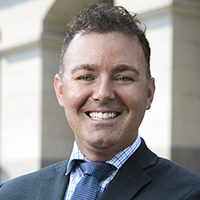
I just learned about this history of the Mi Shebeirach, preparing for my first-ever Shabbat drash. In fact, I am the board chair of the Jewish Federation of the Sacramento Region, and I did not know it. That stopped me cold.
My tradition was already saying “yes” to people like me before I knew I was one of those people, before I was out. Before my husband Marc and I stood on the bimah at Congregation B’nai Israel in Sacramento in 2006 as the first two men to be married there, witnessed by 150 friends, family and community members. That was before same-sex marriage became legal, before we got legally married on our lunch break with our closest family around us. It was before we adopted our son Tyler, before I understood that two things I had always believed were mutually exclusive could both be true: I could be gay and I could have the life I always wanted.
Judaism said “yes” before civil law did.
This is not Northern California history. It is not LGBTQ history. It is Jewish history, full stop. And it belongs to all of us.
Antisemitism is rising. Attacks on LGBTQ people are rising. The way anti-gay messages are delivered have changed, but the message has not. There are gay Jewish kids right now listening to adults debate their existence as they try to figure out who they are. They deserve to know their tradition was already saying “yes” to them before they could say “yes” to themselves.
History that stays forgotten cannot protect anyone.