

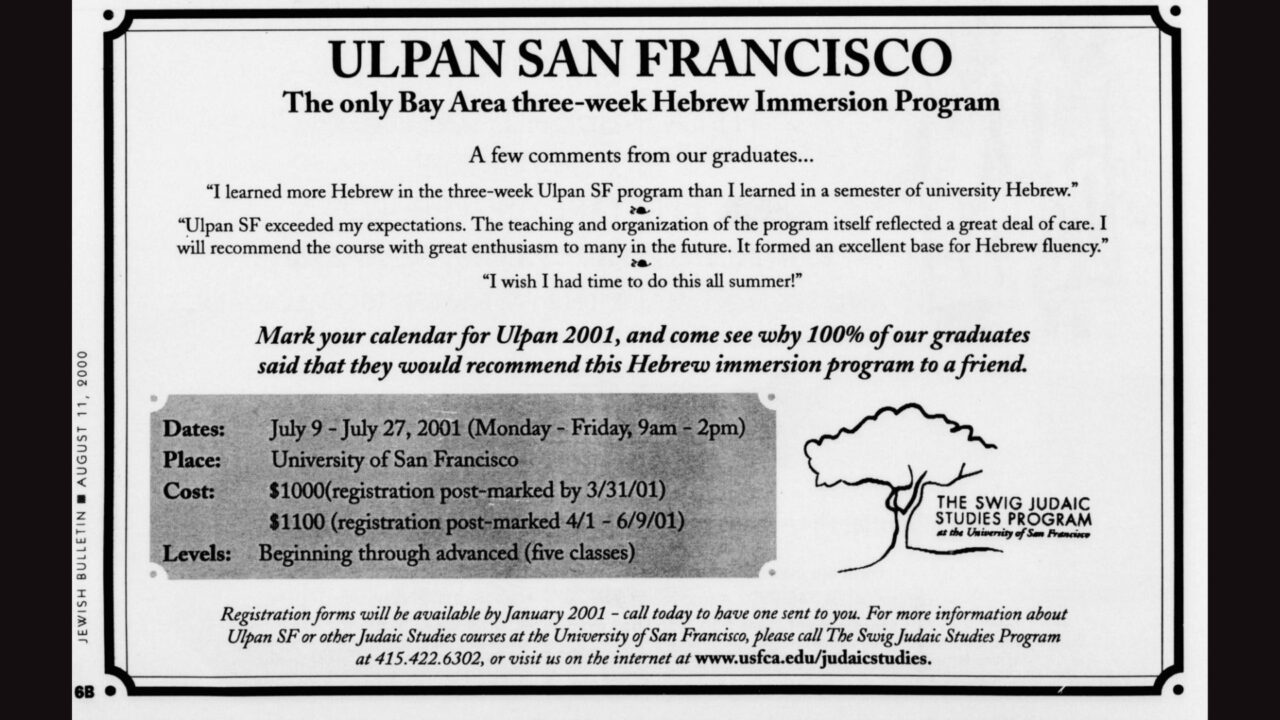
The Bay Area’s first ulpan, a Hebrew-language immersion program based on the Israeli model, was founded at the University of San Francisco, a private Jesuit school, in 1998. The program demanded that students pore over Hebrew study five hours a day, five days a week, for three weeks. Looking back at our coverage of the ulpan, I was struck by students’ fondness and enthusiasm about their education. Though the classes were intense, adults and even children and teenagers gave rave reviews to the summer program.
In an article that year by Leslie Katz, one student told us the ulpan had been a big help in learning to understand Hebrew. “On a scale from one to 10, before I was about a one,” he said. “Now I’m about a seven.”

People from all walks of life, from physicians to doctoral students and even Rabbi Sydney Mintz of San Francisco’s Congregation Emanu-El, studied together in these concentrated sessions. Their reasons for learning Hebrew varied. Some were children who wanted to learn Hebrew in order to chat with Israeli relatives. Rabbi Dev Noily, who now serves as senior rabbi at Kehilla Community Synagogue in Piedmont, studied at the ulpan prior to attending rabbinical school. David Fankushen of San Anselmo told us in the 1998 story that he’d barely used Hebrew since his yeshiva days, but “It’s amazing how things came back.”
Students at the ulpan celebrated Kabbalat Shabbat together each Friday, but there was one rule: to speak only Hebrew while singing the blessings or sharing challah. There were guest speakers and even Israeli dance, all in Hebrew.
Founding director Esti Skloot was there at the program’s inception. Skloot had been teaching Hebrew at Brandeis Marin, a Jewish day school in San Rafael, when she got the call from USF. She told me that her time as an entertainer in the Israeli army, when she traveled throughout Israel to sing and play guitar to cheer up soldiers, made her naturally inclined to entertain in teaching, too.
“I always tried to make it as fun as possible and to add things that people would enjoy,” Skloot told me. “Studying is not supposed to be suffering.”
Skloot recalled one poignant summer session in 2014, during Operation Protective Edge, when she taught a Palestinian student from Gaza named Jihad.
“It was very sad because he was really worried about his family and his house,” she said. He already spoke Hebrew beautifully, Skloot told me, because Arabic and Hebrew are so similar. She said that while the class didn’t discuss politics, “the rest of the students in the class really sympathized with him and felt for him for what he had to go through.”

Skloot was born in England. Her family made aliyah when she was a child, but in Israel Skloot faced teasing from other children for her poor Hebrew skills.
“I decided at that point that I’m going to speak Hebrew better than all of them,” she said.
She later taught Hebrew at UC Berkeley, USF and San Francisco State University — all at the same time. “I crossed three bridges — it was absolutely crazy,” she said. (While at UC Berkeley, she met my grandmother Yael Chaver, a Yiddish professor, who first introduced me to Skloot.)

The ulpan’s occasional field trips to Jewish museums or restaurants became less frequent over the years as funding dried up. Enrollment dwindled and USF threatened to cut the program, Skloot said.
In 2017, when the program was on the chopping block, we wrote that it was “one of the lifelines to Jewish literacy.” The community rallied, and thanks in large part to a contribution from philanthropist Anne Germanacos, the ulpan stayed open. According to a J. opinion article from 2018, “It was thriving, with enrollment more than doubling compared to 2017.”
Today, Hebrew San Francisco: Ulpan, a program offered by the Swig Program of Jewish Studies and Social Justice, lives on at USF in a modified virtual format with five levels of instruction for three weeks in July, culminating in a certificate of completion rather than university credit, as used to be the case.
The ulpan program demands focus and dedication from all its participants — students and teachers alike. “It was a lot of work,” Skloot told me. “But if you don’t invest in something, there are no results, right?”