

Rachel Chancellor first encountered Nancy Katz’s artistry at Camp Newman in Santa Rosa, where the young camper admired her colorful silk banners adorning the dining hall.
Chancellor was so taken with the silks at the Jewish camp that the Sacramento youth talked their parents into flying together to the artist’s Massachusetts studio. There, they worked collaboratively with Katz to create a tallit with a wavy rainbow against a royal blue background for Chancellor’s bat mitzvah in 2013.
“Katz’s work is so effortlessly beautiful,” Chancellor said.
Now, Chancellor is spearheading an upcoming retrospective of Katz’s work at the Osher Marin JCC, where they work as program manager of the JCC Taube Center for Jewish Peoplehood.
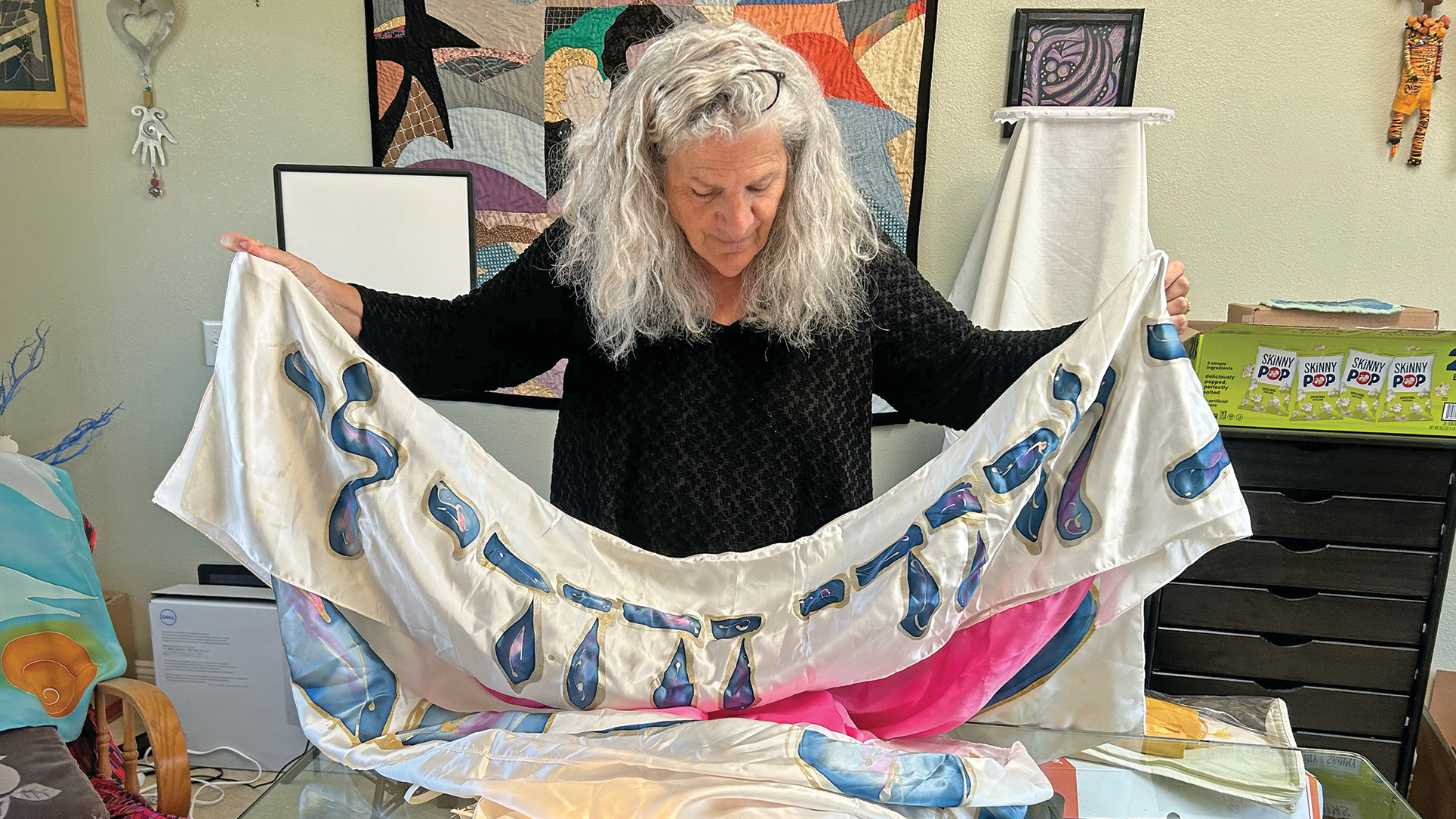
Katz, who returned to the Bay Area two years ago after two decades away, is known for her vibrantly colored tallits and chuppahs, light in weight but heavy in Jewish symbolism.

Her work became known not only for her designs but because she works in collaboration to create them. She sketches designs with input from celebrants, who then paint the ritual objects themselves, under her guidance.
The new show, called “Permission Granted,” includes over 60 of Katz’s works and will be one of the San Rafael JCC’s largest-ever art exhibits. It opens July 6.
It’s a homecoming of sorts, since her silk banners illustrating values important to the institution, such as tikkun olam, welcoming guests, acts of kindness and tzedakah, have hung in the JCC for more than 30 years.
In 2002, she also led the staff there in a silk painting project to express their grief after the death of a 6-year-old who drowned in the JCC swimming pool.

Katz, 70, estimates she has created over a thousand tallits and several hundred chuppahs, most of them together with the celebrants. But this is her first retrospective.
She first moved to the Bay Area in 1980 but left in 2005 to be closer to her parents toward the end of their lives. She and her husband, Mark Liebowitz, a retired stained-glass artist who created installations at synagogues throughout the country, returned to the Bay Area in 2024. They now live in El Cerrito.
Quilting was Katz’s first medium. In the late 1980s, she worked with people memorializing their loved ones in the AIDS Memorial Quilt. She also crafted a quilt that hung at Camp Swig (the predecessor to Camp Newman), where she served as art director in the 1980s and early ’90s. Another one of her quilts hung in the seniors lounge at the Marin JCC for years.
Katz founded a Jewish quilting and text study group in Berkeley in 2003, along with the late Jewish educator Rachel Brodie. That group remains active, and she has now rejoined it.
Although Katz had painted a silk chuppah for a friend’s wedding, silk didn’t become her preferred medium until Katz’s mother was about to turn 70 and another friend suggested Katz paint a silk scarf as a gift. That scarf, with burgundy, blue and green jewel tones, is part of the upcoming exhibit.

Katz’s silk tallits apparently came along at just the right time. Today, Judaica stores sell tallits with a wide variety of designs and colors, including ones considered more feminine, but that was not the case when Katz began creating them in the early ’90s.
“There was so much going on creatively and artistically in the Bay Area then,” Katz said. “I had been brought up to believe that the bigger art world is scary. But the Jewish community was something I knew and was comfortable in. So I kind of ran with it and operated in that space, with the support of the community.”
Chancellor’s own bat mitzvah tallit will be included in the show.
“It’s so magical that I get to create something beautiful with Nancy again,” Chancellor said.
The show will run from July 6 to Sept. 28 with a community celebration from 2-5 p.m. on Sunday, Aug. 2. The JCC’s summer day camp uses some of the exhibit’s rooms, Chancellor noted, so it’s better to visit on weekday evenings or weekends.