
This story was originally published in the Forward. Click here to get the Forward’s free email newsletters delivered to your inbox.
The videos of local activists in San Francisco accosting Scott Wiener, the state senator running to replace Nancy Pelosi in the U.S. House, are hard to watch.
“Say ‘Free Palestine’ for the camera, dog,” Jesus Coba, who runs a popular Instagram account, tells Wiener as he’s trying to watch the World Cup at a bar. “Say ‘Free Palestine’!”
Coba is holding the camera close to Wiener’s face as the politician stares at him in silence.
A few days later Wiener was surrounded and screamed at as he made his way through Dolores Park, where he had come to participate in a Shabbat service as part of the Trans March.
“F— you and your Zionist handlers,” one person shouted at Wiener, who is both Jewish and gay, and has championed legislation protecting trans rights. “F— you and your Israeli masters.”
What happened to Wiener can be seen as part of a national trend. Jack Schlossberg, a Jewish heir to the Kennedy dynasty, face-planted in his attempt to replace Rep. Jerry Nadler in the U.S. House. He ran a poor campaign, but it wasn’t helped by the fact that he tried to trade on his status as a Millennial social media influencer while refusing to embrace the TikTok generation’s skepticism of Israel.
“Can you say ‘F— Israel,’ Jack?” an erratic fellow influencer who goes by the name Crackhead Barney asked visibly stressed Schlossberg during a street interview.
“No way, dude, I’m Jewish,” Schlossberg responds.
And other Democrats have spoken about the extent to which a candidate’s willingness to accuse Israel of committing genocide in Gaza has become a litmus test in primary contests.
But, at the same time, the people hounding Wiener in public are part of a radical but fringe minority — one with deep roots in San Francisco — that has struggled to gain political power even as its members excel at generating viral clips.
San Francisco is home to loud and often obnoxious activism fueled by the very real sense of alienation that comes when a region known for its radical politics is subjected to repeated rounds of displacement by the tech industry. I grew up in the city during the first dot-com boom, when the Mission Yuppie Eradication Project plastered the neighborhood with calls to vandalize luxury cars and sushi restaurants. The man behind the group was eventually arrested and police found instructions in his apartment for how to build acid bombs.
Gay Shame, an anonymous protest collective, carried on this style of activism with a promise to “instigate, irritate, and agitate” and graffiti insisting that “Queers Hate Techies,” while locals blockaded the private buses that ferried tech workers to their jobs south of the city.
When Google Glass — an early precursor to Meta Ray-Bans that embed a livestreaming camera in your glasses — became a symbol of gentrification, a woman was punched in the face for wearing the device into a local dive bar.
It’s not shocking that Jews have not always fared well among this set, for whom strident opposition to symbols of power reigns supreme. A disturbing precursor to the protests against Wiener came in 2018 when activists began weekly protests outside Manny’s, a cafe and “civic event space” in the Mission.
The business replaced a sushi restaurant, but it still somehow became the target of neighborhood activists who demanded a host of concessions from Manny Yekutiel, the cafe’s Jewish owner. Yekutiel agreed to many of the asks: bilingual signage and staff, affordable drip coffee and free event bookings for community groups.
But Yekutiel still found himself facing weekly protests, including by Gay Shame, accusing him of promoting a “pro-elite, pro-Zionist and pro-gentrification agenda.” Someone spray-painted a Star of David and “F— Zionism” on the exterior, and a window was smashed.
His sole crime was apparently a Facebook post from a few years before he opened the business asking for recommendations on “some good Zionist organizations in the Bay.”

The people who thought protesting Yekutiel was a good use of their Wednesday nights for several years are the same folks — sometimes literally — who are now harassing Wiener.
Coba, who was kicked out of the bar for yelling at Wiener, and whom Wiener said had previously accosted him at the airport and accused him of having a “tainted bloodline,” recently posted footage of someone chasing Yekutiel through a street fair.
Yekutiel is now running for the Board of Supervisors, which is San Francisco’s city council, and the man quizzing him was mad that Manny’s had once hosted pro-Israel activist Hen Mazzig. Coba claimed Mazzig was an Israeli commando, which I could find no evidence for, and Yekutiel said all he knew was that Mazzig had served in the Israeli military as most Israeli Jews are required to do.
“Well maybe having Israelis at the cafe isn’t a good idea,” the man, who does not identify himself, tells Yekutiel.
It could be difficult to summon much sympathy for tech workers whose commute was delayed by nudists trying to board their buses as a form of protest. But it’s much easier to see how corrosive the “Zionist” litmus tests being applied to Jews in San Francisco and elsewhere are.
As a longtime politician, Wiener’s record of support for Israel is deeper than Yekutiel’s. But not by much. He joined a solidarity trip to Israel in 2024, but had also called for a ceasefire in Gaza in November 2023, opposes U.S. military aid to Israel at least until a new government is in place, and — after an awkward delay — he joined the other candidates in the race for Pelosi’s seat in accusing Israel of genocide.
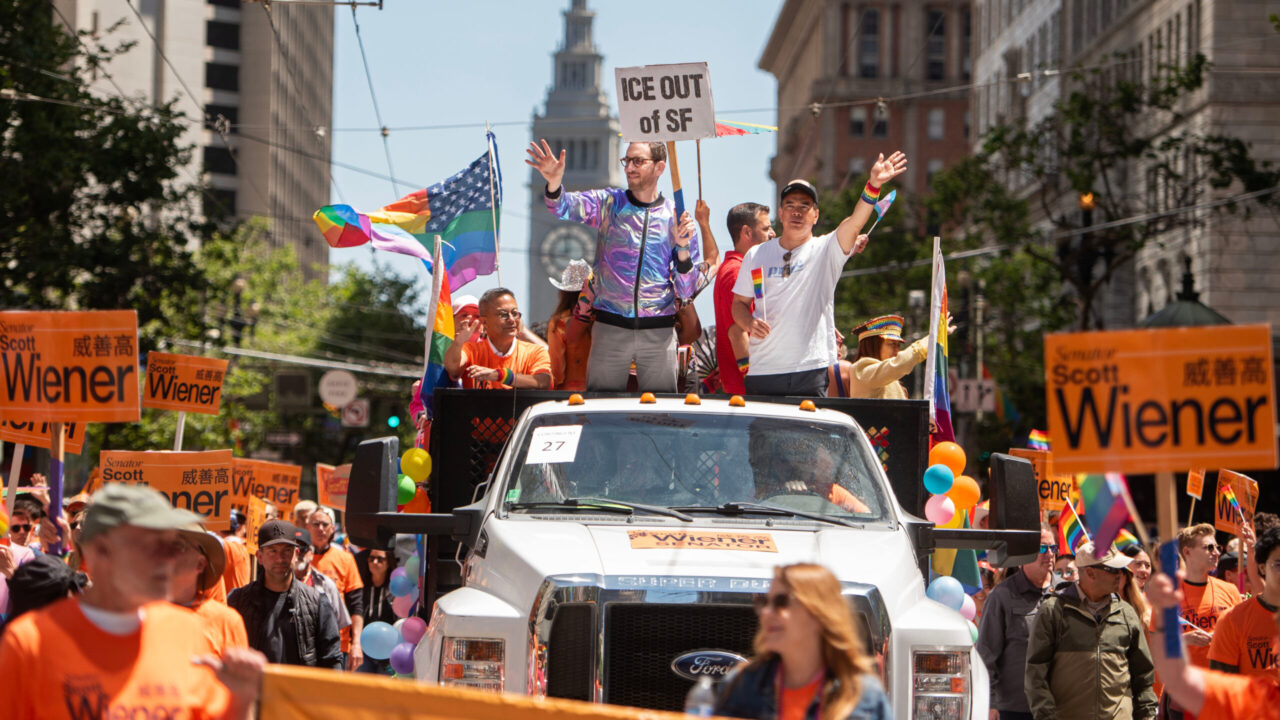
Wiener is a relative moderate in a city where progressives sometimes treat that as akin to being MAGA, and both Coba and the people yelling at Wiener during Pride make allusions to disagreement with his preferred housing policy. Mayor Daniel Lurie, another moderate, was chased out of the Trans March last year, though without as much vitriol.
But it seems clear that the obsession with Wiener supposedly supporting genocide is tied to the fact that he’s Jewish.
His opponent, Connie Chan, is backed by labor unions and has staked out a position to Wiener’s left on Israel, though she has faced no backlash for being endorsed by Pelosi, who embodies moderate San Francisco politics and has been a stalwart supporter of Israel.
At the same time, it’s important to keep in mind that the people leading the charge against Wiener have failed time and again to move the political needle.
They didn’t stop gentrification or slow the mass arrival of tech workers to the city and luxury buses still ferry them to work. Google Glass flopped, but now every other influencer on TikTok is wearing Meta Ray-Bans to film content. Manny’s continues to thrive with support from prominent progressives in the city, and Yekutiel appears to be leading in his race to join the city council.
Wiener rose from the Board of Supervisors to the State Senate, and despite his extremely vocal detractors he remains the favorite to win in November. Local media has not framed Israel as a key issue.
(Schlossberg, for his part, ultimately lost to another pro-Israel Jewish candidate who was to his right on Gaza.)
When Joe Eskenazi, one of the most astute journalists covering local politics in the city, wrote about the Manny’s protests years ago he aptly described the demonstrators as “a diminutive group of attention-seekers.”
That certainly seemed to be the case at the time. Whether the rising tide of animosity toward Israel will afford these hecklers a veto over Jewish politicians ascending the political ladder is now an open question.