

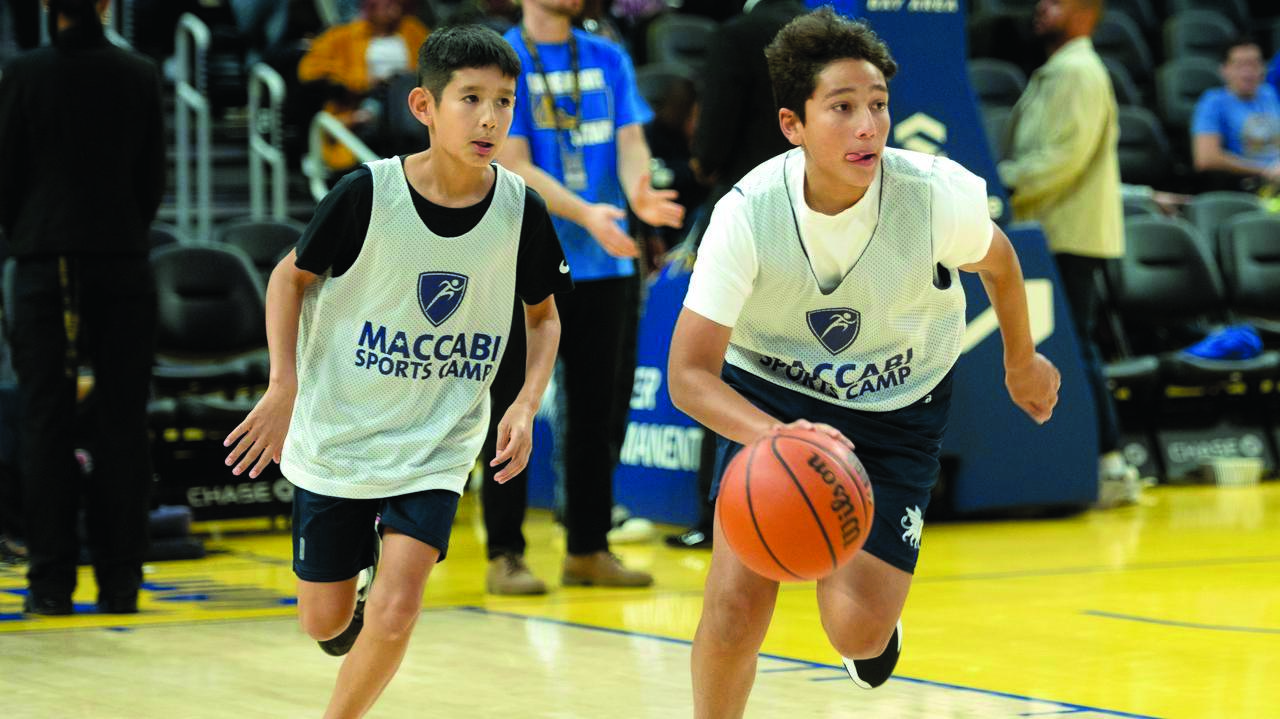
The Maccabi Sports Camp, an overnight summer program run by the Oshman Family JCC, will move to a permanent location after renting space at local college campuses since its 2014 launch.
But that forever home will not be in the Bay Area.
Starting in summer 2027, the sports camp will operate out of Ranch Camp, a Jewish camp managed by JCC Denver and located in Elbert, a town located about an hour southeast of the city.
The OFJCC in Palo Alto said the Colorado camp offers the “ideal campus to offer both the warm, intimate feel of a traditional camp” as well as “athletic facilities and amenities in a more natural environment.”
In addition to providing campers with a more classic Jewish summer camp experience while maintaining an intensive training schedule, Joel Swedlove, Maccabi’s outgoing director, said the decision to move was also related to financial sustainability, at least in part.
“The more expensive overhead you have, the more you have to charge for tuition,” he said Monday. “This decision wasn’t purely financial, but there are absolutely financial benefits.”
As to why Maccabi will move specifically to Ranch Camp, which doesn’t currently have a sports focus, Swedlove described a cultural compatibility between his program and the “outdoorsyness” of Colorado. Both camps are also part of the JCC Association of North America.
“We both understand this idea of a large tent and being a place where Jews from all different backgrounds can come to,” he said.
Compatibility aside, some Bay Area parents might still be reluctant to send their kids to a camp nearly 1,000 miles away, a possibility Swedlove acknowledged.
“I wouldn’t be surprised if there are parents who say ‘we’re going to wait a year,’” he said. “I do think the culture of our camp is strong enough that these kids want to go.… That core group of families who we can count on are the ones who are going to want their kids to continue to do it.”

This will be Swedlove’s last summer running Maccabi after being involved in the camp since its establishment in 2014. Assistant director Luke Sena will stay on staff and continue to work with JCC Denver as it takes over the management of the program.
Sena said his goal for the upcoming year will be to “settle any doubts and answer any questions” from parents who are still on the fence about the transition.
This is not the first time Maccabi’s leadership had to convince parents to follow them to a new location.
The camp initially ran out of Menlo College in Atherton. Josh Steinharter, Maccabi Sports Camp’s founder, developed the program through the Specialty Camp Incubator at the Foundation for Jewish Camp, which grants more than $15 million per year to help develop and expand Jewish camps across the country.
The incubator awarded Maccabi $1.16 million over its first four years, which allowed it to rent dorms and athletic facilities each summer. Temporary rentals were the more financially sound option over attempting to find or build a dedicated space, especially during the program’s early years.
“The finances are pretty daunting, and finding an available space that you could purchase or develop is a pretty big project,” Steinharter said. “So I think the starting point was always to have something just in the summer.”
But as campers returned year after year and its reputation grew as the Western states’ only Jewish residential camp solely dedicated to sports, the interest in finding a permanent location for Maccabi intensified, Steinharter said.
In 2020, the camp merged with the OFJCC. Two summers ago, the camp shifted to California State University, East Bay, in Hayward to expand its capacity and programming.
A majority of its campers — 117 this summer — come from the Bay Area, but Maccabi has attracted young athletes entering grades 3 through 11 from neighboring states and even from across the country.
“For those kids, getting on a plane is getting on a plane,” Swedlove said. “We pull from a national audience.”

Over two 13- and 21-day sessions each summer, the camp has offered intensive training in basketball, soccer, flag football, baseball, tennis and volleyball.
Depending on the session’s length, its current tuition ranges from just over $4,000 to just under $7,000. Starting next summer, Ranch Camp will offer three 13-day sessions for an early-bird rate of $4,975. Prices will increase after Oct. 1.
Once it becomes “Maccabi Sports Camp at the Ranch,” its programming may look a little different, depending on campers’ preferences, Swedlove said. The plan moving forward is for Ranch Camp to host information sessions with families to assess their needs.
Set on a 380-acre property, Ranch Camp houses a turf sports field, hiking trails, a horse corral, a pool and a challenge course but no tennis courts or baseball fields.
“For sports that may use indoor facilities or baseball fields, we’ll partner with local schools to use their facilities,” Ranch Camp chief program officer Courtney Jacobson said in an email.
According to Ranch Camp’s website, the plan for next summer will be to offer three types of programs, each focusing on a mix of soccer, baseball, softball, basketball and ultimate frisbee. It will also introduce “sports of all sorts,” designed to help campers explore a variety of options, including volleyball, flag football and gaga.
Since its founding, Maccabi has inspired other Jewish camps to develop their own athletic programs, including Camp Wise in Los Angeles and at Camp Ramah Galim in Santa Cruz County, which already offers surfing, scuba and biking tracks as well as a new Ramah Sports Academy track focused on basketball or soccer.
The OFJCC will continue to promote the camp to prospective campers, according to OFJCC spokesperson Nathaniel Bergson-Michaelson.
During the search for a permanent location, Bergson-Michaelson said, the camp’s leadership and OFJCC considered other properties both within and outside of California.
“We felt like JCC Denver with Ranch Camp had the space, the right setting and was really excited about making this part of their camp offerings,” he said.