

This story was originally published in the Forward. Click here to get the Forward’s free email newsletters delivered to your inbox.
I’ve never met Harris Saltzberg, but one day last summer, I went to his house to abduct 180 pounds of his Yiddish books. He lived in a sturdy brown-brick co-op in Chelsea. In the lobby, there was a Roz Chastian aroma of long-simmered onions and mothballs, with a subtle undertone of feet.
I took the elevator to the eleventh floor. Once I’d infiltrated Harris’ apartment, I began to get a sense of his personality. From the posters on the kitchen walls, I deduced that Harris liked Van Gogh and Martha Graham. From his box of cassette tapes, I got a taste of his cultured, klezmer-forward musical palate: “Puccini Famous Arias” sat next to Miriam Kressyn’s “Yiddish Folk Songs.” Pavarotti and Marilyn Horne kept company with Sidor Belarsky and Jennie Goldstein.
Before I go further, I should clarify: I did not burglarize Harris’ house. I was there as a “zamlerin,” a volunteer collector and schlepper of Yiddish books for the Yiddish Book Center in Amherst, Mass. I joined the international legion, some 160-zamlers-strong, at the end of a summer internship at the Center two years ago. Since then, every few months or so, I get a call or an email from an older Jew. Some Yiddish books have fallen into their hands, or maybe the books have been in the family for a long time. We tend to meet at their houses. (Once, though, I met a guy at his synagogue and sat through a full service for the first time in Hashem-knows-how-long.)
Wherever we meet, the pass-off process always feels ceremonial, more like the adoption of a child than the transfer of objects. We schmooze a bisl in Yiddish, a bisl in English while we load up the books, stacking them inside cardboard boxes like a game of 3D tetris. Sometimes, like a Yiddish-speaking Neanderthal, I’ll sound out the title of a book, and my host will light up like an electric menorah, turn the book over, rub its spine up and down, and tell me all about it. This? Oh, that’s “Di Yeshiva.” See, you can even see Chaim Grade’s autograph on the inside flap. That? Oh, that’s the Yiddish “Kalevala.” Naturally.
But zamling for Harris was different from zamling for other people, because for one thing, Harris was dead. His niece told me that Harris’ close friend, Andy, would be there to help me pack up the books. Andy was waiting in the lobby when I got there. He was a tall and weathered man of Irish extraction, about 75. His hooded blue eyes and the smoke on his deep, gravelly voice gave me the impression that he’d seen a lot in his time, like a hardbitten reporter in a noir novel. Except, Andy clarified, he was actually in publishing.
He didn’t say much after that.
Harris’ Yiddish bookshelf was right by the front door, so while I did a preliminary inventory, ooing and cooing in a way that would have annoyed me if another person were doing it, Andy shuffled through Harris’ living room and kitchen, shifting his chairs, stacking his dishware, emptying his cabinets. Even with Harris gone for months, the apartment hadn’t lost the ascetic spareness that only monks and longtime bachelors seem capable of cultivating. Dust had already settled over the few wooden tables and shelves. The rugs looked frayed, and a thin white light seeped into the room from in between the vertical blinds. There was a bottle of Cinzano Rosso sitting on the kitchen counter, forever half-finished. It seemed like a place Bernard Malamud might have cooked up for a story about an erudite bachelor character.
But what sort of erudite bachelor, exactly? Before I’d come over, I’d found a few clues on the internet. A Facebook obituary from Camp Kinderland described Harris as “an interesting and complicated person,” adding that he was “often very funny, often thoughtful and generous and warm.” He sounded prickly-sweet, not unlike a jackfruit. I’d also found a LinkedIn profile for one Harris Saltzberg who described his job as “Observer of aging,” employed at “Life.” That sounded about right.
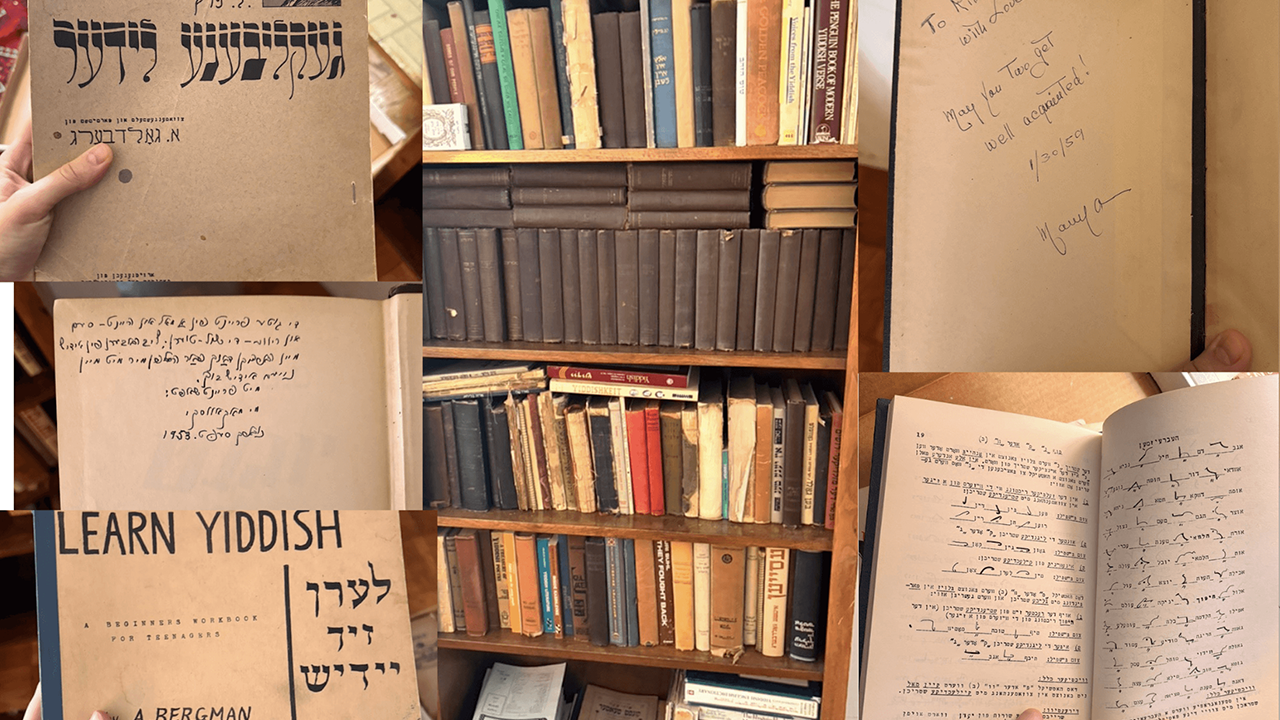
But it was the books that brought Harris into focus. On the shelf, I found at least three Yiddish textbooks. “Harris was insecure about his Yiddish,” Andy told me later, when we were lugging boxes to the lobby. But from the looks of it, he shouldn’t have been. He had the big names on his shelf — Y.L. Peretz, Mendele Mocher Sforim, Sholem Aleichem (who, by the way, is so abundant at the Yiddish Book Center that you can sometimes get a copy of his collected works for free). But Harris was hardcore. He was a proper Yiddish junkie; he’d bought books that would have been challenging to get through even in English, like “Klassenkamfn in Altertum,” “Class Struggles in Antiquity,” by a man named Kalman Marmor. He’d collected landsmanshaft periodicals from tiny Besarabbian shtetls, school almanacs from 1929, an instructional book on Yiddish stenography, song books, and one baffling, proto-woke rhyming tale about a white thug with notably sharp elbows (“sharfn elboygn”) who torments a Black boy with sad eyes (“troyerike oygen”).
Sometimes, I would find signs of a bygone reader— maybe Harris, maybe somebody else —scrawled on a book’s inside cover, or tucked away on a scrap of paper. “To Rivke with Love — May you two get well acquainted!” wrote Manya on Jan. 30, 1959. I found grocery lists, and one detailed pencil sketch of a dog. I found a scrap of paper where Harris had scrawled in cursive ciphers, “Tammy Baker,” “Uniforms,” and something that might have been “human want,” or maybe “human meat.”
I had never met Harris and never would. But even as I stuffed the boxes to busting, I felt reluctant to throw anything out. When somebody is alive, odd bobs like scratch paper are replaceable junk. But when somebody is gone, everything becomes evidence that they lived. Maybe that is why Harris saved all those periodicals from towns that could no longer be found on any map, advertisements for pamphlets of essays and satire by long-dead Jews in the Bronx, stenography manuals, children’s books. So long as even one witness to a fading world remained, that world wouldn’t truly be gone.
There is a story by Jorge Luis Borges called “The Witness,” or “El Testigo” that I have thought about several times since visiting Harris’ apartment. It is about the last pagan in England. As church bells ring, he lies dying in a stable in the shadow of a new stone church. This man is the last living person to remember worshipping the wooden idol of the pagan god Woden. “Before dawn he would be dead and with him would die, never to return, the last firsthand images of the pagan rites,” Borges writes. “The world would be poorer when this Saxon was no more.”
In the moment, though, I was not thinking much about books beyond how many of them I could cram into one box. As Andy and I hauled the book boxes down to an extremely patient Uber driver — six boxes total, around 30 pounds each — he told me how Harris had loved opera. He talked about his own two brothers, and about his upcoming trip to the motherland, Donegal, which he taught me to pronounce “Don-ee-GAL.” In the car to the UPS store, we kvetched about how hungry we were. At the curb, he helped me unload the boxes. Then he bent down and hugged me goodbye. I was sorry to see him go. I wondered if we would ever see each other again.
It’s been over a year since that day. Harris’ apartment probably belongs to someone else now, and as for the books, they are living a literally chilled-out retirement in the temperature-controlled vaults of the Yiddish Book Center. I wonder whose fingers will touch those pages next. And whose will be the last. After all, Borges muses, there is a last for everything. There was a day when the last eyes to see Christ closed forever. When the last man to have loved Helen of Troy died. When the last person to remember the Battle of Junín was buried. “Something, or an infinite number of things, dies in each death,” he writes. “What will die with me when I die?”