

This story was originally published in the Forward. Click here to get the Forward’s free email newsletters delivered to your inbox.
As Germany considers an unprecedented law that would criminalize denying Israel’s right to exist, American free speech advocates worry the proposal could spark similar efforts in the U.S. to curb Israel-related speech.
The proposed law, which passed Germany’s upper house of parliament last week, would make publicly denying Israel’s right to exist a crime, with a maximum sentence of five years in prison.
“We’ve now seen a trend of what’s been happening in Europe can come over to the United States,” said Kevin Rachlin, vice president of government relations at the Nexus Project, which describes its mission as both fighting antisemitism and protecting free speech.
He said denying Israel’s right to exist can be antisemitic, yes, but not always.
“If we are going that whole step of making it punitive and punishable by law — that’s why we have our First Amendment to protect us from that.”
The bill specifies that the speech would be criminalized only if it would reasonably encourage “a willingness to commit acts of antisemitic violence.”
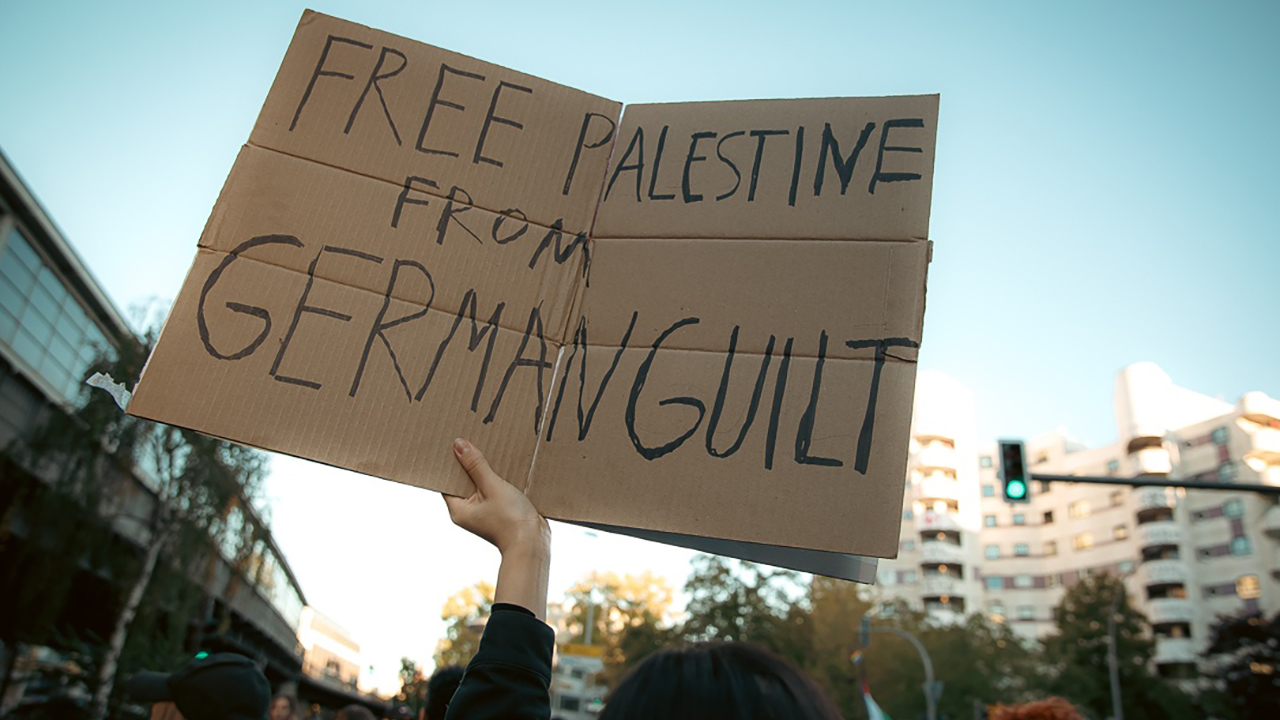
But not everyone will agree on what that means, said Michel Rosenfeld, a professor of law and comparative democracy at Yeshiva University’s Cardozo School of Law. A memo accompanying the bill includes as examples chanting “From the river to the sea, Palestine will be free,” or displaying maps in which Israel is replaced by a Palestinian state.
The Foundation for Individual Rights and Expression, an American free speech watchdog, has warned that similar laws could come to American soil.
“We can expect similar bills and regulations to pop up across borders,” the foundation said in a statement. “That’s why the First Amendment is so vital — it can act as a bulwark against speech restrictions that have advanced in other nations from doing the same here.”
In the United States, such a law would be a blatant violation of the First Amendment, scholars say. But Germany, where Holocaust denial, Nazi symbols, and even public insults are already criminal offenses, has long drawn the boundaries of protected speech differently.
“Under German law, antisemitic pronouncements amount to hate speech and can be criminalized,” Rosenfeld said. “In the United States, you can say antisemitic things as much as you want. It’s free speech.”
In Germany, supporters of the bill have argued that antisemitism is occurring “openly on our streets” and pointed to the surge in antisemitic incidents post-Oct. 7 as evidence that stronger measures are needed. Just this week, a 65-year-old German man was assaulted and left with life threatening injuries after an argument over an Israeli flag pin he was wearing, according to German authorities.
Those incidents are why Shannon Seban, director of European affairs for the Combat Antisemitism Movement, hopes the German bill will serve as a model.
“Our judicial system needs to evolve in order to adapt to this new reality, and to the fact that you have contemporary forms of antisemitism,” Seban told the Forward. “I hope that plenty of other European countries will now adopt such a law.”
But that prospect worries some Jewish Americans, who argue that prison time for anti-Zionist speech is a bridge too far. Even organizations that have argued anti-Zionism can veer into antisemitism have generally not envisioned such speech as the basis for criminal prosecutions.
“I have a real issue of criminalizing any thought or speech, regardless of what it is,” Rachlin said.
The German context
According to Rosenfeld, the bill should be understood in the context of Germany’s postwar constitutional order. In the aftermath of World War II, the Allied powers outlawed the Nazi Party and banned its symbols as part of the country’s “denazification.” Those restrictions were later incorporated into German law, reflecting the country’s commitment to preventing the reemergence of Nazism.
That history shapes Germany’s relationship with Israel. The two countries maintain what German officials describe as a “special relationship,” borne out of Germany’s responsibility for the Holocaust, with Berlin defining Israel’s security as part of its Staatsräson, or reason of state.
“In Germany, the Jewish state and standing for the Jewish state is particularly important in that it’s, if you wish, an inescapable outgrowth of the Nazi period,” Rosenfeld said.
Israel’s Ambassador to Germany, Ron Prosor, lauded the bill as a signal that “those who deny Israel’s right to exist and spread antisemitic incitement will not get away with it unpunished.”
The legislation may also reflect broader anxieties about Germany’s political trajectory. The far-right Alternative for Germany, or AfD, whose leaders campaigned on belittling Germany’s efforts to atone for the Holocaust, is now the second-largest party in the country’s parliament. A campaign to ban the party as unconstitutional has gained momentum, though faces an uphill battle given the AfD’s popularity.
But even this latest bill to criminalize denying Israel’s right to exist might not pass Germany’s constitutional test.
According to Rosenfeld, whether German courts uphold the proposal will depend in part on how they characterize anti-Zionism. If judges conclude that denying Israel’s right to exist is necessarily antisemitic, they would be more likely to view the restriction as constitutional and a part of Germany’s historic responsibility, he said.
On the other hand, if a judge understands anti-Zionism as political speech, then the bill would likely be struck down.
“It would be unconstitutional because not only is that a political opinion, but it would single out Israel,” he said. “In other words, to say that the United States should not exist, or that Cuba should not exist and the United States should take it over, that Canada should be the 51st state of the United States — you can say all these things, but you can’t say that Israel should not exist?”
But others don’t see any inconsistency. Seban, a French politician who spoke out against antisemitic comments directed at her during her campaign, maintains she supports free speech as “a fundamental principle of our democracy.”
At the same time, Seban said she doesn’t view the language the bill targets as deserving of legal protection.
“When you would like to erase a country from the map, a country that has been recognized by international organizations and such, it’s no longer free speech. It’s a call to violence. It’s a call to destroy states. It’s a call to erase people,” Seban said. “So there is no free speech anymore.”
‘Non-legally binding’
For years, antisemitism watchdog groups like the Anti-Defamation League have advocated for U.S. states to pass legislation adopting a definition of antisemitism that treats most expressions of anti-Zionism as antisemitic.
But it was always with a caveat: the definition, written by the International Holocaust Remembrance Alliance, would be “non-legally binding.”
In practice, that meant institutions such as schools, branches of government, or law enforcement could use the definition as a training tool or guideline to help identify antisemitism — not for criminal prosecution.
For example, on its website, the ADL says it “does not support the adoption and application of the IHRA Definition in a manner that would create new categories of legally prohibited speech that are subjected to either civil or criminal penalties – something we believe the First Amendment and principles of free speech would prevent.”
The ADL did not respond to the Forward’s question about its stance on the German bill, instead directing the Forward to speak with the Central Council of Jews in Germany, which backs the bill.
“Freedom of expression is a fundamental right of the utmost importance and a vital safeguard of our democracy,” Katharina Glinder of the Central Council of Jews in Germany wrote in a statement to the Forward. “Yet it, too, is subject to legal limits and must yield where human dignity is violated. Anyone who calls for the annihilation of peoples or the destruction of entire nations must not be allowed to hide behind fundamental freedoms with impunity.”
Glinder added that the bill could “serve as a model for other liberal democracies to follow.”
Remko Leemhuis, director of the Berlin office of American Jewish Committee, which also supports the IHRA definition as “non-legally binding,” said in a statement that AJC supports the German bill, “provided it is designed to withstand constitutional scrutiny.”
Meanwhile, the Nexus Project — which wrote an alternative definition of antisemitism that does not classify all anti-Zionism as antisemitism — has argued that lawmakers undermine the premise that IHRA is “non-legally binding” when they codify it in legislation.
Rachlin said Germany’s proposed bill illustrates that slippery slope, calling it the logical next step after the country codified the IHRA definition into law in 2017. He said he wouldn’t be surprised if such a proposal to criminalize anti-Zionism cropped up in the U.S. — though that doesn’t mean it would pass constitutional muster.
“Could this happen at the federal level? Maybe. Could it happen at the state level? I could see that happening,” Rachlin said. “Would it be challenged? Yes.”
Yet Rachlin also acknowledged that his commitment to a more absolutist version of free speech stems from what may be a distinctly American tradition.
“I can hate what you say, but I’ll defend it because you have the right to say it,” Rachlin said. “That’s kind of the American viewpoint on this. In Europe, it’s a very different game.”