

Related Stories:
- Mystery over: Here’s the kibbutz where Bernie Sanders volunteered in 1963
- Local Jewish voices speculate on the Sanders phenomenon
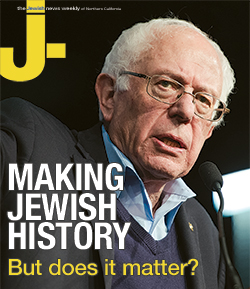
Bernie Sanders is having a month of historic firsts.
In New Hampshire on Feb. 9, he handily won the Democratic Party contest, becoming the first Jew to win a presidential primary. In Iowa, he became the first Jewish presidential candidate to win delegates in a major party’s caucus or primary. What’s more significant is that he’s the first Jew to mount a credible campaign for the White House.

It’s not that credible Jewish politicians haven’t run for president before. There was Republican Sen. Arlen Specter in 1996 and Democratic Sen. Joseph Lieberman in 2004. But they were out of step with their parties and their candidacies went nowhere.
Sanders doesn’t go out of this way to highlight his Jewish background, nor have his supporters or opponents made it an issue. The Jewish community has not rallied around him, nor has there been, until now, any Jewish groundswell of public pride or anxiety over his campaign. No calls have been issued for Jews to support their fellow Jew.
Contrast this with the prominence of gender in discussions of Hillary Clinton’s candidacy.
Former Secretary of State Madeleine Albright and feminist icon Gloria Steinem caused a stir several days ago when they seemed to rebuke younger women who back Sanders over Clinton.
“There’s a special place in hell for women who don’t help each other!” Albright said.
Meanwhile, American Jews are united in comparative nonchalance about Sanders’ Jewishness. Partly that’s because few expected he would do so well. But it’s also because Lieberman already broke the Jewish glass ceiling. His 2000 vice-presidential run proved Americans were prepared to put a Jewish candidate a heartbeat away from the presidency.
Of course, Lieberman wasn’t just a Jewish candidate. He was a very Jewish candidate. He wore his identity on his sleeve: an Orthodox Jew outspoken in his support for Israel and other Jewish causes.
Sanders is different. He describes himself as “not particularly religious.” He is married to a non-Jewish woman. He is aloof from Jewish communal life. A Sanders campaign ad described the candidate simply as “the son of a Polish immigrant.”
Tellingly, last Rosh Hashanah, Sanders wasn’t in synagogue. He was in church — at Liberty University, the conservative Christian educational citadel founded by the late Rev. Jerry Falwell. Sanders was there preaching his secular brand of social justice gospel. Democratic socialism, not Judaism, is his real religion.
But Sanders is also, in his own way, a very Jewish candidate. It’s not just his Brooklynite bearing that marks him as inescapably Jewish. Nor is it the fact that he volunteered in Israel on a kibbutz (see sidebar). After all, former Republican presidential hopeful Michele Bachmann also worked on a kibbutz, and her 2012 presidential campaign’s Judaic highlight was her mangling of the word “chutzpah.”
Rather, Sanders’ personal and political story is emblematic of a whole generation of Jewish idealists.
Sanders was far from the only young Jew in the early 1960s to fervently embrace socialism, following in the footsteps of Jewish radicals from earlier eras. Like many Jews, Sanders was deeply invested in the black struggle for civil rights. After college, he was in the vanguard of the mini-migration to Vermont of socially conscious Jewish urbanites going “back to the land.”
Today, Sanders invokes his Jewish roots to explain his passion for combating bigotry.
In one of his campaign’s most memorable moments, a young hijab-wearing woman at a Sanders rally told the candidate she was worried about anti-Muslim rhetoric in American politics. Sanders beckoned her over for a hug.
“I’m Jewish,” he said. “My father’s family died in concentration camps. I will do everything that I can to rid this country of the ugly stain of racism.”
Sanders’ disconnect with organized Jewry, his attenuated religiosity and his marriage to a non-Jew are not atypical for American Jews, plenty of whom are unaffiliated, secular and intermarried. Sanders fits comfortably into the growing category that Jewish demographers dub “just Jewish.”
At the same time, Sanders’ staunchly left-wing stances occasionally have taken him outside even the liberal mainstream of American Jewish politics. For instance, Sanders backed the Rev. Jesse Jackson’s presidential bids in 1984 and 1988, despite the black leader’s then-acrimonious relationship with the Jewish community.
On Israel, Sanders expresses positions that would put him at odds with Jewish communal leaders. He has strongly criticized Israel’s treatment of the Palestinians and suggested that as president he would “maintain an evenhanded approach to the area.” Yet he has come under fire from anti-Israel activists, as when he was heckled at a 2014 Vermont town hall meeting for expressing sympathy with Israel over the threat it faces from Hamas rocket attacks even as he condemned Israel’s conduct in Gaza.
Iowa and New Hampshire can’t tell us much about how Sanders will perform with Jewish voters, and Clinton has plenty of Jewish devotees. But these early contests do indicate that Sanders’ Jewishness isn’t hurting him with Democrats. If anything, Sanders’ fans find his disheveled-old-Jewish-socialist-from-Brooklyn image to be a charming badge of authenticity.
Still, there are those who think being Jewish can be a political liability. New York City’s former mayor, Michael Bloomberg, who is toying with the idea of jumping into the presidential race, once expressed doubt that America would elect a “short, Jewish, divorced billionaire.” Bloomberg may be correct that being a billionaire or short could be a liability, but is he right about Jewishness?
Polling suggests that politically, Jews may be America’s most popular religious group. Jews are warmly regarded by Democrats and Republicans, evangelicals and atheists. A recent poll by the Pew Research Center found that only 10 percent of Americans are less likely to vote for a Jew for president, compared with 20 percent who said they were less likely to vote for an evangelical Christian.
Sanders’ identity as a socialist may be much more problematic: 50 percent of Americans say they wouldn’t vote for a socialist. And the fact that he’s not particularly religious could be a liability: 51 percent of Pew respondents said they were less likely to vote for an atheist for president.
If Sanders’ Jewishness is not an issue, perhaps it’s because Jews are so well-integrated into contemporary American life. Indeed, Sanders is not the only presidential hopeful with intimate Jewish ties. Clinton, his rival for the Democratic nomination, has a Jewish son-in-law who donned a yarmulke and tallit at his wedding to Chelsea Clinton. The winner of New Hampshire’s Republican primary, Donald Trump, has a daughter who converted to Judaism and goes to an Orthodox synagogue. What’s remarkable is how unremarkable this is.
Mystery over: Here’s the kibbutz where Bernie Sanders volunteered in 1963
ben sales | jta
On a kibbutz in northern Israel, Bernie Sanders would wake up at 4:10 a.m. every morning to pick apples and pears.
Leaving the cabin he shared with fellow American college students, Sanders would have a quick bite of bread before heading out to the orchard. After 21/2 hours of work, he and the other 20 or so volunteers would sit down for a traditional 30-minute Israeli breakfast of tomatoes, cucumbers, onions, butter and hard-boiled eggs.

Then it was back to work. Probably.
It’s hard to know his routine for sure, but that spartan schedule was standard fare for American and French volunteers at Sha’ar HaAmakim, the kibbutz where the Democratic presidential candidate apparently spent several months in 1963. The name of his kibbutz had remained a mystery until last week, when the daily paper Haaretz unearthed a 1990 interview with Sanders identifying the agricultural commune.
No one currently at Sha’ar HaAmakim remembers Sanders, who has preached his doctrine of democratic socialism on the campaign trail. No records with his name survive.
But Albert Ely, 79, who managed the kibbutz volunteer program in the early 1960s, remembered someone named Bernard. And he said that if Sanders was there, he was probably picking fruit before the sun rose.
“I was astonished that the name Bernard, which is French, belonged to an American,” Ely said, sitting in his home on the kibbutz. “I remember a lot of volunteers. I don’t remember him. If he was here, he was with the Americans.”
Founded in 1935 by immigrants from Romania and Yugoslavia, Sha’ar HaAmakim sits at the nexus of two valleys near the northern port city of Haifa. During Sanders’ time, its members grew apples, peaches and pears, and were opening a factory for solar water heaters. The kibbutz also boasts a flour mill.
But ideology, as much as agriculture or industry, drove Sha’ar HaAmakim in the ’60s. The kibbutz belonged to the Israeli political party Mapam, which in the 1950s had been a communist, Soviet-affiliated faction. Kibbutz members had admired Joseph Stalin until his death, and they would celebrate May Day with red flags. They spoke of controlling the means of production, taking from each according to his abilities and giving to each according to his needs.

“All the members were equal in all ways,” said Yair Merom, the kibbutz’s current chairman. “They lived in identical houses. There wasn’t a salary; everyone received according to their needs. The kibbutz gave everything: food, shelter, education, health.”
Merom said Sha’ar HaAmakim is proud to have hosted a U.S. presidential candidate who trumpets its principles.
“Our values of mutual responsibility are social democratic values, and we choose willingly to create that society,” Merom said. “Sanders is talking about the social democratic approach that gives freedom to the individual, but with responsibility for the whole. We do that in a practical way.”
Socialist ethos permeated kibbutz life in the ’60s. All of the kibbutz’s 360-some members wore the same uniform: khaki slacks with a matching button-down shirt. After working in the morning and early afternoon, members often would attend committee meetings where they would discuss the kibbutz’s problems. Until 1991, as at many other kibbutzim, kids lived apart from their parents at a children’s house.
Several things, according to Ely, were considered “taboo” or bourgeois: skirts, playing cards, neckties, ballroom dancing. Instead, when they weren’t working or holding meetings, kibbutzniks would take classes on anything from English language to choral singing. Once or twice a week they would dance to Israeli folk songs. Tuesday was culture night.
“In the ’60s, the members were very idealistic,” Ely said. “They believed in the path they were going on. They thought it was [also] the solution to other problems. They thought they had a mission to help the population outside to do as they did on the kibbutz.”
Kibbutz members tried to impart some of those values to volunteers, most of whom stayed for a one-month program of work and a weeklong hike. After they finished picking fruit at noon, ate lunch and rested for a few hours, volunteers would attend lectures on Zionism, the history of Israel and kibbutz life.
Fewer than 100 volunteers came annually to the kibbutz in the early 1960s, Ely estimates. Those who stayed longer than a month, like Sanders, likely would have worked in the cowshed or the fishery.
Some volunteers also built relationships with adoptive families on the kibbutz.
Although Sha’ar HaAmakim, like many other kibbutzim, underwent privatization in the early 2000s, its members still jointly own its factories and maintain a fund to support kibbutzniks in need.
Local Jewish voices speculate on the Sanders phenomenon
dan pine | j. staff
On the campaign trail, Bernie Sanders may downplay his Jewish roots, but one Bay Area rabbi thinks the rising Democratic presidential candidate cannot hide them.
“People say he looks like a prophet,” noted Rabbi Peretz Wolf-Prusan, chief program officer and senior educator at Berkeley-based Lehrhaus Judaica. “If you look at the [prophetic] Book of Amos, this country will be judged by how it treats its least able. [Sanders] is conducting a seminar in social economic justice with the American people.”
The Vermont senator, who this week became the first Jew ever to win a presidential primary, is now an object of fascination for students of American Jewish history, in part because of his persona — a near-caricature of the cranky Brooklyn Jew — and because he represents an age-old strain of Jewish left-wing activism.
Many American Jews have an “Uncle Bernie” who rails against reactionaries and the rich. Yet no Uncle Bernie ever got this far in a presidential race.
So far, Sanders has chosen to make little of his Jewish identity. Similarly, Jewish Americans so far seem to have held off from rallying around Sanders as one of their own.
“For most people, the first adjective when they think of Sanders is ‘socialist,’ and not ‘Jewish,’ ” said Eran Kaplan, the Richard and Rhoda Goldman Chair in Israel Studies at San Francisco State University. “He’s very different from [former vice presidential candidate] Joe Lieberman, whose Jewishness was much more front and center. Sanders is a product of older, pre-identity politics which came to dominate in the ’80s.”
Another SFSU Jewish studies professor, Marc Dollinger, echoes that contention.
“The surprising thing [about Sanders’ success] isn’t that he’s Jewish. It’s that he’s a socialist,” Dollinger said. “That may be why people weren’t excited. Here we have a genuine Jewish socialist asking for votes, and American Jews, are responding by saying ‘We’re happy you’re Jewish, but a socialist would never get elected.’ ”
Dollinger pointed out the paradox that a Jewish presidential candidate brushing aside his Jewishness is itself very Jewish. “[Sanders’] rejection of his identity as secular socialist leftist Jew — that is a definition of Jew. He can’t get away from it.”
Even if Sanders continues to make little mention of his Jewish identity, admirers such as Wolf-Prusan will draw a line between the senator’s roots and his message.
“I am deeply gratified that he is conducting a menschlichkeit, values-based dialogue with the American people,” the rabbi said. “Everyone wants to vote for the nice Jewish boy, but prophets are annoying. They tell you things you don’t want to hear, and that’s what he’s doing. He’s not concerned about winning Jewish hearts and minds, but with saving the American people.”