
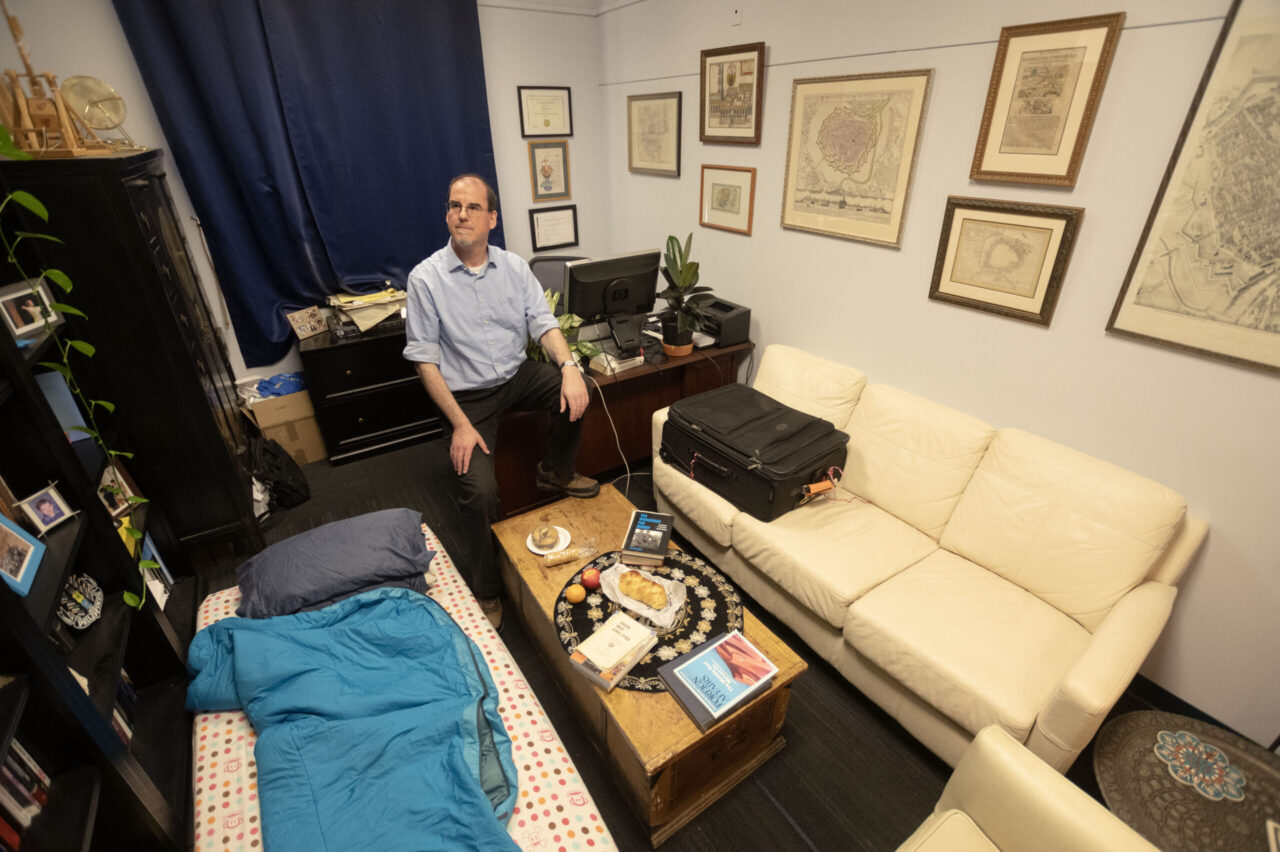
UC Berkeley professor Ron Hassner has gotten noticeably shaggier since turning his campus office into his temporary home a week ago. He sleeps roughly five hours a night in a sleeping bag atop a “cheapo” mattress. His goatee has grown into a nascent beard and mustache.
“Boy, would I love a shower,” Hassner told J. on Thursday by phone.
Hassner, faculty director of the Helen Diller Institute for Jewish Law and Israel Studies, jokes about being disheveled, but the reason is decidedly serious.
On March 7, he began an open-ended “sit-in protest,” vowing to teach, eat and sleep in his cramped office until the university administration meets a series of requests related to a wave of anti-Zionist activity and antisemitism on campus since Oct. 7 that has many Jewish students feeling anxious and upset.
More than 100 students and community members file into Hassner’s narrow office each day to meet with him, he said, and his email inbox is overflowing with supportive messages from students, professors and well-wishers across the globe. His story has been reported by numerous media outlets. Actor Michael Rapaport stopped by on Friday and met with Hassner and students, posting it on his Instagram with 2.1 million followers.
“I was inspired by meeting Ron Hassner! What he’s doing is brave and needed,” Rapaport said in a separate comment to J. “I’m also appalled by what I learned about the long history of anti-Jewish behavior on the campus of UCB. I had no idea, and it’s disgusting and unacceptable.”
Despite the physical challenges of the sit-in, Hassner said he enjoys sharing the donated meals and baked goods he’s received with the students and others who visit him.
“A student yesterday said to me, ‘This office is my haven on campus. This is where I feel happy. This is where I’m surrounded by friends,’” he told J.
Hassner’s decision to upend his life for a cause — uncharacteristic for him, he said — came in response to escalating events on his campus and what he and others see as a failure of university administrators to protect Jewish students.
An anti-Israel demonstration on Feb. 26 outside Zellerbach Playhouse turned violent when protesters shut down a visiting Israeli speaker, pounding on the outside glass until it broke, entering the theater and forcing the speaker and audience to flee through an underground hallway.
For much of the past month, a daily anti-Israel demonstration has blocked access through the main arch of Sather Gate, and Jewish students have reported harassment and intimidation as they walk through the side arches.
On Monday, about 250 Jewish students, faculty and allies responded with a silent march from Zellerbach past Sather Gate, calling attention to two campus locations where tensions have flared.
Though Hassner is relieved that there was no violence around the silent march, he said that protesters remain present at Sather and that Jewish students still feel unsafe and fear harassment when walking through the gate.
“It’s now been more than a month since that illegal barricade went up,” he said. “I understand that students are extremely frustrated, extremely humiliated, and I am even more worried about the next march, and I will be even more worried about the march after that.”
When Hassner began his office sit-in, he emailed UC Chancellor Carol Christ and Provost Benjamin Hermalin with three requests to support Cal’s Jewish students: unblocking Sather Gate to allow student access; establishing antisemitism and Islamophobia training for incoming faculty, resident advisers and leaders of registered student organizations; and issuing an apology and new invitation to Ran Bar-Yoshafat, the Israeli lawyer and reservist whose talk at Zellerbach was disrupted on Feb. 26. Hassner also asked that the protocol be in place should any future speakers be interrupted by hecklers or violence.
“If my students feel that they cannot walk safely across campus without being bullied,” he wrote to them, “then I will not cross campus either.”
A week after presenting the administration with his requests, Hassner told J. he has not had any conversations with administrators, though his colleagues have.
“I know the administration is working on this,” Hassner said. “I’m confident that the administration is trying to get something done.”
On Friday afternoon, one of Hassner’s requests may have been fulfilled. The pro-Israel student group Tikvah announced that Bar-Yoshafat is set to return and speak on campus Monday, without publicizing the location.
Meanwhile, Hassner said that a dozen Berkeley colleagues have decided to show support for his sit-in by moving their courses out of the classroom and onto Zoom.
He’s also heard from professors across other University of California campuses, as well as from East Coast universities, who say they’re facing similar issues of antisemitism on their campuses and are seeking a network of support. Hassner hopes that others will join him by sleeping in their offices for one night as a “campus vigil across the United States.”
“I’m trying now to up the ante a little and say it’s cool that you’re teaching by Zoom, but please take a selfie of yourself on the office couch with a blanket and a pillow,” Hassner said, “so that other colleagues around the country see that there’s a real groundswell of anger at this antisemitic outrage.”