

Books coverage is supported by a generous grant from The Milton and Sophie Meyer Fund.
Sammy, a nonbinary tween, is trying to figure out how to ask their family to refer to them using their preferred pronouns.
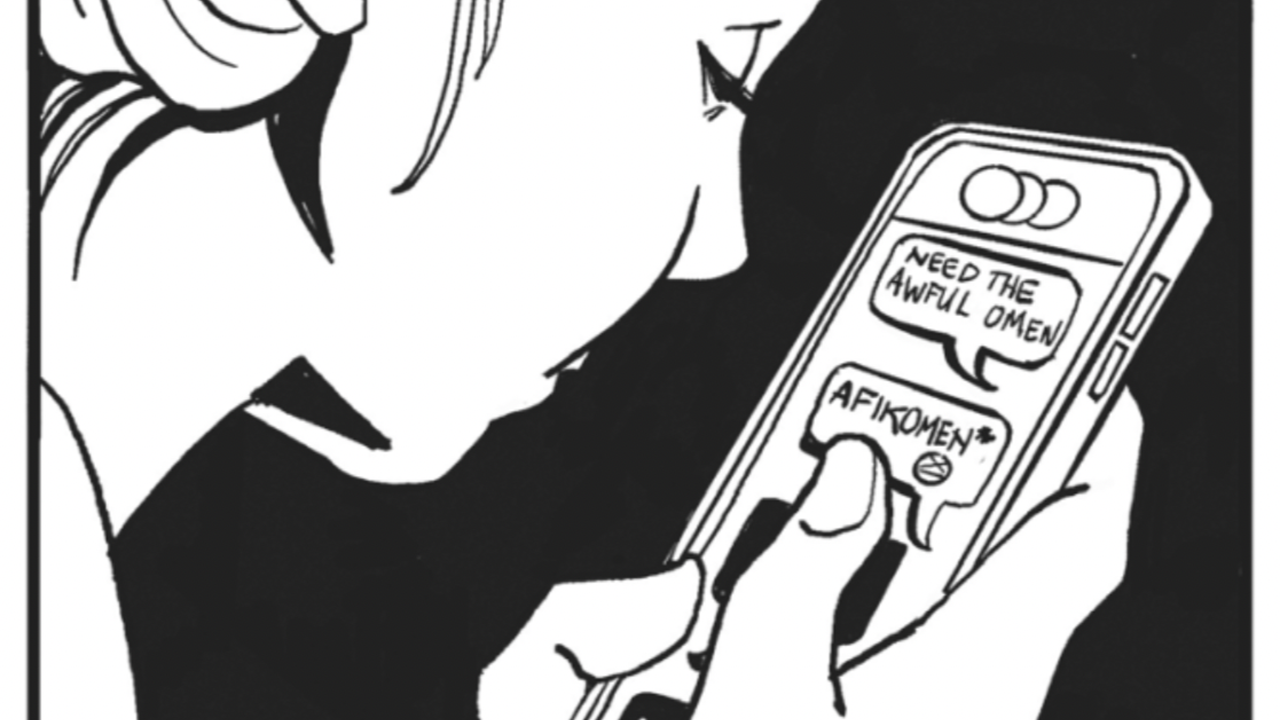
They decide that the best time will be at Passover when the whole family is together. Plus, they have a family tradition: Whoever finds the afikomen gets to request a special prize. If Sammy can find the afikomen, they can request new pronouns as the prize, and their family can’t refuse. The only problem is that Sammy’s cousin, Ava, always finds the afikomen.
“The Awful Omen” is a “different kind of coming out story,” said Oakland author A. J. Sass, whose short story about Sammy appears in the new Passover anthology for middle-schoolers titled “On All Other Nights.”
“For Sammy, the fear of coming out is not necessarily with worrying that their parents and their family will accept them, but instead social anxiety,” Sass, 40, said in a recent interview. “I think coming out stories are important. I wrote one myself, ‘Ana on the Edge.’ But I feel like with queer experiences, there’s such a wide spectrum. … It’s good to have diversity in how you’re portraying coming out.”
Sass’ stories are often about self-discovery, a journey he has been on for most of his life. Today Sass, who uses he/him and they/them pronouns, identifies as both nonbinary (neither male nor female) and “transmasculine,” meaning he does not identify with the gender assigned to him at birth, and his gender identity and expression are masculine-leaning.
As a queer and neurodivergent Jewish author, he stresses the importance of diverse representation in youth literature — something he didn’t have growing up.
“It’s really wonderful that books are getting published that depict various different ways of being Jewish and nonbinary and neurodivergent,” he said. “I’m hopeful that the more books that come out, the more kids feel seen.” (Neurodivergent, which describes people whose brains develop or work differently than what is considered “neurotypical,” includes conditions such as autism, dyslexia and ADHD.)

“Just Shy of Ordinary,” Sass’ middle-grade novel that was also published this year, features a young Jewish character grappling with tough topics, ranging from gender identity to mental health to Jewish identity.
The plot follows 13-year-old Shai, an academically bright, neurodivergent kid who has exclusively been homeschooled. Shai wants to attend public school for the first time, which sets off a chain of events, including skipping a grade. Shai begins investigating their Jewish heritage as part of a school project, leading them to question their Jewish identity and their place in the Jewish community. While all of this is happening, Shai also comes out as nonbinary, but they’re really more concerned about just making it through freshman year.
Like many authors, Sass draws inspiration for his stories from his own life.
“I knew I was different as a kid, but it was hard to tell in what way,” Sass said. “Because there were so many intersecting things, with not knowing I was queer and not knowing I was autistic, and also being in really small towns and very connected to Judaism but surrounded by Christian communities.”
Sass grew up in the Midwest and South in a Lutheran family and spent time in Wisconsin, Minnesota, Nebraska, Iowa, Michigan and Georgia. He converted to Judaism after college, but he recalls being interested in it from a young age. He cites “Number the Stars,” the Newbery Award-winning historical fiction book by Lois Lowry, as what made him want to become an author and as his first introduction to Jewish culture and beliefs. The story follows the escape of a Jewish family from Copenhagen, Denmark, during World War II.
“I didn’t know what Judaism or being Jewish really meant at the time, since this would have been around third grade,” he said. “So I started checking out books on the topic, both fiction and nonfiction, and educating myself. I felt a very immediate connection to it that I cannot explain.”

Much like his character Shai, Sass was academically advanced and skipped a grade in high school. At 15, he began college courses and ended up graduating with his associate’s degree in liberal studies a month before finishing high school. Sass went on to earn degrees in Jewish studies, psychology and religious studies with a minor in Hebrew from the University of Minnesota. Sass, a member of Temple Sinai in Oakland, was in college when he began regularly attending synagogue.
“It was really intertwined with my realizing that I’m trans. I primarily attended a modern Orthodox shul, and it was really interesting for me because at the time, I was still presenting as a woman. So I was on the women’s side with a mechitza,” a divider that separates the sexes, he said. “And I found myself often staring at that, more than actually paying attention to services sometimes, because there was something that I couldn’t quite define that felt uncomfortable about being separated between genders.”
Sass eventually moved to California to attend University of the Pacific’s McGeorge School of Law in Sacramento. He said he started reading children’s books to unwind after long days of studying, and that’s what sparked his interest in writing youth literature.
“About halfway through my studies there, I realized I didn’t actually want to practice law, but I was a bit stubborn,” he recalled. “I just kept going to finish with a degree. But it was around that time that I turned to children’s fiction books as a kind of creative outlet and something to decompress my brain after poring over legal textbooks.”
After finishing law school, he worked as a technical writer and legal editor while writing stories on the side. He had been writing for about a decade before his breakout novel, “Ana on the Edge,” was published in 2020. It’s one of the many books banned in numerous Texas school districts due to its subject matter.
The story is about a passionate tween skater who finds herself navigating gender identity within the world of figure skating. It’s a world Sass knows well, as a senior level figure skater and ice dancer who has been involved in the sport since childhood.
While he was working on his second novel, “Ellen Outside the Lines,” which is about a queer autistic Jewish girl who goes on a class trip to Spain, Sass was diagnosed with autism. He had suspected he was neurodivergent for a while, but the formal evaluation process was long and costly. This experience influenced his diverse portrayals of neurodivergence.
“With ‘Ellen Outside the Lines,’ I have a kid who has a diagnosis of autism and a supportive family. They have an IEP [individualized education plan] at school that can help them. They have a therapist and stuff like that,” Sass said. “With ‘Just Shy of Ordinary,’ it was more my personal experience growing up. Shai had a feeling they were neurodivergent in some way, but didn’t know what it was by the end of the story because they just didn’t have as much access to psychologists that could diagnose it.”
Altogether, he has had four middle-grade novels published, and his writing has appeared in three anthologies. He also has an upcoming children’s picture book titled “Shabbat Is…” that follows three children as they celebrate Shabbat in different ways with their families.
“If you’ve met one Jewish person, or one autistic person, or one queer person, you’ve literally just met one person from a group,” Sass said. “We all have different experiences.”
This year, Sass is celebrating Passover a little differently too. He’ll be in Bordeaux, France, representing the U.S. with the San Francisco ice Theatre Adult Team at an international competition. He says he will still organize a small seder meal in his hotel room while he’s there, though.