

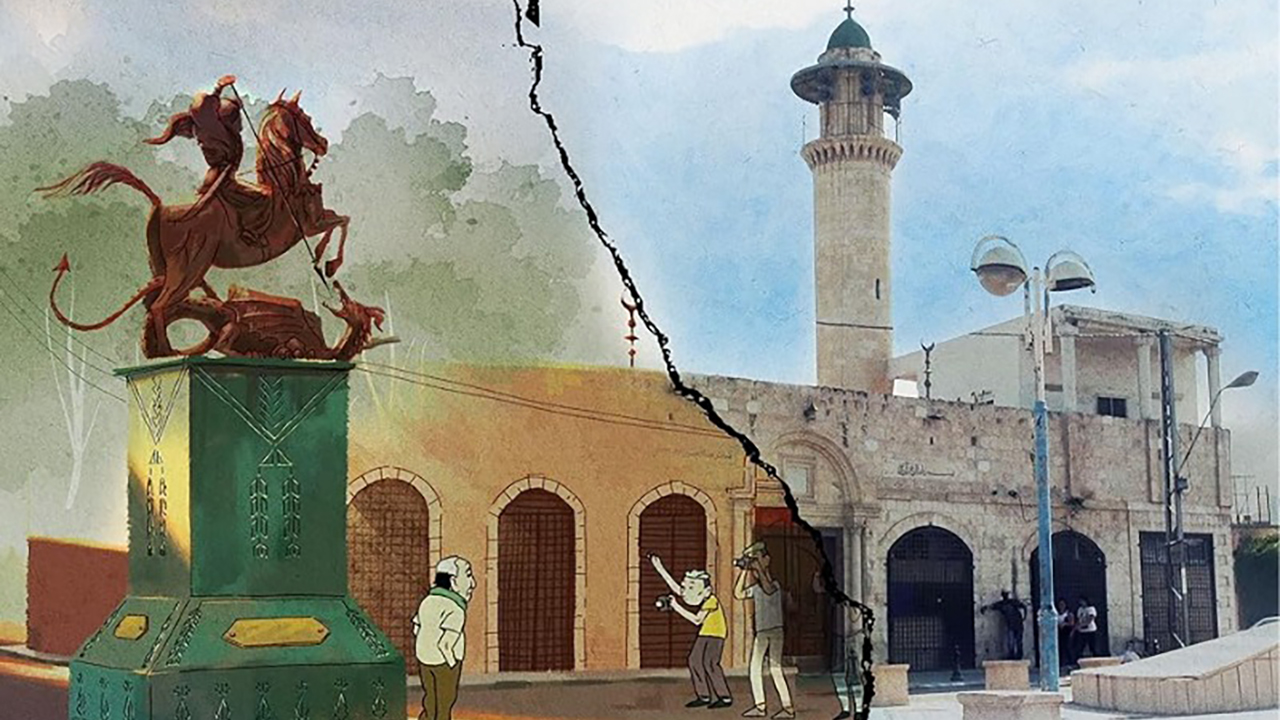
On Oct. 10, Israeli police surrounded the Al Saraya Theater in Jaffa, ordering the cancellation of a planned screening of the Palestinian sci-fi documentary “Lyd,” and detaining theater manager Mahmoud Abu Arisha for hours of questioning.
The raid was carried out following a letter that Israel’s Culture and Sports Minister Miki Zohar, a member of the ruling Likud party, sent to Israel Police Commissioner Daniel Levy. In it, Zohar claimed that screening the film amounted to an incitement to violence that could foment “unrest and tensions in mixed cities.”
But such heavy-handed censorship of the film could not be more removed from the reality of its message, or the diversity of the audiences it has already spoken to.
“Lyd,” which was co-directed by Rami Younis, a Palestinian, and Sarah Ema Freidland, a Jewish American, screened twice in the San Francisco Jewish Film Festival this summer, garnering positive reviews in the local press (including J.) and prompting thoughtful discussions of the film’s subject matter in and outside the theater.
I was fortunate to attend those screenings in my former role as marketing and communications manager at the festival, and saw firsthand the impact the film had on audiences in San Francisco and Oakland.
I’ve also been privileged to be a witness to the development of “Lyd.” While in a fellowship program in the Harvard Divinity School’s Religion and Public Life program a few years ago — along with Younis — I saw early cuts of the film, and this month I took on a role as an associate impact producer for the film.
As a filmmaker, history buff and lifelong sci-fi fan, I immediately fell in love with the film’s daring cinematic approach, which mixes traditional documentary styles with vibrant animation. It tells the story of Palestinian displacement and dispossession from what is now known as the Israeli city of Lod, and imagines what it would be like if things had been different.
While the film tells this story from a distinctly Palestinian perspective, it doesn’t shy away from including the voices of Israelis. Some of its most damning revelations come from newly uncovered Israeli state archive footage of Palmach soldiers describing the massacre and displacement of Palestinians in 1948 in their own words.
In the face of these real life historical horrors, and modern-day incitement and discrimination against Arab citizens of Israel, the film dares to present an alternative timeline in which Palestinians were never displaced. Perhaps even more boldly, it also imagines that Jewish refugees were welcomed in historic Palestine, living side by side with their Muslim and Christian neighbors in peace.
This vision is precisely what makes the film so dangerous to Israel’s far-right establishment.
The film “imagines a world where all people between the Jordan River and the Mediterranean Sea live without violence in a shared future,” co-director Friedland said in press release materials following the film’s cancellation in the Old City of Jaffa. “If Israel’s Ministry of Culture believes that vision is inciting, then they either have not watched the film, or they have no moral compass left.”
“Lyd” is far from the only Palestinian film facing censorship in Israel, and the draconian crackdown on it comes in a context in which Palestinians on both sides of the Green Line live under a culture of fear in which a social media post about Oct. 7 or the ongoing Israeli invasion of Gaza can result in jail time.
While the cancellation of the Jaffa screening was a setback, Younis took the news in stride. “If there’s one thing I learned as a Palestinian journalist and artist, is that if they go this viciously after your work, it means it’s vital to the moment,” he stated in a press release.
While American Jews have little direct say in the politics and policies of the Jewish state, we can choose to refuse the culture of censorship and fear that has led to the suppression of Palestinian voices in and outside of their homeland. It is still rare for mainstream Jewish communal spaces to screen films like “Lyd,” but doing so embodies the Jewish values of inquiry and free expression, and the vital role that film has to play in creating change.
Legendary film critic Roger Ebert once wrote, “For me, movies are like a machine that generates empathy. If it’s a great movie, it lets you understand a little bit more about what it’s like to be a different gender, a different race, a different age, a different economic class, a different nationality, a different profession, different hopes, aspirations, dreams and fears. It helps us to identify with the people who are sharing this journey with us.”
Whether we like it or not, Jews and Palestinians are locked into a shared journey together. The Palestinian experience of the creation of the State of Israel is challenging for many in our community, but making room to hear what challenges us can only expand our knowledge.
While a 79-minute documentary is not going to solve decades of entrenched conflict, a film bold enough to imagine that things could have gone differently in the past offers us a chance to make different decisions in the future.