

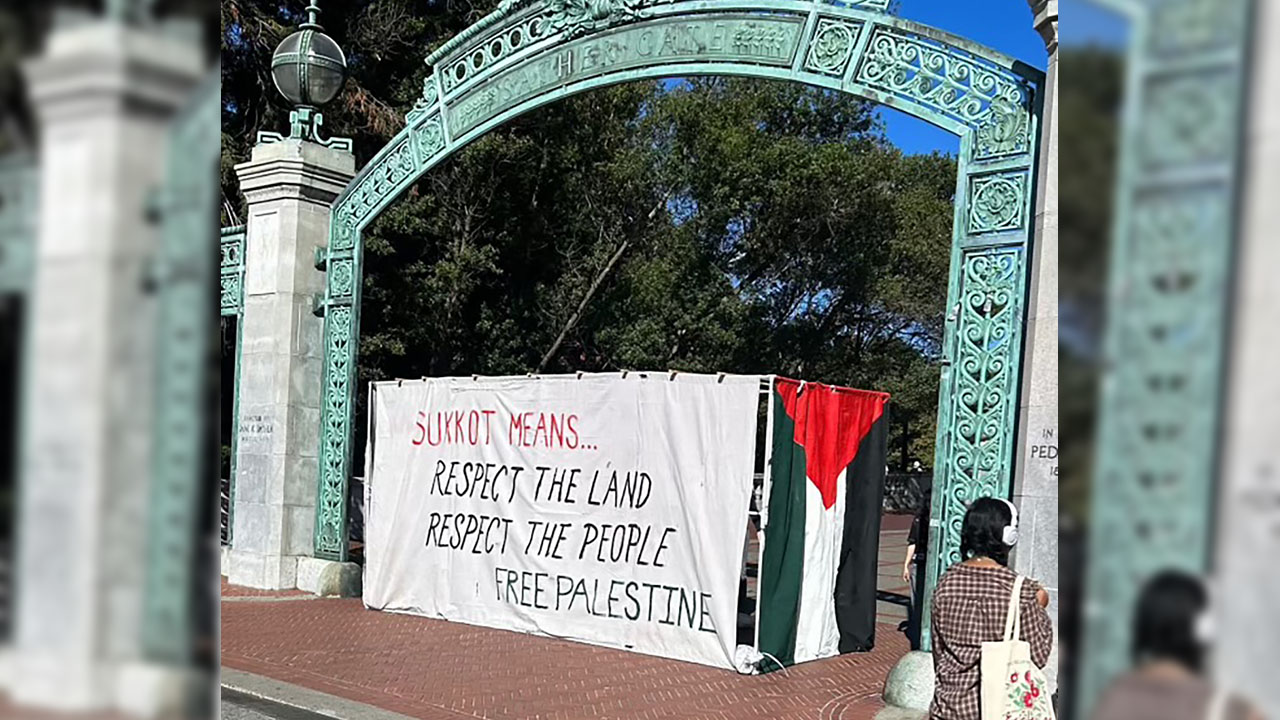
Anti-Zionist activists erected a “Gaza solidarity sukkah” on Oct. 17 at Sather Gate, the main entrance to UC Berkeley’s campus, on the first day of the Sukkot holiday.
When students did not heed a university warning to dismantle the sukkah, UC Berkeley administrators began taking it down at 6 a.m. the following day.
The Cal sukkah, erected by students from Jewish Voice for Peace, displayed the words “Sukkot means… respect the land, respect the people, Free Palestine.”
By blocking access through Sather Gate, the structure violated time, place and manner rules regulating student protests, according to university spokesperson Dan Mogulof. JVP did not seek administrative permission to build the sukkah anywhere on campus, Mogulof added.
In comparison with last school year, when pro-Palestinian students had months of uninterrupted protesting at the Gaza solidarity encampment on Sproul Plaza and at demonstrations at Sather Gate, the overnight response to remove the sukkah signaled a more muscular approach to student protests. New UC Chancellor Rich Lyons said in an Aug. 19 video address to students: “Behavior of that sort will not be tolerated.”
The sukkah at Sather Gate was the second protest blocking the entrance by anti-Israel activists last week. On Oct. 16, the gate entrance was blocked off for an hour as protesters displayed a banner that said “End Israeli apartheid” and “Free Palestine.” Students set up tents and used a loudspeaker.
Administrators and campus staff “were quickly assembled and dispatched to warn and admonish the students,” according to a statement on X posted by the university on Oct. 17. The statement noted that the demonstration “violated campus rules at Sather Gate” and included a link to information about campus safety and support resources explaining rules around political protests.
Mogulof discussed campus rules surrounding protests in an interview with J.
“The university has communicated on more than one occasion this academic year about what the campus rules are, about how important the time, place and manner rules are in terms of supporting both students’ rights to free speech as well as the rights of students to attend classes and transit the classes without disruption,” Mogulof said.
Yet, the students who built the sukkah claim they didn’t know the rules they were violating, according to Gregg Drinkwater, the program director of the antisemitism education initiative, a project of the Center for Jewish Studies at UC Berkeley.
“In the various conversations I’ve had over the last couple of days, there’s a little bit of a lack of clarity around the extent to which the JVP students were fully aware of the policies and all the details of those policies,” Drinkwater said, adding that the administrator’s in-person warning to the students at the sukkah may not have been “sufficiently detailed.”
Mogulof said the warning issued on Oct. 17 was clear.
“They had more than 12 hours to dismantle it as requested,” Mogulof said, “and they chose not to abide by that request or by the rules.”
In a statement emailed to J., JVP members in Berkeley expressed disappointment with the university’s decision.
“We intended to spend the week in prayer and community but this has not been possible after UC Berkeley admin tore down our sukkah and hauled away our building materials,” the statement said. “It was extremely upsetting to have our only avenue to celebrate Sukkot as anti zionist Jews destroyed. … We are guided by our commitment to Tikkun Olam, and right now for us that means calling on the UC system to divest from arms manufacturers and calling on the US government to stop arming Israel which is destroying life in Gaza.”
When third-year student Sharon Knafelman approached the campus entrance on Oct. 17 and encountered JVP’s sukkah, she said she was “baffled and angry and upset.” She saw students inside the sukkah wearing kaffiyehs and kippot with watermelon designs.
“I just had to physically avoid it,” said Knafelman, who is president of Bears for Israel and a member of Berkeley’s Students Supporting Israel group.
She felt the sukkah was “politically exploitative.” Drinkwater, on the other hand, expressed support for JVP’s right to protest.
“We can and should make an extremely wide berth for what Jewish expressive activity looks like and how to do Jewish, and should not be policing that unless someone is doing something that is clearly harassment or discriminatory in the name of their Jewish values,” Drinkwater said.
A different story played out Monday at UCLA, where another protest sukkah was erected. Police arrested one student for failure to disperse. Police then dismantled the structure. This came after pro-Israel students showed up to engage in a counterprotest, according to the Los Angeles Times.