

Updated at 4:19 p.m.: This article has been corrected to reflect that sloths are first-grader Daniel’s favorite animal, not his second favorite.
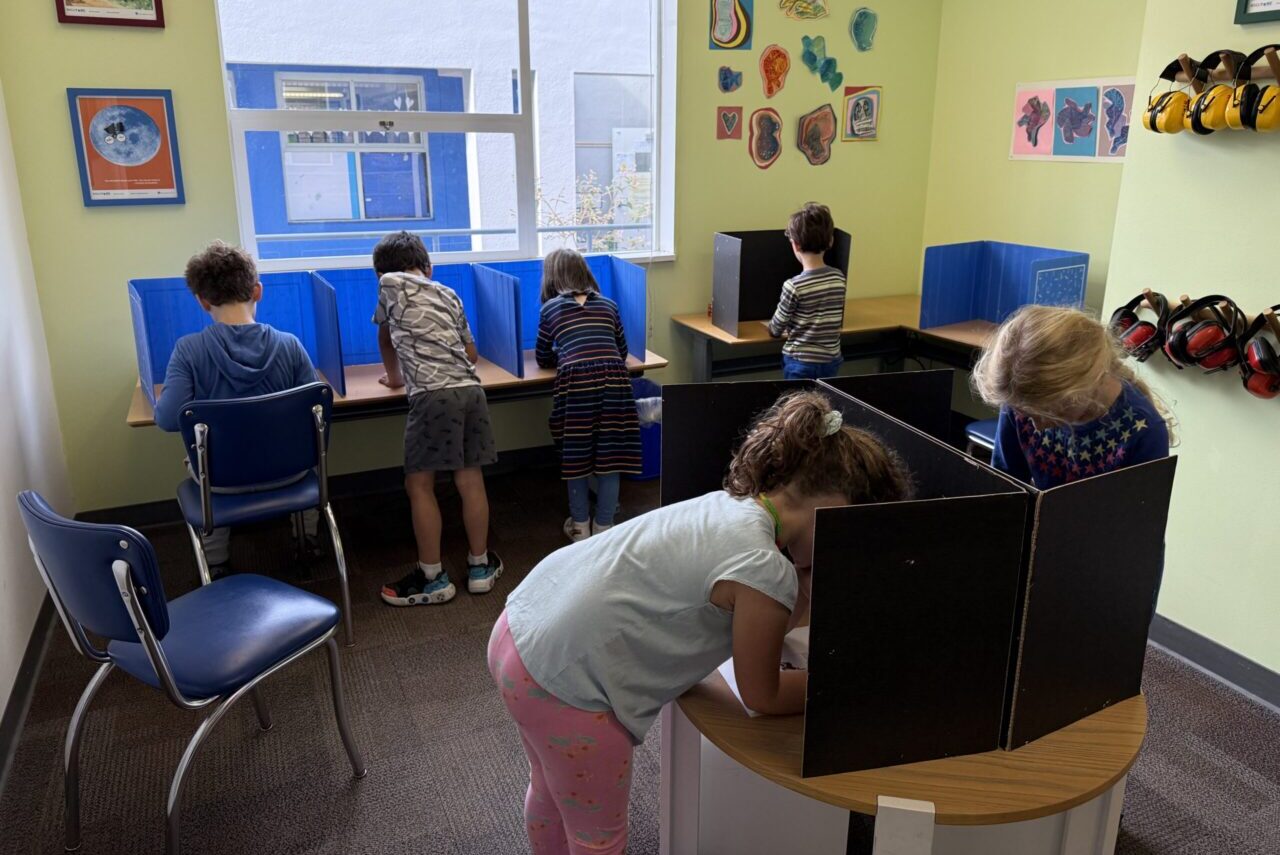
While millions of Americans anxiously cast their ballots on Tuesday and waited to see who would lead the country, a very different kind of election took place at a Jewish elementary school, one designed to help young students learn how to disagree.
Students at the Brandeis School of San Francisco voted for their first-ever lower school president. Rather than choosing a human being, though, students were presented with inanimate, though quite cuddly, alternatives: stuffed animals.
“I wanted the lower school students to learn about the process of the election because it’s really important for kids to understand all of the details behind the election,” said Jenny Rinn, director of the lower school for K-4. “I wanted to take the focus off of a very heated national campaign. I didn’t want that to be the discussion in the classroom, not with lower school students.”
Rinn hatched the plan to elect a stuffed animal, or “plushie,” for president because “all kids love stuffed animals.” It was a way to teach about the democratic process in an age-appropriate way, she said.

The election, held at several polling places in the school’s main office, featured a roster of three candidates: Karen Koala, Ivan Ibex and Sloan Sloth. Each furry contender was chosen in a primary election in the beginning of October and represented one of three “political parties”: Kindness, Integrity and Service, which the school calls its core values.
Throughout the election season, Rinn led assemblies explaining what an election is, who can vote, the meaning of parties and candidates and how the election process works. Students were encouraged to consider each candidate’s unique qualities, experiences and positions on key issues.
Service candidate Sloth was praised for her gentle, non-aggressive nature. Integrity candidate Ibex was touted for his adaptability to harsh environments, as well as his strength and agility. Kindness candidate Koala was lauded for her harmonious existence with the environment and resilience in the face of habitat destruction. Koala and Sloth also both brought their babies on the campaign trail, demonstrating family values.
With the help of the fourth-graders, each candidate was linked to a one-sentence platform statement based on their party’s value. Together the students campaigned for their favorite plushie, making hand-drawn posters and hats, chanting slogans and preparing brief speeches on behalf of their cuddly candidates. They even held a convention, complete with walk-on songs, live performances from teachers and a roll call for delegates from each class to vote for a candidate.
According to Rinn, another one of the main goals of the election was to teach how to practice civil discourse based in Jewish values when opinions differ.

“We had to talk about positive campaigning and what that is and why we’re not going to engage in negative campaigning here at Brandeis,” said Rinn. “It does exist, but we’re not going to participate in that.”
To make the process even more similar to the U.S. presidential election, there was an electoral college. Classes of 20 or more got two electoral college votes, and classes of less than 20 got one electoral vote.
One of the lead campaign managers for Ibex, fourth-grader Cecily, donned a paper hat and a “Vote for Ibex” sign while eagerly watching the live election update during lunchtime. She said she mainly supported Ibex because he is from Israel — the wild goats are found in Eurasia, North Africa and East Africa — and because she believes integrity is the most important value. Cecily also attributes the poor turnout for Sloth to her supporters’ lack of campaigning.
“They were too lazy to make posters and stuff,” she told J.

While perhaps Sloth’s lack of campaigning was detrimental to her, each student had their own reasons for voting for their chosen candidates.
“I voted for Kindness Koala because my dad is Australian,” said first-grader Leora.
“Lots of people voted for Ibex, and I also have Ibex in one of my books,” said kindergartener Jema, who voted for Ibex.
“Because they’re super kind, and whenever somebody’s sad, you need to use kindness and be kind,” said first-grader Ora, who also voted for Koala.
“Because koalas are actually not as sweet as you think they are. They are actually very, very tough. They have very sharp teeth and claws, and they will scratch you if you try to, if a normal person would just touch a koala, it would scratch them or bite them,” said first-grader Brandon, another Koala supporter.

“I voted for Ibex because he’s honest,” said first-grader Alex.
“I like Sloth’s baby, and sloths are my favorite animal,” said first-grader Daniel.
In the end, it was a close race between Koala and Ibex. Despite Koala winning the popular vote in a last-minute turnabout, Ibex won the electoral college by a single vote.
The election, though whimsical, sparked meaningful conversations among students about the democratic process and the role of elections in society.
As for Ibex, Rinn said that his first presidential duty will be to visit each of his constituents in their classrooms to hear their comments and concerns about the school. She hopes to use Ibex’s position as a direct connection between the students and the administration and to further demonstrate that a president’s duty is to the people.