

I traveled to Poland in November 2006 at the age of 17 with a few dozen other American Jewish teens. One of our trip leaders, who visited Poland every November, said it was some of the worst weather he’d experienced there. It poured rain the day we visited Auschwitz, and there was mud everywhere — which set the mood perfectly.
That night we went back to a very comfortable, modern hotel. The dissonance of that day has stayed with me ever since.
Another day, after visiting Majdanek, we ate dinner at a cute, historical-feeling restaurant where a klezmer band of non-Jews played comically jaunty tunes as we ate.
The mixed feelings of both of those evenings came up in the back of my throat during two specific scenes in actor Jesse Eisenberg’s sophomore directorial effort “A Real Pain,” which I saw at a recent Jewish Film Institute screening at the Vogue Theater in San Francisco.
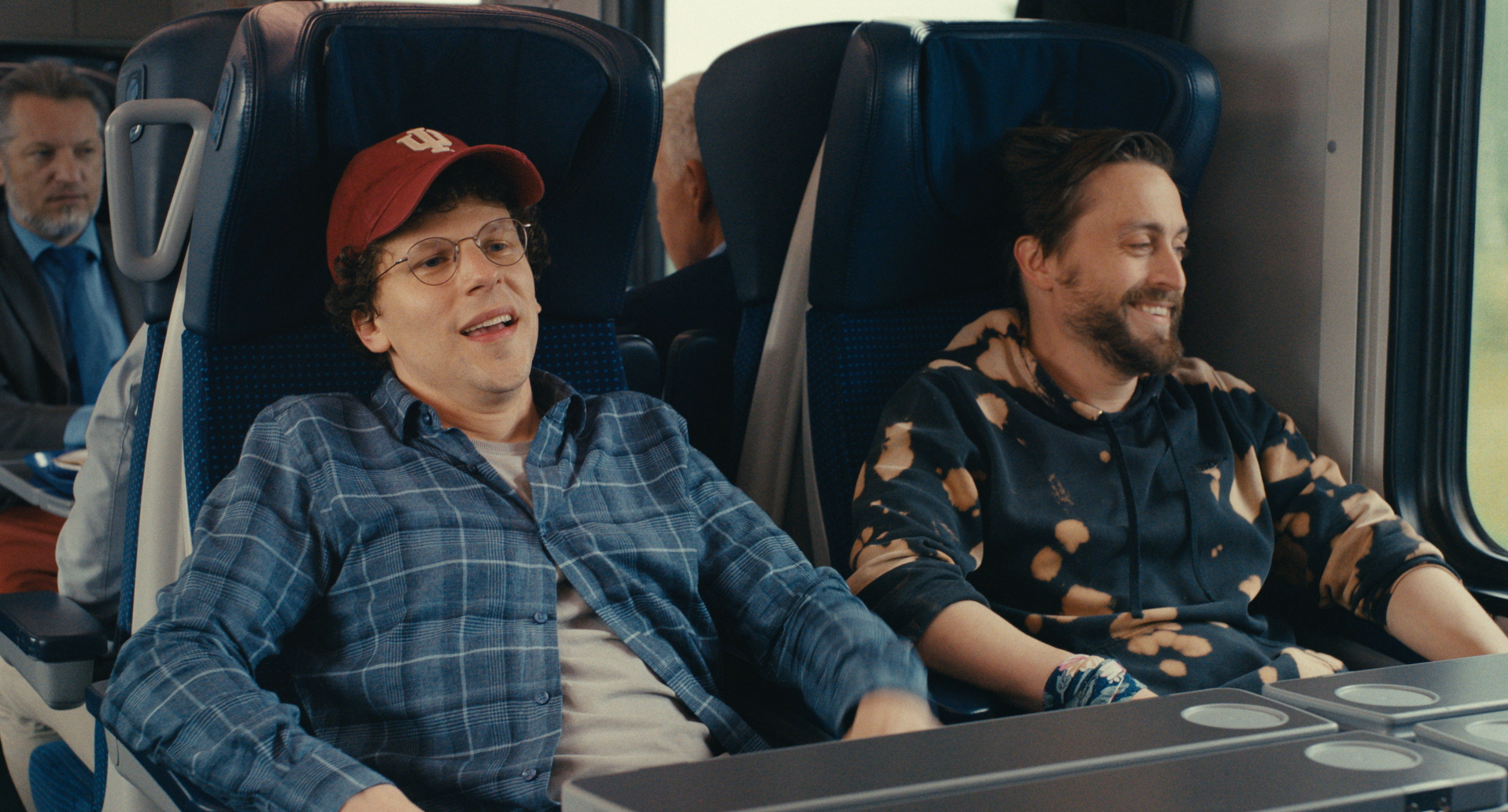
The film, which is playing across the Bay Area, stars Eisenberg and Kieran Culkin as cousins David and Benji. Once upon a time, they had a close relationship. Now all grown up, David is a tightly wound internet ad banner salesman with a wife and kids, while Benji lives in his mom’s basement and smokes too much weed. (He’s even mailed some to their Warsaw hotel so he can smoke in Poland.) Both loved their grandmother, a Holocaust survivor, very much. Now that she’s gone, they’ve decided to go on a Holocaust heritage trip.
They visit some of the usual sites in Poland with a motley tour group, including a non-Jewish British tour guide, some middle-aged American Jewish suburbanites and a survivor of the Rwandan genocide who converted to Judaism after moving to Canada. Benji and David leave the tour group early to visit their grandmother’s childhood home. Along the way, they hope to connect with each other, their shared heritage and the memory of their grandmother.
But neither can get far enough out his own head to connect with much of anything.
David and Benji represent two Ashkenazi male archetypes we’ve seen in many Hollywood and literary representations of Jewishness. David is the tightly wound, anxiety-riddled dyspeptic — Woody Allen with a sharper edge — right in Eisenberg’s acting wheelhouse. Benji is the raw truth-teller who says too much, too loudly, always at the wrong time, played by Culkin as a far less moneyed variation on his celebrated role as Roman Roy on “Succession.” Benji’s antics and outbursts drive David up the wall, while David’s jumpy close-mindedness angers Benji.
Most Jews — most people, I suppose — fall somewhere in between the two characters. Many who’ve seen the film tell me they often found the pair unbearably, awkwardly painful. I feel like I’m always one or the other, Benji or David, never in between; I found them awkward only in that they were too similar to me for comfort.

“A Real Pain” isn’t really a Holocaust film. It’s a family road trip dramedy, at turns uncomfortably funny and affectingly quiet and tragic, that confronts the way we engage in Holocaust tourism.
And yet, when it turns its attention fully to the Holocaust, it is more touching and honest than the vast majority of films set during the Holocaust manage to be.
One scene set and filmed at Majdanek, the best preserved of the extermination camps, is nearly silent. Eisenberg allows viewers, like the characters in the film, to wander quietly through the camp, confronting its sights with little commentary. Afterward, during dinner at a restaurant, a piano player interrupts an uncomfortable conversation among tour participants with an excessively upbeat rendition of “Hava Nagila.” The similarity to my own dinner the night after visiting Majdanek delivered a genuine shock.
In another scene, Benji freaks out on a train. He objects to sitting in first class, eating fine food and sleeping in nice restaurants on a trip about confronting the horrors of the Holocaust. His anxieties and jumbled emotions tumble out.
I didn’t freak out on a train, but I felt the same cognitive dissonance when I visited Poland. I imagine many Jewish viewers may have similar experiences watching “A Real Pain.”
Benji and David, like many American Jews, imagine they will have some flash of insight or deep connection with the past on such a trip. But I think the film itself offers a more realistic perspective — and this was my experience as well: You can go, you can see the camps, you can wrestle with the horror, but there’s no great revelation to return with. You go back to the same life you had before, and it all becomes pictures on your phone, like any other trip.