

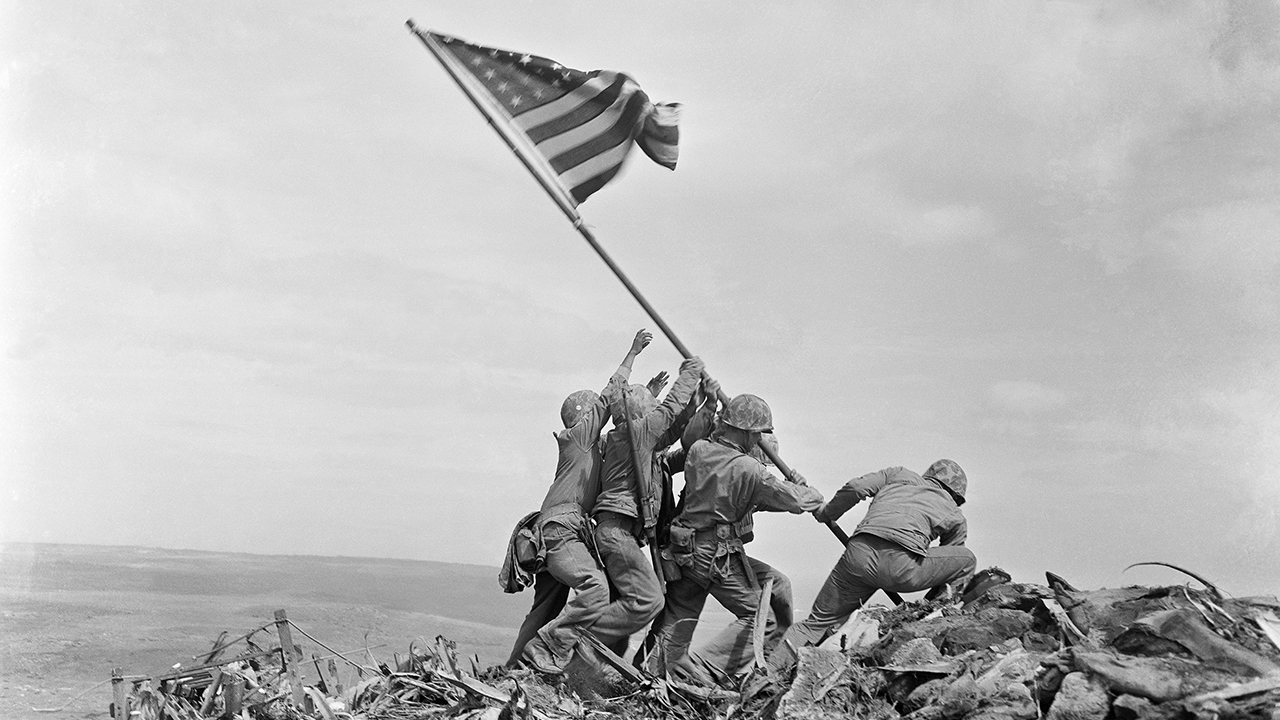
Joe Rosenthal’s iconic photo of six U.S. Marines hoisting the American flag on the Pacific island of Iwo Jima during World War II is a national treasure, recognizable to most Americans even if they don’t know the late photographer’s name.
San Francisco is hoping to change that. In October, the San Francisco Board of Supervisors approved a resolution to add a commemorative street name — Joe Rosenthal Way — to the 600 block of Sutter Street to honor his wartime and local photojournalism.
“He represents the spirit of American Jews to me, and I revere him,” Quentin Kopp, who served as a San Francisco supervisor, a California state senator and a Superior Court judge, told J.
Born in 1911 in Washington, D.C., Rosenthal moved to San Francisco in 1932 and worked for local newspapers for nearly a decade before World War II began. According to the San Francisco Chronicle, he couldn’t enlist in the military due to his abysmal eyesight but instead served as combat photographer with the merchant marine and then with the Associated Press.
He was sent to the Pacific Theater, where he covered the fighting between the U.S. and Japanese forces.
His photo “Raising the Flag on Iwo Jima” was shot on Feb. 23, 1945, five days into the devastating five-week Battle of Iwo Jima that led to the deaths of more than 6,000 U.S. Marine and Navy servicemen and about 20,000 Japanese soldiers and sailors.
Rosenthal’s black-and-white photo was printed worldwide and largely seen as a symbol of American military success. He was awarded a 1945 Pulitzer Prize for that image, cementing his legacy. The Pulitzer site describes his photo as “perhaps the best known” image to ever win the award.
The photo was used on a war-bond poster that raised $26 billion that year, ended up on a U.S. postage stamp and served as the model for the Marine Corps War Memorial.
After the war, Rosenthal returned to San Francisco and worked at the San Francisco Chronicle. He photographed the entire range of subjects that come before the lens of a city photojournalist, from the renovation of the Palace of Fine Arts to Giants baseball legends Willie Mays and Juan Marichal to the Embarcadero Freeway before the 1989 Loma Prieta earthquake.

“During the next 35 years, Rosenthal took thousands of photographs, including of local politicians, baseball heroes, celebrities, the Dan White trial and riots, a future FBI director, San Francisco’s most remote residents and many others,” Chronicle library director Bill Van Niekerken wrote in a 2020 tribute.
Rosenthal died at age 94 in 2006.
Kopp, who was the subject of Rosenthal’s lens himself, said he admired the man because he represented how Jews respond to adversity. (Rosenthal was born into a Russian Jewish immigrant family but converted to Catholicism as a young man, according to the Washington Post.)
Growing up in the 1930s, Kopp said that the adversity included stereotypes that “Jews had no military experience and that they didn’t serve in the military voluntarily, that they weren’t productive in the military.” Kopp, a U.S. Air Force veteran, served during the Korean War.
Longtime local Jewish educator and historian Fred Rosenbaum noted that the 1930s and 1940s were among the most antisemitic periods in U.S. history, amid anti-immigrant, nativist and isolationist attitudes, along with the rise in the American Nazi Party.
Kopp, who serves on the San Francisco War Memorial Board of Trustees, has long sought to get the Navy to name a ship in Rosenthal’s honor — as has the S.F.-based Joe Rosenthal Chapter of the U.S. Marine Corps Combat Correspondents Association.
In 2017, San Francisco Supervisor Aaron Peskin — the current president of the board — introduced a resolution urging the Navy to name a ship after Rosenthal. The resolution passed. The Navy has yet to follow through, but the effort continues.
Kopp pushed for recognition for Rosenthal once again after Tom Graves, a photographer, author and chapter historian for the Rosenthal chapter of the combat correspondents association, suggested that a street be named for him. Kopp contacted Peskin and Supervisors Connie Chan and Myrna Melgar — the latter of whom Kopp knows through San Francisco’s Congregation Am Tikvah — and the trio co-sponsored the resolution, which passed unanimously in late October.
Feb. 23 will mark 80 years since Rosenthal shot the iconic moment on Iwo Jima. The date for the public installation of the commemorative street sign has yet to be set.