

Ever since the release of “Screams Before Silence,” a documentary detailing the sexual violence of Oct. 7, 2023, Rabbi Nat Ezray knew he wanted to show the film to his congregants.
“This is not meant to be watched alone,” Ezray, who leads Congregation Beth Jacob in Redwood City, told J. “When you’re encountering something painful, something difficult, shocking and traumatic, we need to be together.”
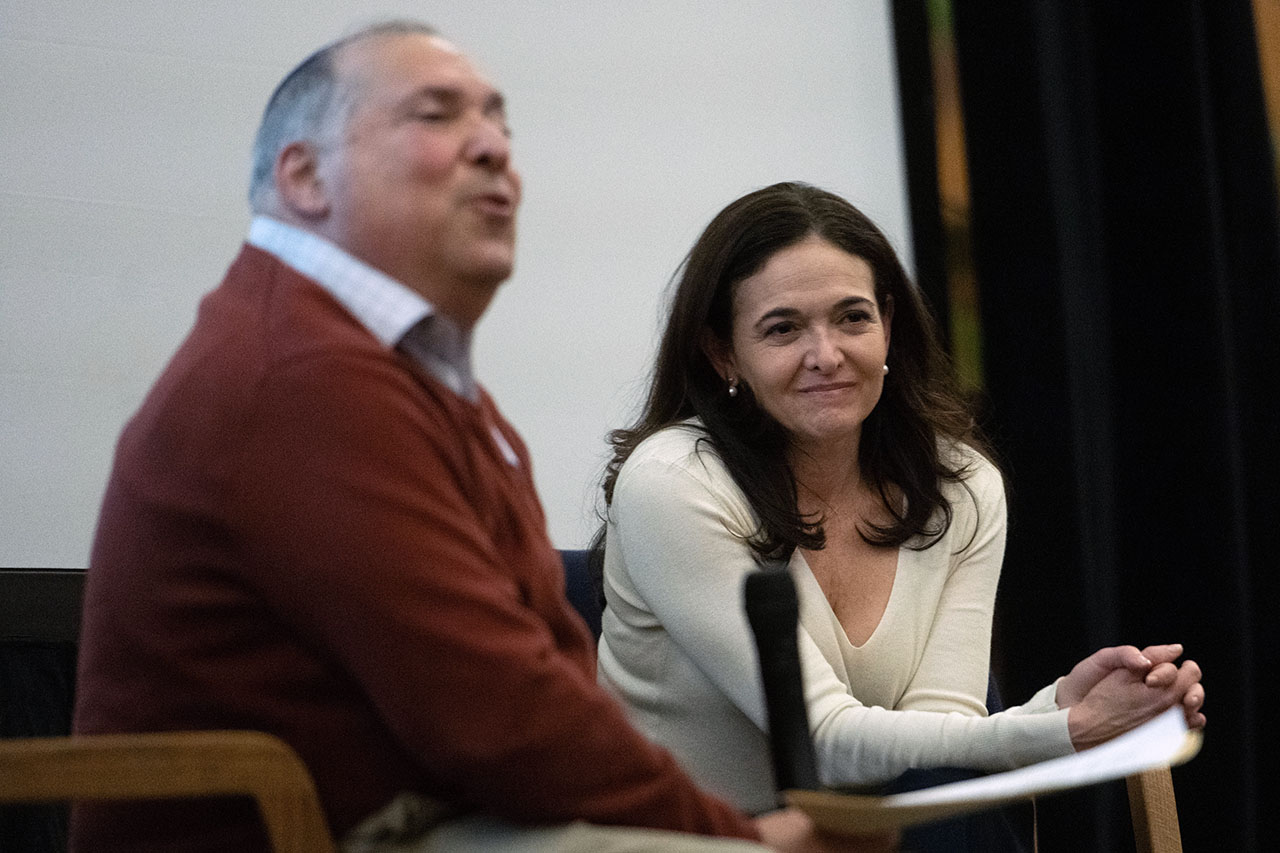
The 57-minute documentary is the outcome of a project led by Sheryl Sandberg, a former executive at Meta, the founder of LeanIn.org and a member of Beth Jacob since 2006. She joined Ezray at the Conservative synagogue for the screening on Monday night before an audience of more than 300.
The documentary was released on YouTube for free in April, but Beth Jacob wanted to use a public screening as an opportunity to hear from Sandberg, support one another and learn about the historical context of the sexual violence committed during Hamas’ deadly invasion of Israel.
Attendees were also offered information about mental health resources since they would be exposed to traumatic details that survivors, former hostages, first responders and forensic experts shared with Sandberg in the documentary.
Sandberg, who sat for an interview with Ezray prior to the screening, said the Oct. 7 attack and the world’s response to it have changed her, as well as her beliefs about how the world sees Jews.
“I think until Oct. 7, I believed –– falsely, I was wrong –– that antisemitism was something my parents told me about from my grandparents’ generation,” she said during her opening remarks.
That notion, she explained, was shattered soon after the attack.
“It wasn’t just Oct. 7 that shocked me — of course, that was shocking,” she said. “What really shocked me was Oct. 8, 9, 10 and so on. And how just the sheer terrorism, sheer threat, not just to Judaism and to Israel, but to the American way of life, was being completely ignored.”
Since that wakeup call, Sandberg has spoken publicly about the absence of comment or the delayed responses from human rights organizations about the sexual violence on Oct. 7. UN Women, a United Nations entity dedicated to gender equality, issued a statement addressing the attacks only in mid-January. A statement from the National Organization for Women did not mention Hamas by name.

“Screams Before Silence” has been translated into nine languages and viewed over 1.2 million times on YouTube.
“As you watch this, what you’re going to understand is that this is giving voice mainly to people who did not survive to tell the tale of what happened to them,” Sandberg said, referencing the 1,200 people who were massacred that day.
Following the screening, the congregation heard from Stanford history professor Gil-li Vardi. Though her research primarily focuses on the modern history of European armed forces and of the Israel Defense Forces (she herself served in the IDF as an intelligence officer), Vardi spoke to the historical precedent of sexual violence in times of war.
Violence against women is “recorded in almost every armed conflict in the past,” she said.
When rape is used as a tool of war, Vardi said, it is “meant to shatter communities. It’s meant to deprive victims and their families of their human dignity.”
However, she added, the use of and motives behind sexual violence in warfare seem to have changed since the end of the Cold War. This especially applies to “unconventional warfare,” or fighting that does not solely involve national militaries.

“Because it’s not an army against an army, they tend to really blur the lines between combatants and noncombatants,” Vardi told J. in a follow-up phone interview. “The role of sexual violence in them is different. It’s not dysfunctional. It’s in fact part of the war goal.”
Not every armed conflict fits neatly into this model, though, and Hamas’ use of sexual violence on Oct. 7 is no exception.
“The extent to which rape was premeditated is unclear to me,” she told the audience. “Had [Hamas] not been so keen on rape, they would have probably gone farther into [Israeli] territory, killing many more.”
Prior to the screening, Ezray introduced a group of therapists, counselors, psychologists and psychiatrists who could offer mental health support.
Among them was Dr. Barbara Sommer, associate professor emerita of psychiatry and behavioral science and former director of the geriatric psychiatry department at the Stanford School of Medicine. Sommer, a Beth Jacob congregant, spoke with people throughout the evening about ways to manage their emotional response to the trauma recalled in the film. Those included mindfulness meditation to keep the mind in the “here and now.”
“Here, we’re among friends,” Sommer told J. “And we all had the same exposure and we could talk about it. But then when you go home and you turn the lights out and you’re with your own thoughts, that’s where there could be a problem.… At some point, we all need to confront what we saw.”