

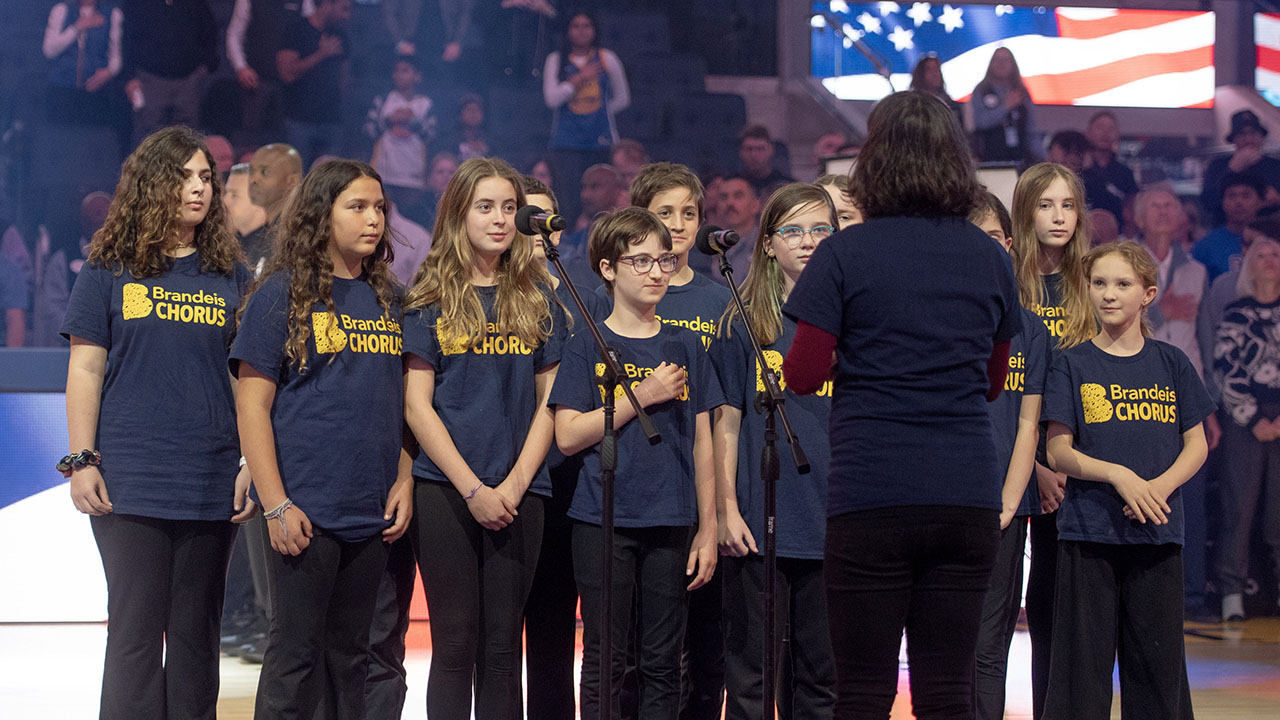
EarlyJ, which supports 48 Jewish preschools across the Bay Area, and NorCal Jewish Day Schools, a regional collaboration of a dozen schools, are local recipients of historic grants from the Israeli government.
In all, seven Jewish groups in the U.S are receiving a total of $4 million in grants from the Ministry of Diaspora Affairs and Combating Anti-Semitism, aiming to improve the quality of education and attract more students.
The grants, announced in late November, represent the first time that an Israeli government agency has financially supported formal Jewish education in the U.S., according to those interviewed by J.
“What is important is that the State of Israel is saying, for the future of the Jewish people, we must invest in deep Jewish education in the diaspora,” said Paul Bernstein, CEO of Prizmah, an umbrella group for Jewish day schools in North America that also received a grant.
Bernstein noted that the Israeli government has in the past given money to day schools in Europe, Latin America and elsewhere, as well as to less formal forms of Jewish education in North America, such as summer camps and Hillels.
The grant program was initially announced in June 2023 by Diaspora Minister Amichai Chikli, who said that his ministry would allocate $40 million to a new project called Aleph Bet aimed at strengthening Jewish education in the U.S., particularly in the wake of increased antisemitism.
The Oct. 7, 2023, Hamas massacre and subsequent war put the brakes on the project until fall 2024. The grant amount also dropped significantly, to $4 million.
Aleph Bet is a joint initiative of the ministry and the Jewish Federations of North America. A nonprofit called UnitEd is running the project, which focuses on increasing day school and preschool enrollment, fostering Jewish identity and improving both quality of education and connections to Israel.
“The Ministry understands the relationship between a strong Jewish identity, best developed in a Jewish day school, and the battle against antisemitism,” Rabbi Scot Berman, a UnitEd director who is overseeing Aleph Bet, told J. in an email. “The Jewish people need Jews that identify Jewishly and are proud of who they are, where they came from and where they are going. The way to do that is through education.”
Distributed across the seven organizations, the $4 million is symbolic more than anything else, said those interviewed.
The NorCal group is receiving $160,000, said Peg Sandel, head of school at Brandeis Marin, a K-8 school in San Rafael that is part of NorCal Jewish Day Schools.

“It’s not big dollars. It’s not game-changing for us,” she said. Regardless, Sandel added, the money is meaningful for what it represents.
“For 70-plus years, the direction of support has been diaspora communities giving to Israel to support Jewish life in Israel,” said Sandel, speaking on behalf of the group. “This is really the first time where Israel said: Hey, the folks in America are struggling under rising antisemitism and growing anti-Zionism. Is there a way in which we can support the work of Jewish day schools, which we know are strong incubators of strong Jewish identity, cultivating the next generation of leadership?”
The Jewish day schools in Northern California have worked together for more than 20 years, Sandel noted, with the heads of schools meeting regularly to discuss issues of common concern.
In 2021, with help from the Jim Joseph Foundation and the Jewish Community Federation and Endowment Fund — both based in San Francisco — the 12 current day schools in the region formalized their relationship by creating NorCal Jewish Day Schools. The organization seeks to increase enrollment by persuading more Jewish parents of the value of day school education.

Sandel and Bernstein said they believe that such a collaboration among day schools is unique nationwide. Berman concurred and said the same is true about EarlyJ, noting that this is why the two groups were chosen for grants.
“UnitEd found these to be exciting initiatives that have local support, are measurable, sustainable and replicable. They are also both innovative in their thinking and strategy, and offer a large-scale solution to problems that were usually solved (or not) on a school-by-school or sole organization level,” he told J.
EarlyJ launched in spring 2023 as a joint venture of the Rodan Family Foundation and the Koum Family Foundation. It seeks to transform the “reach and quality” of Jewish early childhood education. The Weingarten Foundation joined as an anchor funder in 2024. Together the three foundations helped fund the project with $12 million for its first five years; additional funders pushed the total over $20 million.
EarlyJ’s goal is to “significantly increase” preschool enrollment. Both EarlyJ and UnitEd see early childhood ed as the start of a pathway for children through the Jewish educational system “and exposing them and their families to Jewish life,” said EarlyJ founding president and executive director Sharona Israeli-Roth.

Nationwide, some 20% of Jewish families send their children to Jewish preschools, but according to a 2017 Federation study, that is true for just 16% of Jewish families in the Bay Area. EarlyJ’s goal is to raise that number to 20% by 2027.
EarlyJ works by giving grants and by funding programs designed to help the 48 preschools in the Bay Area improve their reach and the quality of their education, and to develop and strengthen their leadership, Israeli-Roth said.
In less than two years, EarlyJ has distributed more than $3 million through 46 grants. Some have helped schools increase capacity, such as $50,000 to the JCCSF preschool that enabled it to enroll more than two dozen new students and run for a full day; some have expanded school activities, such as $50,000 to bring a Jewish music program to five local preschools; some are focused on enhancing teacher skills and motivation, such as $123,000 to enroll eight local teachers in the American Jewish University for master’s degrees in Jewish early childhood education, and a further grant to increase their salaries.
In addition, EarlyJ supported the creation of three new Jewish preschools in the Bay Area last year, helped add security to many schools in the wake of Oct. 7, 2023, and increased enrollment in preschools by 7.9%.
“Our work truly highlights the importance and distinctiveness of Jewish early childhood education, positioning it as a critical stage in shaping the future of the Jewish community,” Israeli-Roth said. Preschools “are not babysitters. This is where the Jewish community starts, and our responsibility is to invest in them.”
How will these two organizations use their grant money?
Sandel said the $160,000 grant to the NorCal group will help kickstart the next phase of the 12 Jewish day schools’ marketing campaign: hiring a consultant who will help each school develop a marketing strategy — much more efficient than each school hiring its own consultant, which would be financially prohibitive, Sandel said. Six schools will work with the consultant this first year, focusing on attracting interest in their kindergarten classes; the other six schools will be added next year.
Adding the Diaspora Ministry to its list of donors will help NorCal generate interest from other philanthropists, Sandel noted. “It shows we have attracted attention abroad,” she said.
Israeli-Roth and Berman declined to say how much money EarlyJ is receiving, but Israeli-Roth said the money will augment grants it gives to local Jewish preschools.
But becoming part of the Aleph Bet project is about more than receiving grants, both Sandel and Israeli-Roth said. For example, the seven recipient groups will convene once a month and will present their work to other Jewish educators at conferences. .
“So the work is not just receiving the money,” Israeli-Roth said, “but creating those relationships and making sure that we are all successful and sharing information that will make us better.”