

Updated Jan. 27
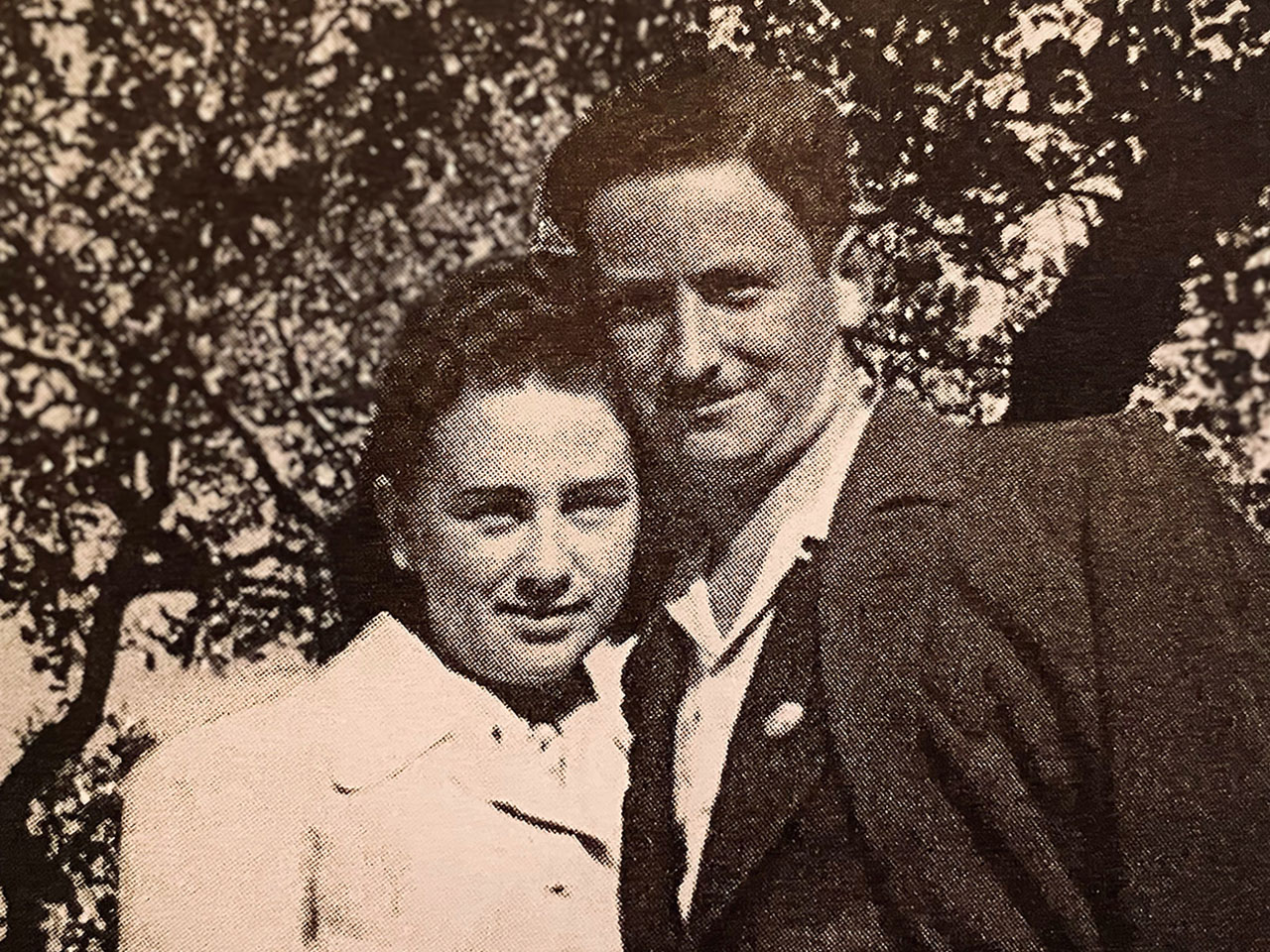
Mira Shelub was a survivor, and she was a fighter. She was just 20 years old and laboring in a work camp in 1942 when she joined a unit of wartime Jewish partisans, hid in the Polish forest and resisted Nazi tyranny. After two years, she came out of the forest alongside the man she would marry, and took steps to begin her new life.
On Dec. 30, 2024, Mira Shelub died in San Francisco. She was 102.
Mira was born Jan. 13, 1922, in Zhetel, Poland, and raised in a modest but happy home with her father, Chaim Michoel Raznov, who owned a general store, her mother, Chanah Rashke, her sister Sara and brother Morris.
“It was a very warm household,” Mira would recall.
“They didn’t have much in material means,” said her oldest son, Irwin Shelub, “but they made the most of what they had, and they were rich in spirit.”
Mira was ambitious and studious from a young age, with aspirations of becoming a teacher. After attending a Yiddish elementary school, she was one of only two students accepted into the prestigious Real-Gymnasium in Vilna. At age 13, she moved nearly 100 miles away to live with relatives while pursuing her education, focusing on Yiddish language and Yiddish literature.
“She wanted to leave her little small town and go to something more vibrant and big,” said Elaine Shelub, Mira’s daughter. “She was very young… but this was a theme for her. She had a will to do things once she made a decision, and she had dreams for herself.”
However, her studies in Vilna were disrupted by the beginning of World War II and the Soviet occupation of eastern Poland. Mira returned home to Zhetel, persisting in her studies until June 1941, when Nazi Germany invaded the Soviet Union. Within a week, Nazi forces occupied Zhetel, and months later all Jews were forced into a ghetto.
In August 1942, the Nazis began liquidating the ghetto, murdering nearly all 4,500 Jews living there. Among the 300 who escaped death were Mira and her sister, who hid behind a false wall in a chicken coop. When they emerged three days later, they walked in the darkness with other survivors to a work camp at Dvoretz, six miles away. There they were relieved to find that the rest of their family had also survived.
One day, two partisans showed up in search of a doctor. Seeing an opportunity to escape from the work camp and fight for their future, Mira, 20, and Sara, 17, convinced the partisans that they should join their movement. The sisters left and headed into the forest with their father’s blessing, throwing away the yellow stars they had been forced to wear.

“I see this choice as my passage to adulthood,” Mira wrote of that decision in “Never the Last Road: A Partisan’s Life,” her 2015 autobiography. “I began anew, going from victim to master of my own fate.”
Unlike many women in partisan groups, Mira did not limit herself to domestic tasks. She quickly proved herself capable of much more, becoming an armorer who managed the weapons and a trusted night patroller who guarded the group while they slept.
One night she was on patrol with Nuchem “Nonye” Szelubski, a young commander from a neighboring shtetl. The two began to talk — or argue, as their children today recall the story — and their debates led to a deep bond.
“Here they are, these two young people on guard duty, arguing about chemistry and politics,” said daughter Elaine Shelub. “And at the end of the morning, they were in love.”
Life in the forest was not easy. Partisans were subject to hunger, cold and death, especially when carrying out guerrilla missions. Nonye decided to break off from the Russian partisans and lead a group of Jewish fighters. He and Mira said that the Russians, though technically allies, were as antisemitic as the Germans.
Nonye fought one mission after another, and Mira often carried his machine gun ammunition from one forest camp to another.
“They remained an inseparable couple,” said Mark Shelub, Mira’s younger son. “She was always with him during this entire time.”
In August 1944, the Soviet army liberated their area. Mira’s mother had been killed in a police raid, and her father fell ill and died shortly after liberation, but all of the siblings survived.
Mira and Nonye left the forest where they had lived for two years and started toward his family home in Novogrudok. On the way, settled in their campsite for the night, they began to profess their love to one another.
“The moon was our rabbi, the stars were our witnesses, and we pledged to one another that we would never part,” Mira would later recall.
“This was the moment they essentially made an oath of marriage to become each other’s husband and wife,” said Irwin Shelub. Mira and Nonye tied strings around each other’s fingers in place of wedding rings.
When they arrived in Novogrudok, they discovered the Jewish community wiped out and the remaining population hostile and unwelcoming. Nonye was soon recruited by the Zionist Betar Movement to fight with Jewish forces in British Mandate Palestine. With false documents provided by Betar activists, the couple gained passage across Poland and Czechoslovakia to the American zone in Austria, from which they planned to complete their journey to Palestine.
In 1945, Mira and Nonye ended up in a displaced persons camp in Austria, where Mira documented survivor testimonies as a translator and transcriptionist. The stories she recorded are preserved at the United States Holocaust Memorial Museum in Washington, D.C.
After waiting four years in D.P. camps, they ultimately decided to immigrate to America. Nonye’s uncle in San Francisco sponsored them, and they arrived at Ellis Island in January 1949 with 9-month old Yitzchak (Irwin) in their arms.
Mira and Nuchem “Nonye” Szelubski became Mira and Norman Shelub, and together they carved out a happy life. After a time in New Rochelle, New York, they moved to San Francisco, where they raised three children and operated several businesses through the years, including a Venetian glassware company, a sandwich shop and a family restaurant.

After Norman’s death in 1977, Mira continued to run the restaurant. When that venture closed, she became a student at San Francisco State University, finally fulfilling her lifelong dream of completing her higher education. She graduated magna cum laude with a bachelor’s degree in Eastern European history, followed by a master’s in counseling. She taught Yiddish at S.F. State in the 1980s, taught at the now-defunct Hebrew Academy in San Francisco for years and worked for Jewish Family and Children’s Services counseling Russian immigrants until she was 96.
In 2000, Mira began participating and was instrumental in the Jewish Partisan Educational Foundation, sharing her story through lectures and Holocaust education. Fifteen years ago, she recorded her testimony for the USC Shoah Foundation’s Visual History Archive.
“She became, in the Jewish community, kind of a celebrity,” said Mark Shelub. “Everybody knew who she was because she was the featured speaker when it came to discussing the Jewish partisan resistance movement.”
In addition to her remarkable story, Mira was known for her warmth, charm and spirit, always ready to embrace people and opportunities, her family said. She traveled extensively, touring the world and leading high school students as a guide throughout Poland and Israel.
“She was persistently optimistic, always kept on going,” recalled Elaine Shelub. “She lived life to the fullest.”
Mira remained a lifelong learner and participated in several educational trips, including a six-week Yiddish intensive course at Columbia University when she was in her 80s.
Mira frequently concluded events by singing the Jewish partisan hymn, “Zog nit keyn mol az du geyst dem letstn veg,” translated from Yiddish as “Never Say That You Are Going the Last Way.” It inspired the title of her autobiography, co-authored with historian Fred Rosenbaum.
Mira is survived by her son Mark, daughter Elaine, son Irwin and wife Cheryl, grandsons Aaron and partner Lucy, and Nathan and wife Ivy, and great-grandchildren Daniel, Ron, Emery, Abigail and Benjamin.
This story was updated on Jan. 27 to correct some details of Mira Shelub’s story.