

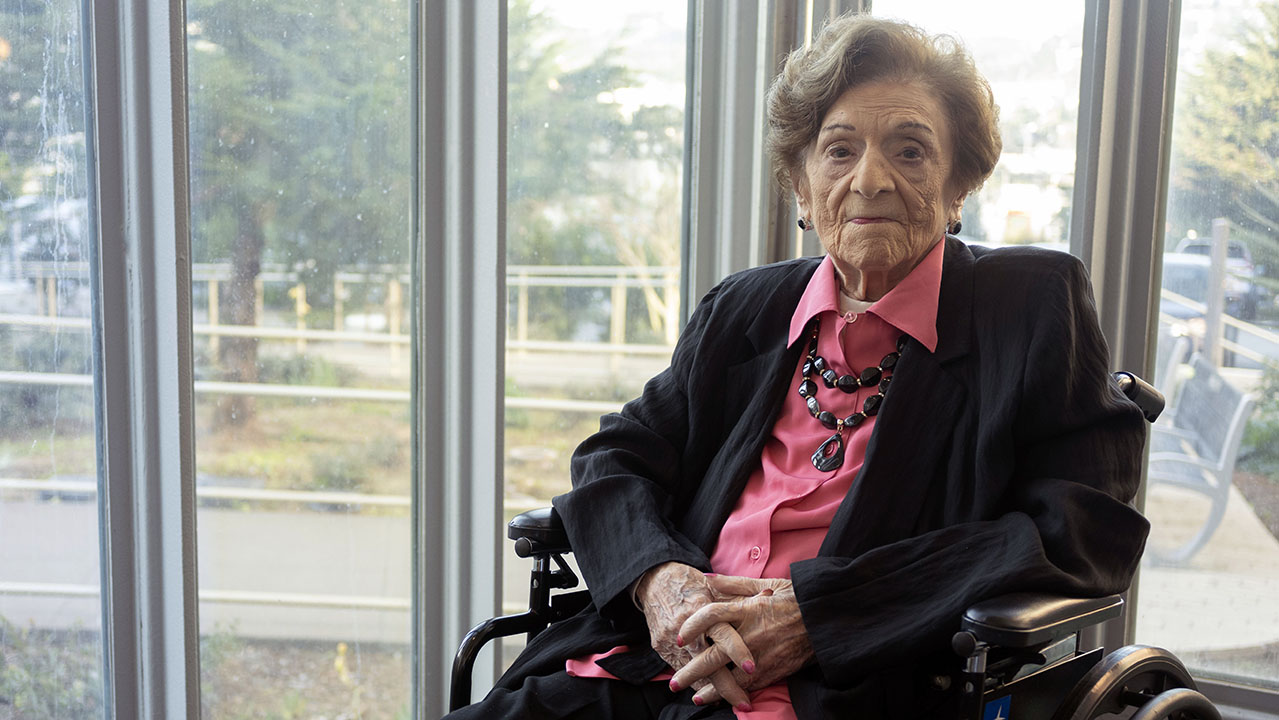
San Francisco resident Luba Grungras is a Holocaust survivor who recently celebrated her 100th birthday. The following is her testimony, as recalled and written down by her son, Neil Grungras. J. is publishing her story in honor of International Holocaust Remembrance Day, which falls on Jan. 27.
She will appear at Congregation Sha’ar Zahav in San Francisco at 2 p.m. Sunday, Jan. 26, to share her story, with her son’s assistance. The event is free, but registration is required. An online option is available.
I do not seek to “prove” to anyone that the Holocaust and Auschwitz were real. Those who deny will learn little from me or from the monuments you erect to the horrors European Jewry underwent.
Nor do I seek sympathy. At 100, I’ve lived more life, in more countries, than the vast majority of people. I raised two children and have three grandchildren and two great-grandchildren. I had a long career, lived as a strong, independent woman and enjoyed the love of friends and family. And if all this were not enough, I had the privilege of rebuilding a homeland in Israel after 2,000 years of Jewish dispersion. I can only wish each of you a century of life with the depth and kavanah (intention or sense of purpose) that I had.
I tell you my story so that you may learn and teach others what American Jews have not learned nearly well enough: Antisemitism is a virus of endless mutations and no national boundaries. As a Jew in the diaspora, you must never bury your head in the sand to this reality.
I was born in 1924 in Lodz, Poland, where my father’s family owned a large fabric-dye factory. On my mother’s side, my grandparents owned a textile factory in a nearby village, where many of the villagers worked.

We lacked for nothing. One of my fondest memories is listening to my mother play Chopin and other classics. At home, we spoke Polish. Like many Polish women of her time, my mother was fluent in French, which she often spoke with her peers. The women of our family were well educated in the arts and humanities, and some went on to study at the Sorbonne.
Like most of my peers, I identified as Jewish by ethnicity and culture. I didn’t attend synagogue more than a handful of times in my life — neither in Poland nor during my years in the U.S. or Israel. Yet, my family and I were, and remain, Jews. In Poland, I was constantly reminded by my non-Jewish peers that I was not fully Polish.
My parents were nominal Zionists. While we had been taught that Israel was the Biblical home of our forebears, this knowledge was purely theoretical. The “Promised Land” was seen as a destination for socialists, communists and idealists, not for the Polish-Jewish upper class.
I was 15 when the Nazis breached the Polish border on Sept. 1, 1939. A week later, the Wehrmacht fully occupied Lodz. Measures to target and isolate the Jewish community began almost immediately. Widespread violence, looting and public humiliation were common. Jewish homes and businesses were raided by German soldiers and local collaborators, and Jews were commonly beaten. Jewish-owned businesses and properties were seized, and many people were forcibly displaced from their homes.
The Lodz Ghetto was officially established on Feb. 8, 1940. Over the coming weeks, all of the Jews were forced to relocate to the ghetto, allowed only to bring their most essential belongings. My family made the journey across the freezing city several times, transporting what little we could carry on a two-wheeled cart, leaving behind our spacious apartment for a cramped, one-room hovel.
The Nazis never intended for all 233,000 of the Lodz Jews to survive. Only 160,000 were moved into the ghetto, which the Nazis intended as a labor hub. The remaining 70,000 — mostly children, the elderly and the sick — were either murdered on the spot or sent to the nearby Chelmno extermination camp.

Living conditions in the ghetto were horrific. We shared an outhouse with several families, and the only water source was an outdoor pump that froze in winter. Food was rationed, and supplies were always scarce. Malnutrition was widespread, and starvation claimed countless lives. Despite the constant fear, suffering and death, we fought to preserve our humanity. Cultural, religious and social activities continued in secret. Underground schools were held, and religious services were conducted, symbols of defiance against the dehumanization we endured.
The Lodz Ghetto was one of the last to be liquidated, in 1944, because of its importance to the German war economy. I was deported from the ghetto late that year, leaving my mother and sister Edzia behind.
The grueling 150-mile journey to Auschwitz lasted about three days. We were among thousands of deportees crammed into cattle cars, which had previously been used to transport livestock. We stood for the entire journey, with no ventilation, food, water or sanitation.
When the cattle car doors opened at Auschwitz, I was thrust into an atmosphere of terrifying chaos, confusion and despair. Immediately, a horrific stench overwhelmed me. I later learned it was the burning flesh of new arrivals. The stench was searing, an odor no survivor will ever forget. Once it entered your lungs, you could never breathe freely again.
I was stripped of my clothes and given striped pajamas and wooden shoes to wear. A number was tattooed on my forearm. Living conditions in the women’s barracks were brutal, dehumanizing and relentlessly abusive. The barracks were filthy, with floors covered in dirt, urine and excrement. Without cleaning supplies or the ability to wash, the conditions remained unbearable, and the stench of human waste and decaying filth filled the air.
Several weeks after I arrived at Auschwitz, another inmate told me that my sister and mother had arrived at the camp. During the selection, Edzia was sent to the right. My mother, deemed beyond the age for labor, was sent to the left. Wanting to stay close to our mother, Edzia sprinted to the left to join her. A young Nazi guard noticed and barked at her to go to the right. A few minutes later, she tried again, and once more, he sent her back. On her third attempt, he did not intervene. She marched with our mother into the gas chamber.
In late 1944, as the Red Army advanced through Poland, the Nazis began transporting the remaining inmates of Auschwitz westward. We were sent by truck to the Bergen-Belsen concentration camp, deep inside Germany. On April 15, 1945, the British Army liberated Bergen-Belsen. They ordered the remaining Nazis to collect the hundreds of dead bodies scattered throughout the camp. When I awoke among the corpses, I did not understand I was still alive.
Editor’s note: After liberation, Luba spent four years in Sweden, where she was reunited with her father, who also survived Auschwitz. The rest of her family died in the ghettos or death camps. In 1949, she immigrated to Israel, where she married and had a son and daughter.
In 1967, Luba, her husband and son Neil moved to New York, and in 2003, she moved back to Israel where she intended to live out her days. It was only in October 2023, when the Israel-Hamas war began and Neil realized his 98-year-old mother was unable to get to her basement during bombing alerts, that he made what he calls the “hard decision” to bring her back to the U.S. She now lives at the San Francisco Campus for Jewish Living.
Luba can no longer speak, Neil told J., but her mind is active. She does not consider herself a Zionist but is adamant in her support for Israel as a safety net for the Jewish people, whom she believes must constantly be prepared for the next crisis.
Rabbi Mychal Copeland of San Francisco’s Congregation Sha’ar Zahav recently asked Luba her advice about what to tell her congregants regarding increasing antisemitism in this country.
“My mother had two words for her,” Neil said. “Learn Hebrew.”