

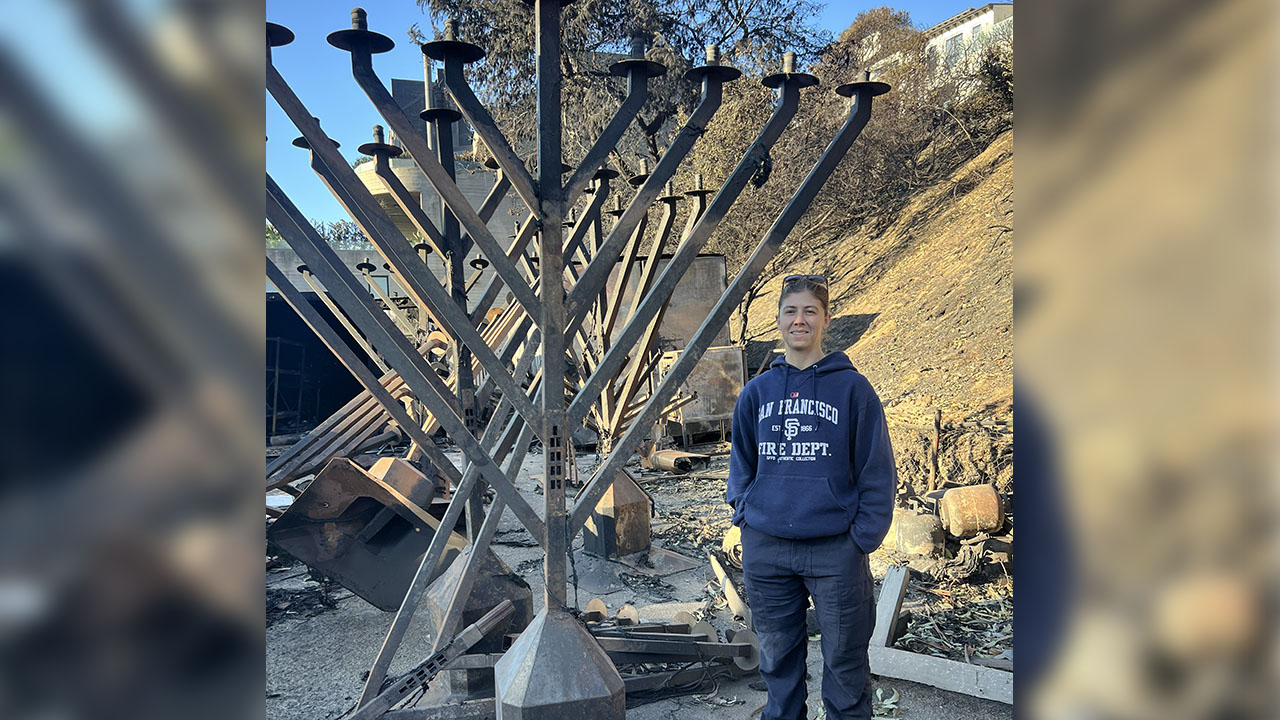
San Francisco firefighter Danielle Rosenthal and fellow crewmates on an emergency strike team returned home early Thursday after more than two weeks of helping local firefighters subdue the devastating wildfires in Los Angeles.
Rosenthal, 32, has worked for the San Francisco Fire Department for 10 years and served on strike teams during the Napa Valley fires and Fresno area Creek fires in 2020. She recently joined the Ner Tamid Society, a new group formed for SFFD’s Jewish personnel.
The San Fernando Valley native spoke with J. on Jan. 20 — nearly two weeks into her deployment in Pacific Palisades — about her experiences.
The interview has been edited for length and clarity.
J: How did you join the strike team?
Danielle Rosenthal: The fire started on Jan. 7 and it sounded like something that could potentially need help. So we signed up on our online accounts for the department and made ourselves available for deployment. I got a phone call from my strike team officer late Tuesday night, and we left first thing Wednesday morning on Jan. 8. We drive the engines down. There are five engines and one strike team leader buggy [command vehicle]. There are 22 of us down here. We left first thing in the morning. We got there in the early afternoon, and then we were put to work right away.
What was it like driving through Los Angeles that day? Was there a palpable feeling of chaos?
Somewhat. I’m from down here, from the San Fernando Valley originally. And I grew up going to these beaches with my family, specifically with my mom. I moved up to San Francisco for a job, and that was in 2015. So my whole life, until that point, I was in the area. So that was kind of crazy. I never thought I’d see all the establishments I grew up going to for the first 23 years of my life burnt to the ground. So that was surreal.
What specific duties do you have on the team?
We rotate driving the engine because we’re all qualified to drive it. We all just rotate that duty so no one’s overly exhausted. When we’re on the fire line, we’re there 24 hours at a time. So we’re awake for that amount of time, just ready to go. And we are tactically patrolling that whole time, so just staying vigilant, making sure that we’re ahead of everything, so that nothing becomes a bigger problem.
Have you had interaction with local residents?
We’ve met a couple residents — most of the area has been blocked off to public traffic due to safety concerns. There are a lot of buildings that are unsafe, a lot are burnt down. And that causes safety concerns.

We have helped a few people search through rubble for valuables. We had a family whose grandmother had a lot of family heirlooms, and so we were looking through what was left, but the incident chain of command eventually told us to stop. They have a certain team assigned to that.
So if we come across people who need that sort of assistance, we can stay with them but then call this team who will come and help with them to look through their stuff, just to ensure that there are no looters.
There’s a huge law enforcement presence, and there were definitely people who shouldn’t be there. We saw multiple arrests being made for people impersonating firefighters, wearing firefighter equipment, who were trying to make it seem like they belong there when they didn’t.
In the two weeks that you’ve been deployed in Pacific Palisades, what’s been the most rewarding experience for you on the team?
I think the first day was the most rewarding for us. Because resources were not as available at that point, we were fighting a structure fire in a family home. It was just us alone.
We did our absolute best, and we were pulled off of it at a certain point, and reassigned to a different location. But before we left, we went through the houses as quickly as we could and took any valuables. There were some pictures, some art that it was clear a child made for a parent, or a couple boxes that said “memories” or “wedding. So we took those out, along with some jewelry, and then put them in their family car and parked it down the street, as much out of danger as we could, and then locked it up and left a note saying: We did what we could.
There was a lot of damage to their home, but at least they got some irreplaceable things saved.
There were also a couple synagogues and Chabads in the area that had a little bit of damage but were mainly saved, so that was exciting for me. It was nice to see that those establishments didn’t burn to the ground. [For example] at the Chabad center of Pacific Palisades, there wasn’t a ton of damage to the building itself, compared to the rest of the Palisades — some damage but not completely destroyed. We consider damage like this, to just stuff or a small part of the building, as minor, given we saw thousands of buildings and homes actually burnt to the ground.