

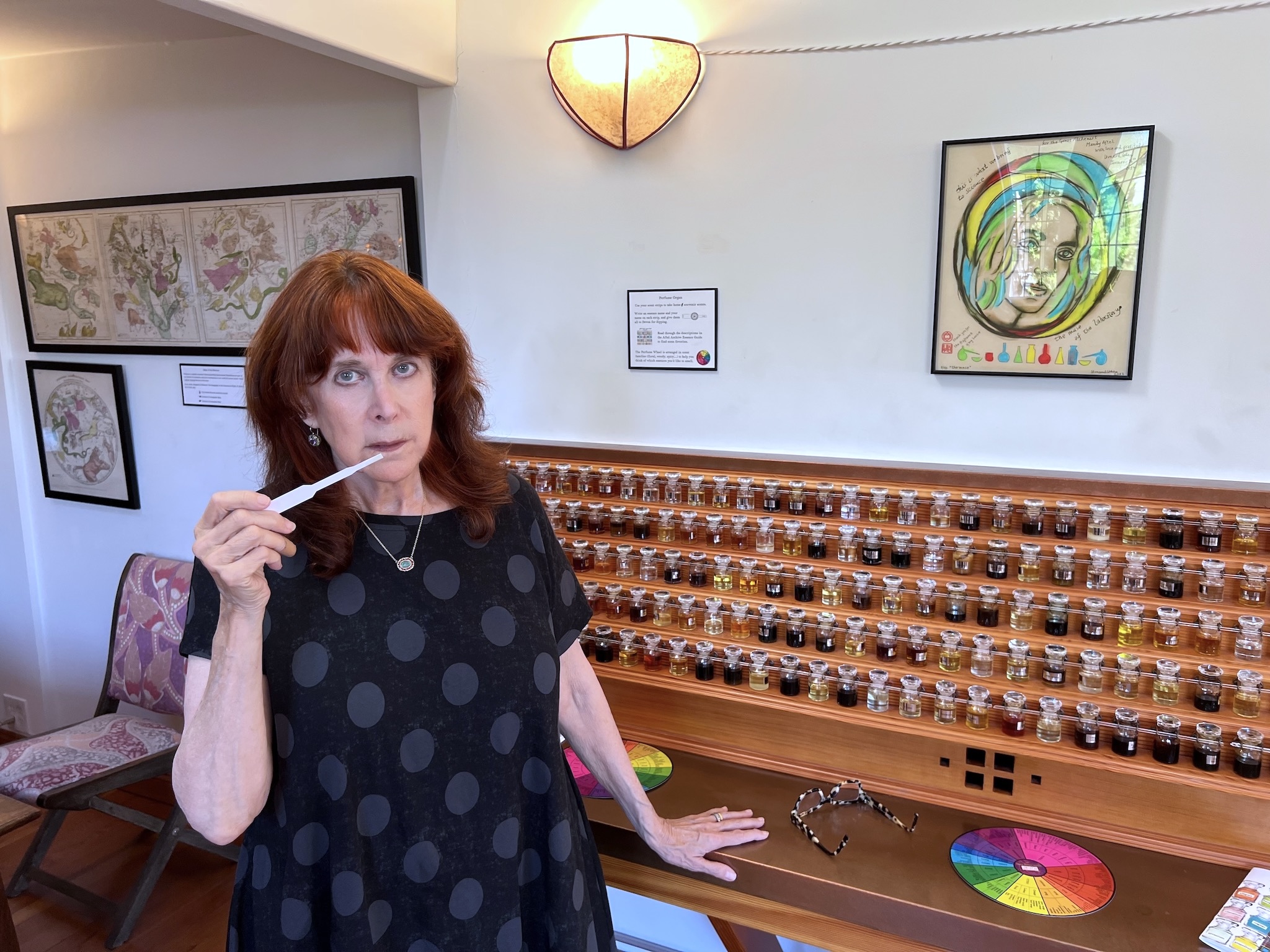
Mandy Aftel, 76, is an internationally acclaimed perfumer who founded Aftelier Perfumes in Berkeley 30 years ago. Brought up Jewish in Detroit, Aftel also is an author, an educator and the curator of the interactive Aftel Archive of Curious Scents Museum, also in Berkeley and open Saturdays only. Aftel hand-blends and packages her artisanal fragrances, all of which are made from natural essences. The late Leonard Cohen liked her “Oud Luban” — based on an incense resin — so much that he kept a bottle in his car’s glove compartment, Aftel said.
J.: Is perfume always in fashion, or is its popularity cyclical? Is there a Jewish history of perfume?
Mandy Aftel: Perfume has been in fashion since the beginning of time. People always have taken pleasure in rubbing scent on themselves and in using it for rituals, bathing, love-making or death. Deborah A. Green writes about (the Jewish history) in her book “The Aroma of Righteousness: Scent and Seduction in Rabbinic Life and Literature.”
What were the earliest fragrances derived from?
The word “perfume” comes from the Latin per fumen, which means “through smoke.” The earliest sources were resins and woods that were burned as offerings, including the famous incense recipe God gave Moses for the ketoret, which included frankincense.
In your book “Fragrant: The Secret Life of Scent,” you call frankincense “one of the deeply aromatic resins…that represents our inclination to the spiritual.” What are some of the most unusual scents you’ve encountered?
Ambergris, a substance that sperm whales excrete, is one. After tossing on the ocean, it washes ashore, and eventually transforms into a drop-dead, gorgeous smell. Costus root smells like a wet dog and violets, very animalic and floral.

Your studio holds more than 400 natural essences, sourced from all over the world. What inspires you to craft a new perfume?
I start with a feeling, a picture, a song or an experience and two essences that are in contrast to each other. My inspiration then is the conversation between those essences, what they bring to each other.
Next, I add two additional essences, and those four are the central spine.
Once I have the smell in the right proportions, I add and subtract other essences, revising as I go. I never mess with the start, but I do tinker with what else goes in and how much. I stop when there is nothing left to explore.
How long does that take?
The process can take weeks or even months. I wouldn’t want it any other way, because I am interested in the effect of each inclusion or exclusion. And once I’ve begun, I’m kind of in a fever until I get to the end.
Vanity Fair once dubbed you “an angel of alchemy,” and you have written that “perfume is a message in a bottle.” What messages do your fragrances send?
Memento Mori is about love and grieving, being physically close to someone and losing that connection. Sepia, inspired by traveling through Gold Rush County, is about loving old, imperfect things. Sacré Bleu is about the strangeness of beauty.
Why are some perfumes so expensive?
Marketing, packaging and shipping drive up the price of commercial perfumes. For a natural perfumer, the process takes time and the materials are expensive. I’m asking customers to buy a perfume that costs a whole lot, comes in a tiny bottle and doesn’t last long on the skin.
How many perfumes have you made?
I have my line, plus I make custom perfumes and perfumes for other people’s lines. Also, I’ve taught hundreds of classes, and I make samples of the works-in-progress for the students.
Your first career was as a psychologist for writers and artists. What led to the change in your life’s path?
I wanted to work with people who were creative, people who believed in the work they were doing, and use that as a way of helping them. Along the way, as I collected books on the lore, the witchiness and the culture of fragrance, I planned to write a novel about a perfumer.
When I attended a class at an aroma therapy studio in Fair Oaks, California, I fell in love with the essences, and I was smitten. Now my museum provides that kind of rich experience for visitors.
What do you like best about your work?
Everything — sourcing the essences, working with them, making and packaging the perfumes, studying fragrances in other cultures and assembling displays for my museum. I’m doing exactly what I love.