

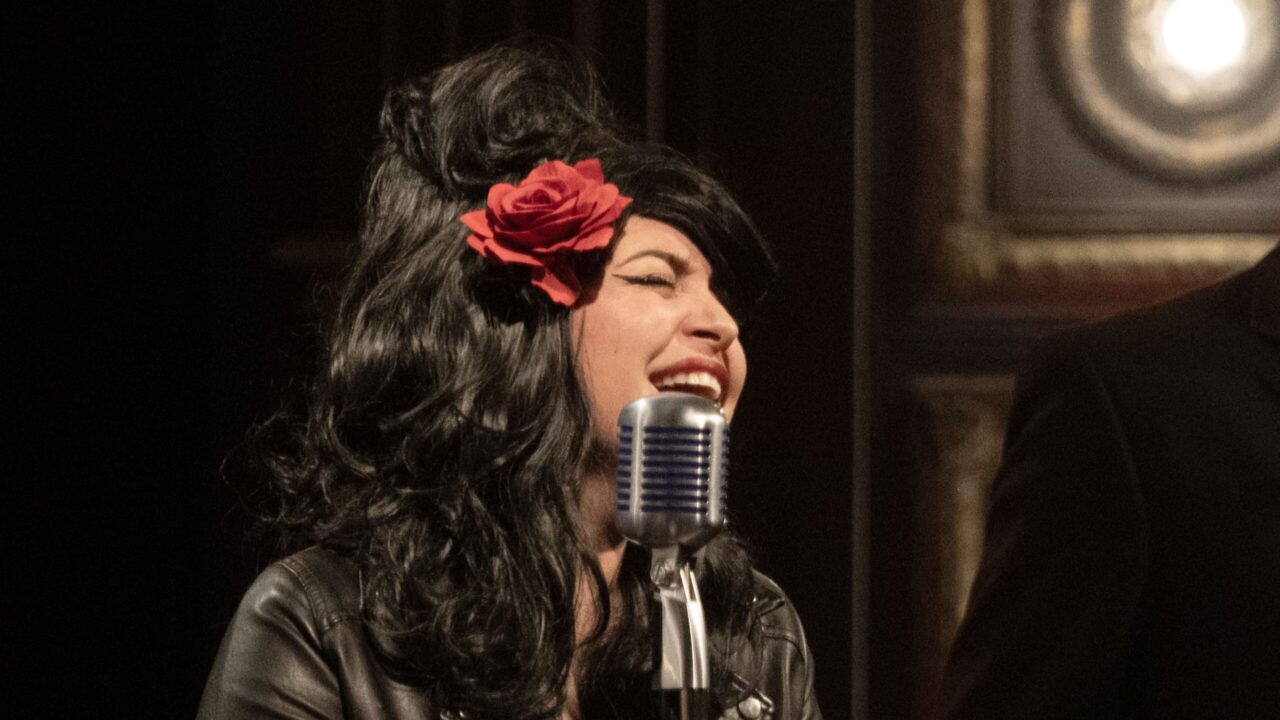
Elsa Cedeño was 15 when she first heard an Amy Winehouse song. The song was “Stronger Than Me,” a jazzy ballad from Winehouse’s 2003 debut album, in which she laments her boyfriend’s substance abuse and his failure as a man “to live up to his role.”
The singer and her fan had completely different upbringings — Winehouse, a Jewish girl born in London, and Cedeño, a Mexican American girl born in Chicago — but Cedeño related to Winehouse’s song as soon as she heard it. Her own father had been deported to Mexico several years earlier and had become addicted to methamphetamines.
“My dad was a gnarly drug addict, so I always kind of felt like that song fit with my life,” recalled Cedeño. “That was the thing that started it for me, that song and her life story.”
Now 33, Cedeño didn’t know at the time that she, too, would one day struggle with addiction and depression, like Winehouse. She also never would have guessed that one day she would make a living impersonating the Jewish songstress, who died in 2011 at age 27.
Cedeño is the lead singer in the Amy Winehouse tribute band Valerie, which has played sold-out shows throughout the state since its first performance in August. The eight-piece band, based in Santa Cruz, was created by manager Kevin Summer, a lifelong Winehouse fan who wanted to bring the singer’s legacy to new audiences. He named the band for one of Winehouse’s best-known songs.
“Because she died young, a lot of people never got to see her perform,” Summer said. “We focus on re-creating an authentic and passionate experience where people can feel close to her.”

For performances, Cedeño dons Winehouse’s signature retro beehive hairstyle and winged eyeliner, but Cedeño’s expressive vocals anchor the re-creation. She originally answered Summer’s Craigslist ad for a backup singer because he had already chosen a lead. But after her audition, Summer knew she was the right person for Winehouse’s role, despite Cedeño’s lack of formal training or stage experience.
For Cedeño, feeling connected to Winehouse goes beyond the music. When Cedeño’s father was deported, she was 12 years old and her whole family was forced to relocate to the slums of Tijuana to avoid being split up.
“We didn’t have money. We didn’t have anything, not even school,” she said. “So I started singing. I’d go downtown and I’d put out a little hat and I’d get money and bring it home to my siblings for food.”

About a decade later, in 2013, Cedeño moved to the Bay Area so her 6-month-old daughter could receive treatment at UCSF for bilateral retinoblastoma, a rare type of cancer that affects both eyes.
Cedeño said the stress from her daughter’s cancer diagnosis and subsequent treatments, plus a toxic relationship, caused her to become severely depressed and turn to alcohol.
“Alcohol was my best friend,” she recalled. “I feel like alcohol saved me so many times from killing myself. I didn’t want to live, and alcohol was right there, like, ‘Hey, just drink me and you’ll feel OK.’ But eventually it was killing me.”
Tragically, it did kill Winehouse, who died of alcohol poisoning.
In her short career, Winehouse earned numerous accolades, including six Grammy Awards. Her music and life story have continued to generate interest in the years since her death, with books, documentaries and museum exhibits, including one at San Francisco’s Contemporary Jewish Museum. She was also the subject of a 2024 biopic.

While critics praised her raw talent and lyricism, Winehouse was lambasted for her openness about her issues with mental health, addiction and long-term bulimia. Her authenticity made her relatable to fans but also loomed over her musical achievements. Those close to her have said in interviews that fame exacerbated Winehouse’s struggles with mental health and addiction. Others have argued that family members, especially her father, Mitch Winehouse, and her husband, Blake Fielder-Civil, enabled her heroin, crack cocaine and alcohol use and exploited her talents.
“Her addiction took her. She didn’t win that battle, but she left a mark on a lot of people who have suffered the same story as her with family issues, romances and addiction,” Cedeño said. “Thankfully, I was able to get out. But she didn’t.”
Cedeño celebrated one year of sobriety on Dec. 7, 2024. Her daughter, though losing her right eye to cancer, remains in remission. During Valerie concerts, Cedeño always acknowledges Winehouse’s struggles with addiction and shares her experience with recovery. She said that many attendees come up to her after the shows to discuss their own struggles and to offer words of strength and encouragement. She hopes that by spreading awareness through her performances, she can reach those who need support.
“I think it’s important that we put it out there — what addiction is and how you can recover,” Cedeño said. “I think it’s important for people to see that.”