

The students in Piedmont High School’s sophomore acting class had never heard the word “putsch.” But they were about to find out what it means.
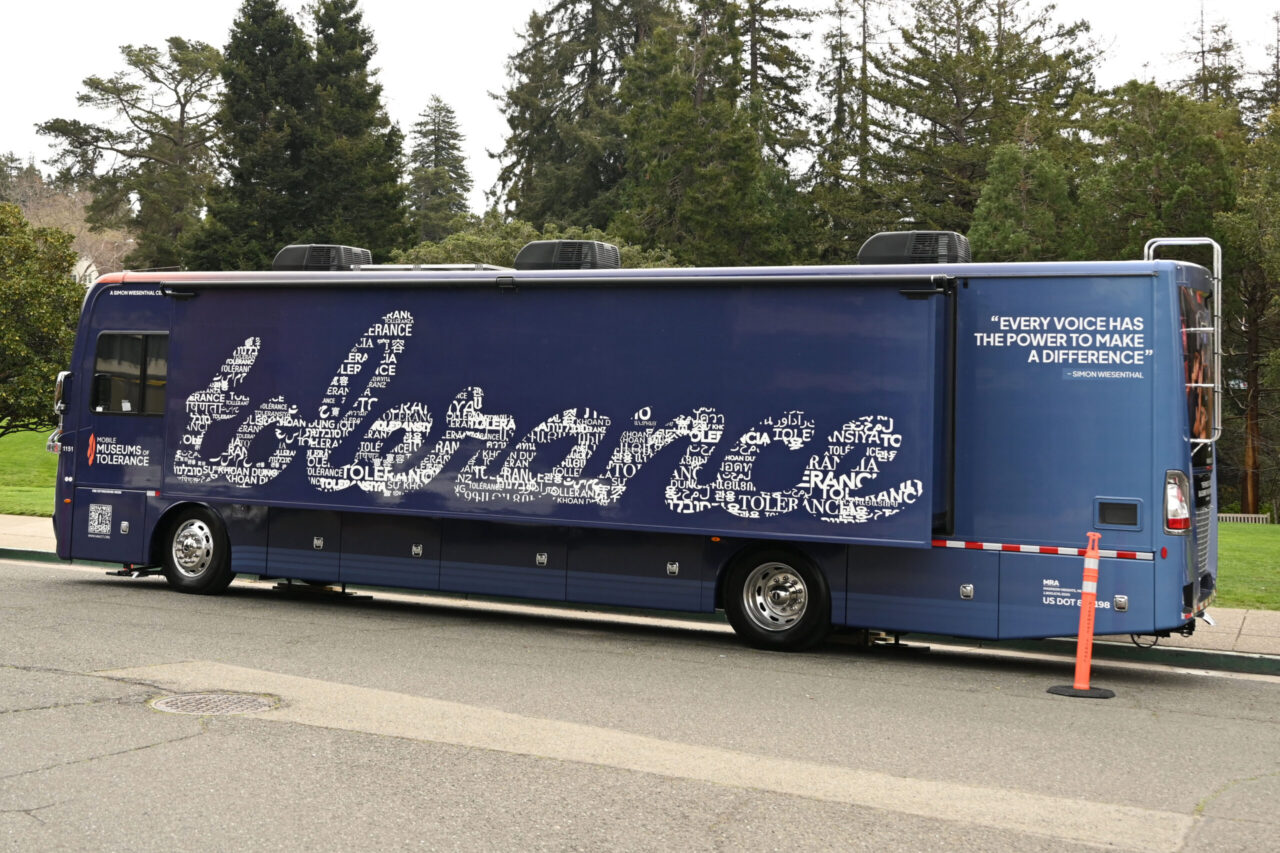
Their class on Tuesday took place inside a bus that doubles as one of four Mobile Museums of Tolerance (MMOT). Parked near Piedmont City Hall for the week, it was outfitted to seat 30, movie theater-style, with three screens projecting films and photos that brought history to life. An initiative launched in 2021 by the Los Angeles-based Simon Wiesenthal Center and its Museum of Tolerance, the four mobile museums travel the country.
As museum educator Elizabeth Blair explained to about a dozen students and their teacher, Kimberly Taylor, the German word “putsch” means “coup.” It famously references the Beer Hall Putsch, Hitler’s 1923 failed coup attempt, which launched his rise in German politics. Blair’s presentation, called “The Power of Ordinary People,” is meant to show how average Germans over time bought into Hitler’s exterminationist views of Jews and other groups the Nazis deemed subhuman.
As stated on its website, the mobile museum project “aims to inspire people of all ages and backgrounds to promote human dignity by empowering them to raise their voices to combat antisemitism, bullying, racism, hate, and intolerance.” Other workshops cover such topics as civil rights and the dangers of hate on social media.
“The MMOT does not simply tell the story, but encourages young people as participants in moral episodes and to think how they themselves would act,” said Eric Simon, director of communications for the Simon Wiesenthal Center. “It’s to encourage young people to think of themselves as capable of making moral decisions.”
Kerin Nash, associate director of development, called the buses an “exciting opportunity” to bring the “lessons of the Museum of Tolerance to regions that don’t necessarily have access to our brick-and-mortar space.”

Blair’s presentation began with a 1937 painting by a German artist, depicting Hitler addressing a solemn group of citizens during the putsch. The painting is titled “In the Beginning Was the Word,” a Biblical allusion linking Hitler to a kind of divinity. When Blair asked why such propaganda might have been effective, one student replied, “You have to see it in order to believe it.”
From there, students watched film clips and photos of the steady Nazi dehumanization of Jews, leading up to Kristallnacht, the 1938 “Night of Broken Glass,” which led to the murder of dozens of Jews, the arrest of tens of thousands of Jews and the burning of hundreds of synagogues. From there, war loomed, along with the “Final Solution” of industrialized mass murder.
Woven into Blair’s narrative was her description of ordinary people who eagerly took part in the mayhem, with some joining ad hoc battalions of adjunct killers who helped with the slaughter.
“It was a way of emphasizing that even with soldiers and police,” she said, “regular citizens of Germany had turned into this army of hate.”
Offering students these kinds of lessons about the Holocaust may be more important than ever. A statewide report, released in January, found that only 26 percent of California school districts and publicly funded charter schools have formal programs about the Holocaust and genocide. In the Bay Area, that figure is 25 percent.
In the aftermath of the Oct. 7, 2023, Hamas terror attack in Israel and the subsequent global rise in antisemitism, MMOT organizers see their work as vital.
“The events of Oct. 7 have made this work even more important and have reinforced to us and educators the importance of teaching tolerance and history,” Simon said.
Blair’s presentation ended with a different take on ordinary people: examples of individuals who stood up to the Nazi’s genocidal aims. They include Sophie Schott, a young German woman who countered Hitler’s propaganda with truth-telling. It cost Schott her life in 1943.
Miep Gies, a young Dutch woman also risked her life to help hide Anne Frank and her family in an Amsterdam attic for two years.
“I wanted to fulfill my human obligation,” read Gies’ quote on the big screen. “I thought it was quite normal.”
At that point, Blair asked the students what they could do to make a difference in preventing future waves of hate and intolerance. One student responded, “If you see something, say something.”
Josh Hammond,16, said afterward that although he’d studied the Holocaust and World War II in his freshman year, he found it interesting that the workshop “focused on the perspective of citizens and reminded [us] that those were ordinary people in those positions. It’s a powerful message and a good message to remember.”
A Simon Wiesenthal Center educator since 2020, Blair said she believes the MMOT can play a significant role.
“Some of this feels like such distant history to these students,” she said. “It’s about bringing the experience into the modern day, and thinking about how this didn’t happen all that long ago. Our programs are about making those connections between the events of the past and what’s happening in the world right now, and how we can apply these same lessons to make a difference in our community.”