

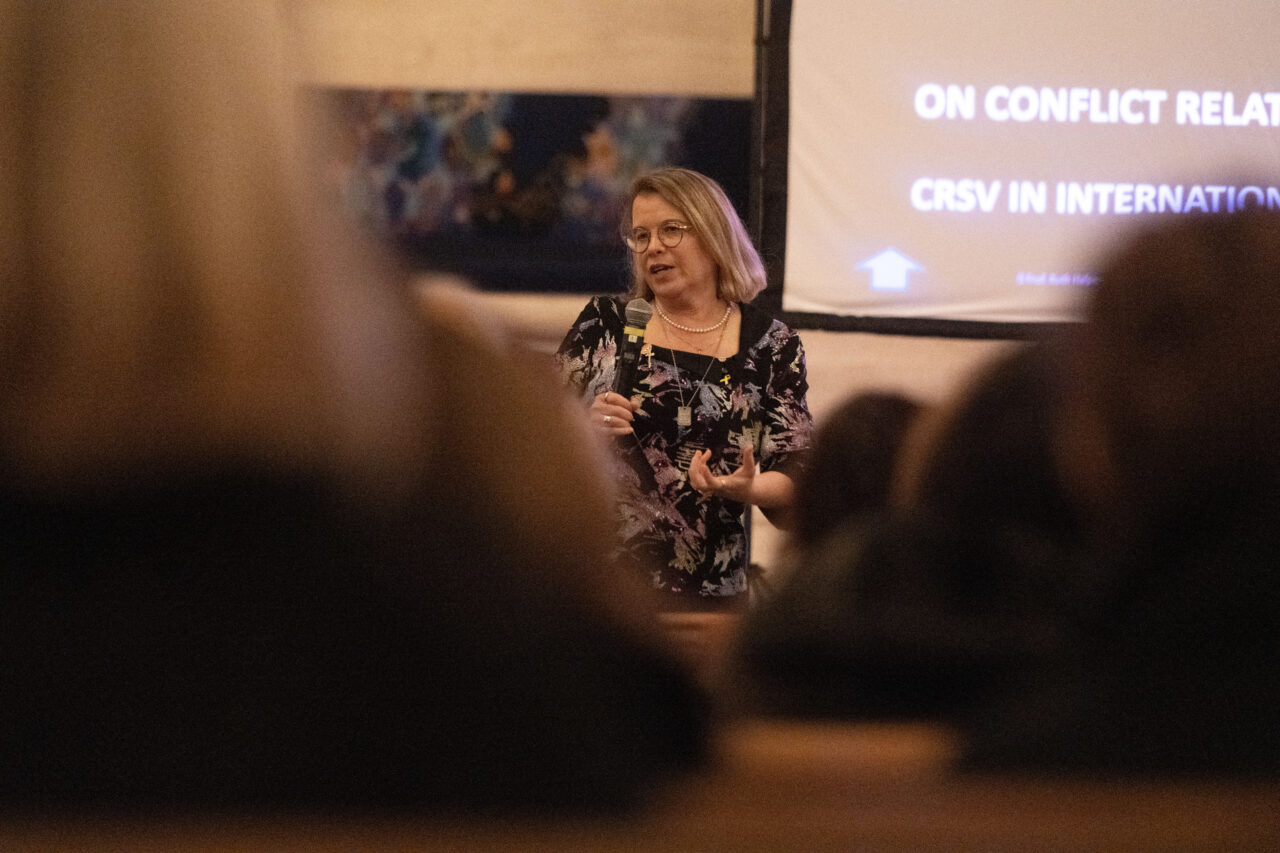
For the past 17 months, Ruth Halperin-Kaddari has sought to increase public awareness of the sexual violence perpetuated against Israelis on Oct. 7, 2023. A longtime advocate for women and a Bar-Ilan University law professor, she has spoken about it on cable news and in the documentaries “Screams Before Silence” and “October 8.”
On Wednesday evening, she talked with a local audience.
Around 60 people gathered at Congregation Emanu-El in San Francisco to learn about her work with The Dinah Project, an advocacy group formed shortly after Oct. 7 to counter the widespread international denial of the sexual violence, primarily against women, that occurred during the terror attack. The group is named for Leah and Jacob’s only daughter, who survived the first act of rape recorded in the Bible.
“If you read Genesis 34, you’ll notice that Dinah does not have a voice. She does not speak throughout the story,” said Halperin-Kaddari. “This is, of course, very symbolic. The victims of Oct. 7 do not have a voice, and it is for us to give them a voice.”
The primary reason for their lack of testimony: So few of them survived that day.
Halperin-Kaddari identified what she called two phases of the rape-denial narrative, which spread on social media as well as on traditional news outlets after Oct. 7.
The first was “complete silence,” an outright denial that any sexual violence had occurred. The second phase, which emerged as reports detailing the evidence of rape, sexual assault and bodily mutilation came to the surface, was “more sophisticated.”
“It’s the [claim] that says, ‘Maybe there were a few rapes, but women always get raped in war,’” Halperin-Kaddari said. “Or ‘Maybe there were [a] few rapes and sexual assault, but it was not Hamas. It was the mob, and it was certainly not systematic.’”
In an interview with J. following her talk, Halperin-Kaddari said that the arguments downplaying violence against women as simply a byproduct of war set a dangerous precedent not only for Israeli women, but for women all over the world.
“It actually takes us back to [before] the recognition of international law of conflict-related sexual violence,” Halperin-Kaddari said. “Because they want to avoid recognizing what happened to us, they’re actually willing to sacrifice all of the progress that had already been made on the international legal front.”
One of five Dinah Project co-founders, Halperin-Kaddari heads Bar-Ilan’s Rackman Center, which promotes gender equality and women’s status in family law. She also served from 2007 to 2018 as a member and, for much of it, as the vice chair of the United Nations’ Committee on the Elimination of Discrimination Against Women.
Her credentials in both Israel and in the U.N. helped pave the way for a U.N. investigator to visit Israel on a fact-finding mission and write a report on the sexual violence of Oct. 7. That report became crucial in establishing credibility on the international stage.
In an attempt to counteract the first phase of denialism that was already surfacing on Oct. 8, 2023, Halperin-Kaddari appealed to Pramilla Patten, the U.N. secretary-general’s special representative on sexual violence in conflict and her former colleague from the Committee on the Elimination of Discrimination Against Women.
“I realized that she is actually placed in the most relevant, the most prominent position internationally,” Halperin-Kaddari told the audience. “To direct us in what needs to be done to reveal what happened on Oct. 7.”
On the Israeli side, government officials also had to be convinced to allow a U.N. investigator to visit due to deep suspicions over the bias against Israel in the international body.
Over two weeks in January and February 2024, Patten and her team visited Israel to investigate the trove of evidence of sexual violence, most of it physical and photographic or in the form of witness testimonies, collected in the aftermath of Oct. 7.
Based on the information gathered during the fact-finding mission, Patten’s office concluded in a report published in March 2024: “There are reasonable grounds to believe that conflict-related sexual violence occurred at several locations across the Gaza periphery, including in the form of rape and gang rape.”
Apart from discrediting the claims of anti-Israel activists, the report’s details and its conclusion made it possible for these accounts of sexual violence to be included in the U.N. secretary-general’s annual report, which Halperin-Kaddari characterized as the “highest possible international intellectual entity.”
Because Gazan civilians and other terrorist groups, including Palestinian Islamic Jihad, took part in the Oct. 7 invasion, Patten’s report stopped short of labeling Hamas terrorists as the sole perpetrators of sexual violence that day and concluded that a separate investigation would be required to make a final determination.
That same month, Halperin-Kaddari published a response to Patten’s report. Given the clear systematic nature of the attack detailed in the report, Halperin-Kaddari argued, there were sufficient grounds to determine that the sexual violence of Oct. 7 counts as a crime against humanity.
Hamas terrorists “have been indoctrinated throughout their training to annihilate the Jewish nation and the Israeli state,” Halperin-Kaddari said. “We know that [sexual violence] had happened, that it had occurred in multiple locations, with the same degree of cruelty. They were part of a pattern.”
All of these factors, she said, point to the “joint responsibility of each and every terrorist who joined this attack with the intention of destroying the Israeli state.”
“When sexual violence is used as a tool of war, it is not directed against the specific individual,” Halperin-Kaddari said. “It is directly against the whole people that she represents. It is the body of the woman that actually symbolizes the body of the whole nation.”
This report, combined with The Dinah Project’s continued effort to keep the sexual violence of Oct. 7 in the public consciousness, will help to achieve “historical justice” — something Halperin-Kaddari said is crucial to ensure the denialism that continues to run rampant both online and in academia will not persist in the historical record.
“This is another step in our mission to set the record straight, to get the recognition of the world that sexual violence was used as a weapon of war in Israel,” Halperin-Kaddari said. “The battle now is on social media.… Each and every one of us can and should take part. We must all be educated, and we must educate others, and we have to avail ourselves of where accurate information is.”